

Cost-Benefit Analysis of Automated Ledger Matching Solutions for Investment Funds
Traditional manual reconciliation processes are failing to keep pace with the velocity of modern financial markets. According to recent industry data, financial institutions lose an average of 15% of their operational budget to manual error correction and delayed close cycles. This inefficiency directly impacts net asset value (NAV) accuracy and regulatory compliance. For family offices, fund administrators, and investment managers, the shift toward autonomous AI agents is no longer optional. It is a financial imperative. This guide analyzes the tangible costs, hidden benefits, and strategic value of implementing automated ledger matching solutions. (About Us Aetherix Systems)
Understanding the Cost of Manual Reconciliation
Before calculating the benefits of automation, we must quantify the current financial bleed. Manual ledger matching is a labor-intensive process that relies on human operators to reconcile custodian positions against internal books of record. This workflow is prone to three primary cost drivers: time, error, and opportunity cost. (Process Guides amp Operational)
Operational Labor Costs
Reconciliation teams spend hundreds of hours monthly investigating breaks. These breaks occur when transactions do not match due to timing gaps, corporate action errors, or pricing discrepancies. The cost of this labor includes not just salaries, but the overhead of managing a team that could be focused on higher-value strategic tasks. For multi-family offices managing complex asset classes, this cost scales linearly with portfolio growth, creating a bottleneck. (NetSuite Account Reconciliation Services)
The Cost of Errors and Delays
Human error in ledger matching can lead to significant financial losses. A single missed corporate action or incorrect settlement date can result in material misstatements in financial reports. Furthermore, delayed close cycles impact investor confidence and regulatory reporting timelines. The cost of rectifying these errors often exceeds the cost of the initial mistake by a factor of ten. (For Engineering Teams Aetherix)
Opportunity Cost
When skilled professionals are tied to repetitive data entry and matching tasks, they cannot engage in analysis that drives alpha. The opportunity cost is the lost potential for strategic insights that could improve fund performance or client service.
The Automation Value Proposition
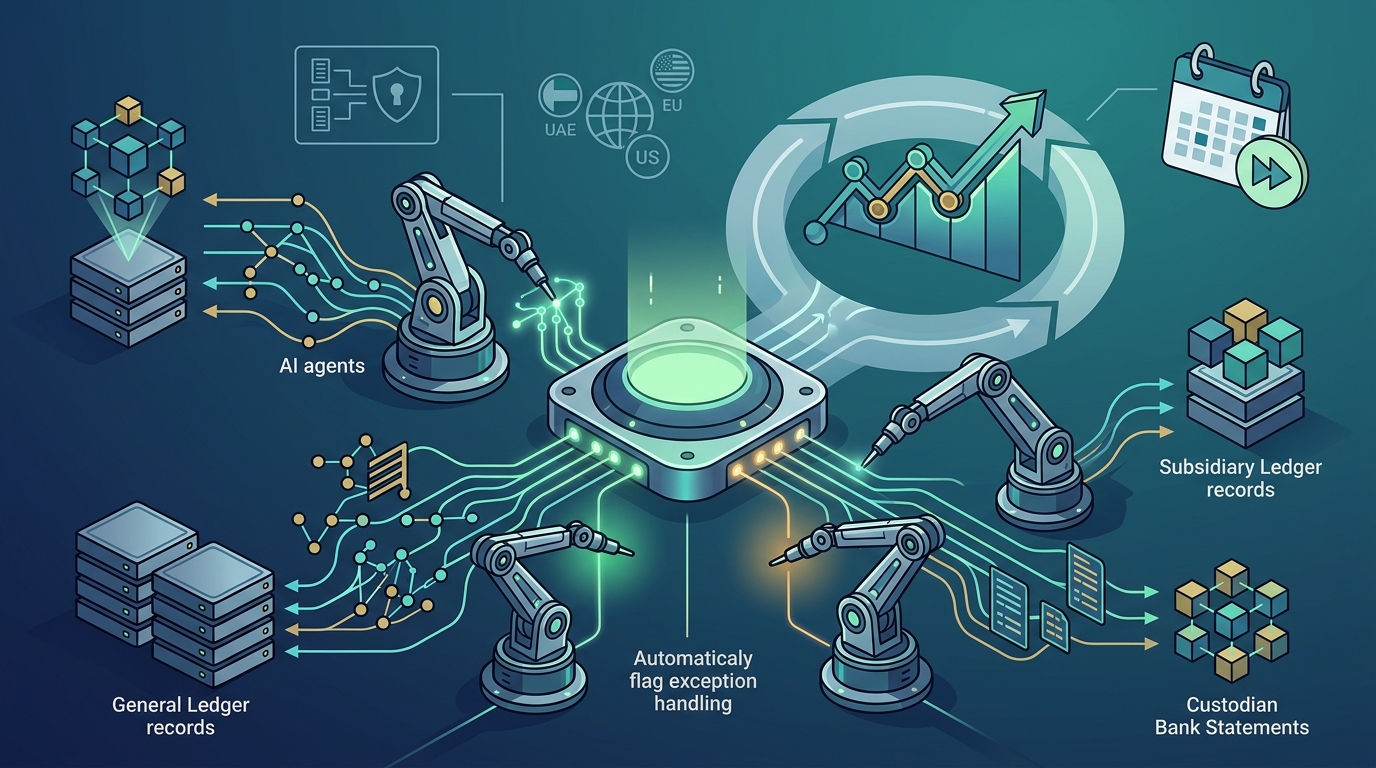
Automated ledger matching solutions, particularly those powered by autonomous AI agents, offer a paradigm shift from reactive correction to proactive resolution. Aetherix Systems specializes in this approach, deploying agents that ingest data, match positions, investigate breaks, and propose resolutions with full audit trails.
Definitional Clarity: What is Automated Ledger Matching?
Automated ledger matching is the process of using software algorithms and AI agents to automatically reconcile financial records between different systems, such as custodians, banks, and internal general ledgers, without human intervention for standard transactions.
Definitional Clarity: What is an Autonomous AI Agent?
An autonomous AI agent is a software system that can perceive its environment, reason through complex tasks, make decisions, and execute actions independently to achieve specific goals, such as resolving a financial break in a ledger.
Definitional Clarity: What is NAV Reconciliation?
NAV reconciliation is the process of verifying that the Net Asset Value of a fund matches the underlying assets and liabilities recorded by the fund administrator and the custodian, ensuring accurate investor reporting.
ROI Metrics for Investment Funds
The return on investment (ROI) for automated ledger matching is measured in both direct cost savings and indirect operational improvements. The following table summarizes the key financial and operational metrics impacted by automation.
| Metric | Manual Process | Automated Process | Impact |
|---|---|---|---|
| Reconciliation Time | Days to Weeks | Hours to Minutes | Accelerated Close Cycles |
| Error Rate | High (Human Fatigue) | Near Zero (AI Precision) | Reduced Risk Exposure |
| Operational Cost | High (Labor Intensive) | Low (Scalable Agents) | Direct Cost Savings |
| Audit Trail | Fragmented | Full & Auditable | Enhanced Compliance |
| Scalability | Linear (Hire More Staff) | Exponential (Add Agents) | Flexible Growth |
Direct Cost Savings
By automating the ingestion and matching of transactions, funds can significantly reduce the number of full-time equivalents (FTEs) required for reconciliation. Aetherix Systems agents handle the full lifecycle, from data ingestion to exception resolution, allowing teams to reallocate resources to strategic analysis.
Indirect Operational Benefits
Beyond direct savings, automation provides real-time monitoring and performance analytics. This visibility allows fund administrators to track task completion, accuracy, and operational efficiency. The result is a more agile operation that can respond quickly to market changes and investor inquiries.
Implementation and Integration
Implementing automated ledger matching requires careful planning to ensure seamless integration with existing tech stacks. Aetherix Systems provides enterprise-grade infrastructure that connects to leading platforms such as NetSuite, Sage Intacct, QuickBooks, and Microsoft Dynamics.
Integration Architecture
The integration process involves connecting AI agents to custodian feeds, bank statements, and internal ERP systems. This is achieved through secure APIs and event-driven architectures that ensure data flows in real-time. The agents then autonomously match positions, cash, and transactions, flagging only the exceptions that require human review.
Security and Compliance
Security is paramount in financial services. Aetherix Systems maintains rigorous compliance with global standards, including SOC 2 Type II, GDPR, and HIPAA. Data is encrypted at rest and in transit, and role-based access controls ensure that only authorized personnel can view sensitive information. This multi-jurisdictional approach ensures that your data is protected wherever you operate.
Compliance and Security
Regulatory compliance is a critical component of the cost-benefit analysis. Automated solutions must not only be efficient but also adhere to strict regulatory frameworks. Aetherix Systems addresses this through a comprehensive compliance program that includes:
- SOC 2 Type II Certification: Ensures that the service organization has effective controls in place for security, availability, processing integrity, confidentiality, and privacy.
- GDPR Compliance: Adheres to the European Union's General Data Protection Regulation, ensuring lawful basis for data processing and honoring data subject rights.
- UAE PDPL Compliance: Aligns with the UAE Personal Data Protection Law, implementing safeguards for cross-border data transfers and data retention.
- EU AI Act Readiness: As an AI-first company, Aetherix Systems is prepared for the world's first comprehensive AI regulation, including risk classification and transparency obligations.
This robust compliance framework reduces the regulatory burden on fund operators, allowing them to focus on their core business activities.
Key Takeaways
- Manual reconciliation costs financial institutions an average of 15% of their operational budget due to errors and delays.
- Automated ledger matching accelerates close cycles from weeks to hours, improving investor confidence.
- Aetherix Systems agents provide a full audit trail on every action, ensuring complete transparency and accountability.
- Integration with major ERP systems like NetSuite and Sage Intacct ensures seamless adoption.
- Enterprise-grade security includes SOC 2 Type II, GDPR, and HIPAA compliance.
- Autonomous AI agents reduce the need for manual labor, allowing teams to focus on strategic growth.
- Scalability is exponential with AI agents, allowing funds to grow without linear cost increases.
Frequently Asked Questions
How does automated ledger matching reduce errors?
Automated solutions use AI agents to match transactions with high precision, eliminating human fatigue and oversight. Agents investigate breaks and propose resolutions based on predefined rules and historical data, ensuring consistent accuracy.
What is the typical implementation timeline?
Implementation timelines vary based on complexity, but Aetherix Systems aims for rapid deployment. Many clients see value within weeks, not months, due to pre-built integrations and agent orchestration capabilities.
Is automated reconciliation compliant with regulatory standards?
Yes. Aetherix Systems maintains compliance with SOC 2 Type II, GDPR, UAE PDPL, and other global standards. Every action is logged and auditable, ensuring full regulatory adherence.
Can AI agents handle complex corporate actions?
Yes. AI agents are designed to resolve corporate action breaks, settlement timing gaps, and pricing discrepancies by analyzing source documents and applying logical reasoning.
How does Aetherix Systems ensure data security?
Data is encrypted at rest and in transit. Role-based access controls and multi-jurisdictional data residency options ensure that sensitive financial information remains protected.
What platforms does Aetherix Systems integrate with?
Aetherix Systems integrates with leading ERP and accounting platforms, including NetSuite, Sage Intacct, QuickBooks, Microsoft Dynamics, and Bill.com.
What is the ROI of implementing AI agents for reconciliation?
ROI is realized through reduced labor costs, fewer errors, accelerated close cycles, and the ability to scale operations without proportional cost increases. Many clients see a positive ROI within the first year.
Next Steps
Transform your reconciliation operations with Aetherix Systems. Our AI agents provide clean, auditable results and full audit trails, empowering your team to focus on strategy and growth. Book a scoping call today to see how our autonomous agents can optimize your fund's operations.