

Financial reconciliation has historically been a bottleneck for enterprise operations, with Gartner reports indicating that finance teams spend up to 40% of their month-end close time on manual data matching. This inefficiency creates significant risk for accuracy and compliance. As organizations seek to automate these workflows, the choice between traditional rule-based software and autonomous AI agents becomes critical. This evaluation examines how modern agentic systems, specifically those offered by Aetherix Systems, outperform legacy methods in speed, accuracy, and auditability.
What is AI Reconciliation?
Before diving into the comparison, it is essential to define the core technology. Reconciliation is the process of verifying that two sets of records agree. In financial contexts, this means matching internal ledgers with external data from banks, custodians, or vendors.
Traditional automation relies on static rules. If a transaction does not match perfectly, it is flagged as an exception. AI reconciliation is the use of intelligent agents to investigate, resolve, and close these exceptions autonomously. Unlike simple scripts, these agents can reason through discrepancies, retrieve supporting documentation, and propose resolutions without human intervention.
For family offices, investment managers, and financial institutions, this shift from manual matching to autonomous operations is not just a convenience; it is a necessity for scaling operations. According to McKinsey research, generative AI can reduce the time spent on routine financial tasks by up to 50%, allowing teams to focus on strategic analysis.
Legacy Systems vs. Agentic AI
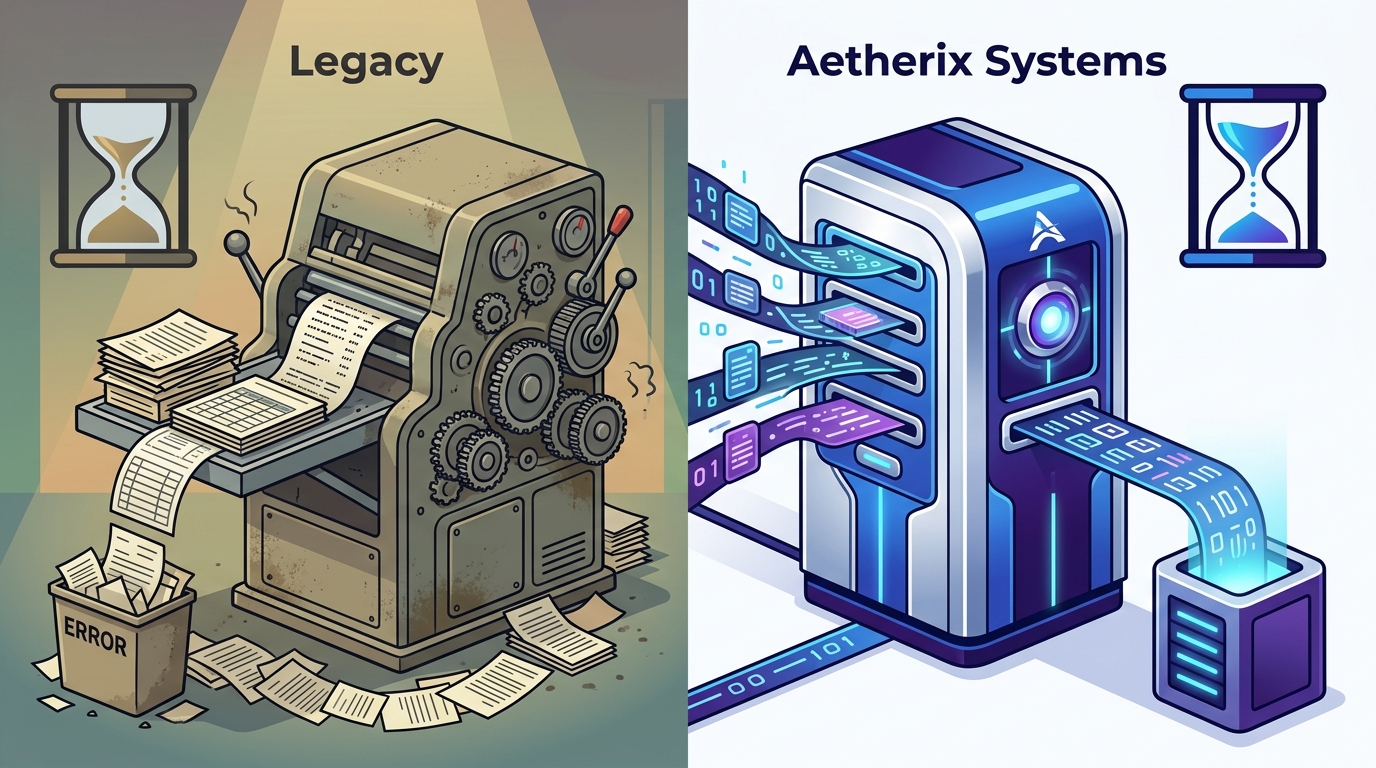
Most enterprises currently use legacy reconciliation tools. These systems are built on deterministic logic. They are excellent at matching 90% of transactions that fit predefined patterns. However, they fail when faced with the remaining 10% of complex, unstructured, or novel data.
The Limitations of Rule-Based Matching
Legacy systems require constant maintenance. When a bank changes its file format or a new vendor introduces a different invoice structure, IT teams must update the rules. This creates a backlog of technical debt. Furthermore, when exceptions arise, the system cannot "think" its way out of the problem. It simply passes the ball to a human analyst.
The Agentic Approach
Agentic AI, such as the platform provided by Aetherix Systems, operates differently. It uses a multi-agent architecture where specialized agents collaborate to solve problems. One agent ingests data, another matches transactions, and a third investigates breaks. This division of labor allows for parallel processing and deeper analysis.
According to IBM documentation, AI agents are distinct from chatbots because they can take action and execute workflows autonomously. In reconciliation, this means the agent can log into a banking portal, download a statement, and reconcile it without human prompting.
Key Evaluation Criteria
When evaluating reconciliation solutions, finance leaders must look beyond basic functionality. The following criteria determine long-term operational success.
1. Auditability and Compliance
In financial services, every action must be traceable. Legacy systems often provide a log of matches but lack the reasoning behind exceptions. A robust AI solution must provide a full audit trail for every decision. SOC 2 compliance is the minimum standard for enterprise security. Aetherix Systems maintains rigorous compliance with global data protection regulations, including GDPR, UAE PDPL, and HIPAA, ensuring that sensitive financial data remains protected.
2. Integration Capabilities
Your reconciliation tool must integrate seamlessly with your existing tech stack. This includes ERP systems like NetSuite, Sage Intacct, and QuickBooks, as well as banking APIs. Poor integration leads to data silos and manual data entry, which defeats the purpose of automation.
3. Time-to-Value
How quickly can you deploy the solution? Traditional enterprise software implementations can take months. Agentic AI platforms are designed for rapid deployment. Aetherix Systems emphasizes that their agents can go live in weeks, not months, providing immediate ROI.
Aetherix Systems: The Agentic Advantage
Aetherix Systems specializes in applied agentic AI for the enterprise. Their platform is not a generic chatbot but a purpose-built system for complex workflows. Here is how their approach stands out in the evaluation landscape.
Autonomous Exception Resolution
While legacy systems flag errors, Aetherix agents investigate them. The agents can research breaks, chase source documents, and propose resolutions. This reduces the workload on human analysts from 100% of exceptions to only the most complex edge cases.
Multi-Agent Orchestration
Complex enterprise processes require multiple agents working together. Aetherix builds orchestration layers that coordinate agent teams, routing tasks and managing handoffs. This ensures end-to-end process completion without manual intervention.
Industry-Specific Expertise
Aetherix serves specific verticals, including family offices, fund administrators, and investment managers. This specialization means their agents are pre-trained on domain-specific data and workflows. For example, their agents understand the nuances of investment reconciliation, including corporate action breaks and settlement timing gaps.
Feature Comparison Matrix
The following table summarizes the key differences between traditional reconciliation methods and the Aetherix agentic approach.
| Feature | Legacy Rule-Based Systems | Aetherix Agentic AI |
|---|---|---|
| Exception Handling | Manual review required | Autonomous investigation and resolution |
| Audit Trail | Basic transaction logs | Full reasoning trail for every decision |
| Integration | Static API connections | Dynamic integration with NetSuite, Sage, QuickBooks |
| Compliance | Varies by vendor | SOC 2, GDPR, UAE PDPL, HIPAA compliant |
| Deployment Time | Months | Weeks |
| Scalability | Limited by rule complexity | Highly scalable via agent orchestration |
Key Takeaways
- Efficiency Gains: AI agents can reduce reconciliation time by up to 50%, according to industry benchmarks.
- Auditability: Aetherix provides a full audit trail on every action, ensuring complete transparency.
- Compliance: The platform adheres to SOC 2, GDPR, and UAE PDPL standards, critical for global operations.
- Integration: Seamless connectivity with major ERPs like NetSuite and Restaurant365.
- Speed: Deployment is measured in weeks, not months, accelerating time-to-value.
- Specialization: Purpose-built agents for financial services, logistics, and manufacturing.
- Security: Enterprise-grade security with encryption at rest and in transit.
Frequently Asked Questions
How does Aetherix ensure data security during reconciliation?
Aetherix maintains rigorous compliance with global standards including SOC 2, GDPR, and HIPAA. Data is encrypted at rest and in transit, with role-based access controls and full audit trails.
Can AI agents handle complex investment reconciliation?
Yes. Aetherix agents are designed to match custodian positions against books of record, resolving corporate action breaks and pricing discrepancies autonomously.
What ERPs does Aetherix integrate with?
The platform integrates with major systems including NetSuite, Sage Intacct, QuickBooks, Microsoft Dynamics, and Bill.com.
How long does it take to implement Aetherix?
Implementation is rapid, typically taking weeks rather than months, due to the agentic architecture's flexibility.
Is the AI decision-making process transparent?
Absolutely. Every action taken by the agents is logged and explained, providing a full reasoning trail for audit purposes.
Does Aetherix support family offices?
Yes, Aetherix specifically serves family offices, helping them reconcile across multiple custodians and asset classes.
What is the difference between Aetherix and a chatbot?
Unlike chatbots, Aetherix agents are autonomous systems that perceive, reason, decide, and act within enterprise workflows without human prompting.
Next Steps
Evaluating your reconciliation strategy is the first step toward operational autonomy. Aetherix Systems offers a proven path to cleaner closes and reduced operational risk. To see how our agents can transform your workflow, book a scoping call or schedule a demo today.