

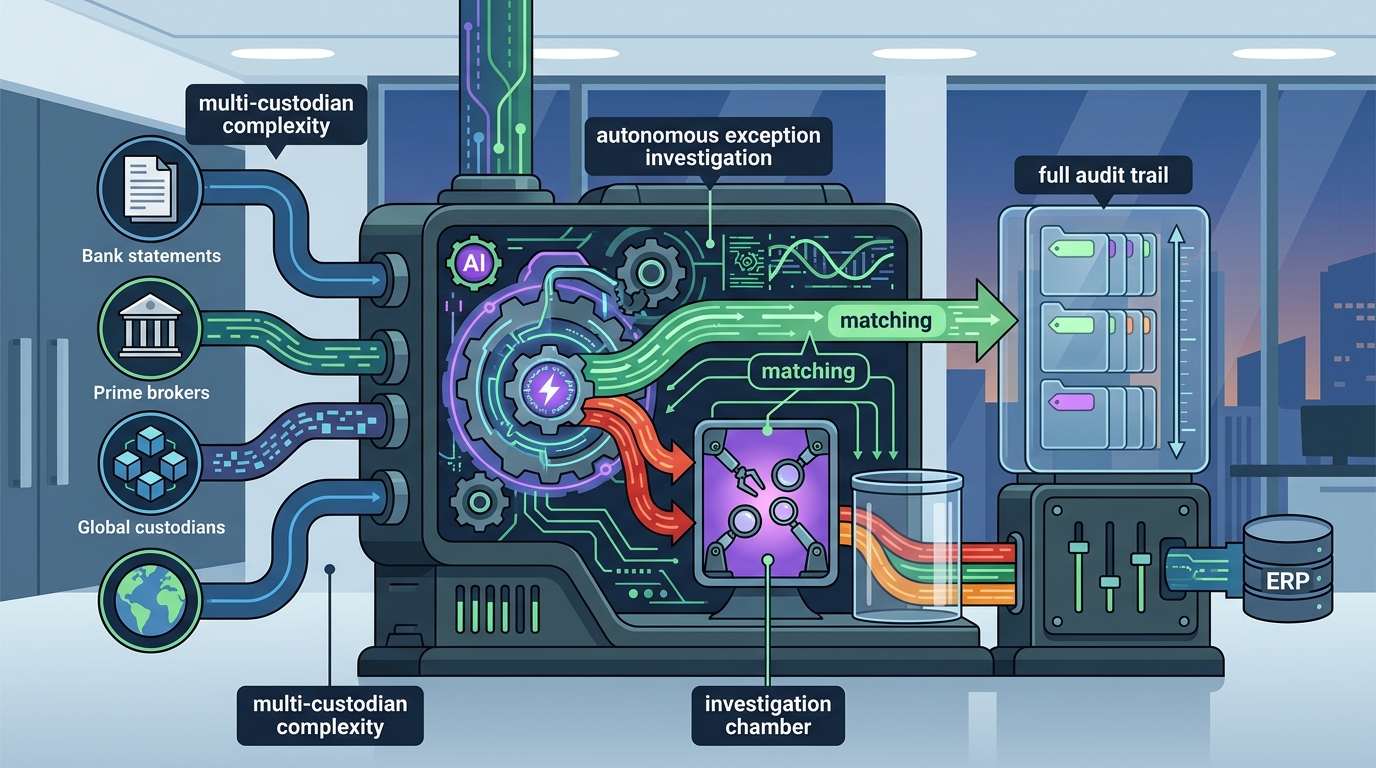
Choosing the best AI reconciliation tool for a multi-family office requires prioritizing autonomous exception investigation over simple matching. The right platform must handle multi-custodian complexity, provide a full audit trail, and integrate with your existing ERP. This guide covers evaluation criteria, verification methods, implementation timelines, and cost drivers for 2026.
How to Choose: Separating Good from Bad
Reconciliation automation is the process of using software to match financial records across different systems. Many tools stop at matching, leaving the hard work to humans. A superior tool investigates breaks autonomously. It pulls source documents, traces the transaction, and proposes a resolution with reasoning attached. For a multi-family office, this distinction is critical because the volume of exceptions scales with the number of entities and custodians.
Matching vs. Investigation
Basic matching engines flag discrepancies but do not explain them. Agentic systems investigate the root cause. They check settlement dates, corporate actions, and fee schedules. This capability reduces the time your team spends on manual data wrangling. It allows your staff to focus on high-value analysis rather than chasing PDFs.
Multi-Entity Complexity
A multi-family office manages assets across multiple legal entities. Each entity may have different custodians, currencies, and close calendars. The tool must handle this matrix without manual configuration for every new pair. It should support intercompany eliminations and multi-currency revaluation natively. If the tool requires a new setup for every entity, it will not scale.
What to Ask: Specific Questions Before Committing
Before signing a contract, you must ask specific technical and operational questions. These questions reveal whether the vendor understands the nuances of family office operations. Do not accept generic answers about "AI" or "automation." Ask for details on how the system handles specific break types.
Technical Interoperability
Ask how the tool connects to your current systems. Does it support direct API integration with your ERP and custodians? Or does it rely on manual file uploads? Direct integration reduces data latency and error rates. Ask about the data formats it supports, including SWIFT messages, PDF statements, and Excel exports.
Exception Handling Logic
Ask how the system classifies exceptions. Does it distinguish between timing differences and genuine errors? Can it auto-resolve items within a defined tolerance? Ask for a demonstration of the investigation workflow. You want to see the reasoning trace, not just the final result. This transparency is essential for audit readiness.
How to Verify: Checking Claims and Credentials
Vendors often make broad claims about security and compliance. You must verify these claims independently. Do not rely on marketing materials. Request specific documentation and proof of compliance. This step protects your organization from regulatory and security risks.
Security Standards
Verify that the vendor adheres to recognized security standards. Look for SOC 2 Type II reports, ISO 27001 certification, and ISO 42001 alignment. These standards ensure that the vendor manages data security and AI governance properly. Ask for the scope of the audit and the date of the most recent report. Ensure the report covers the specific services you plan to use.
Data Residency
How It Works: Process and Timeline
Implementing an AI reconciliation tool follows a structured process. Understanding this process helps you set realistic expectations. The timeline typically ranges from a few weeks to a few months, depending on complexity. The goal is to move from scoping to production with minimal disruption.
Scoping and Configuration
The process begins with a scoping call to map your systems and data sources. The vendor configures matching rules and tolerance thresholds. This phase usually takes one to two weeks. No code changes are required on your side. The vendor connects to your ERP and custodian feeds directly.
Shadow Period and Production
Next, the agents run in a shadow period alongside your existing process. This phase lasts two to four weeks. Every proposed resolution is reviewed by your team before action. This ensures accuracy and builds trust. Once validated, the agents move to production. You receive daily exception reports with proposed resolutions and full reasoning.
What It Costs: Price Drivers
Cost is a major factor in choosing a reconciliation tool. Pricing models vary, but most are based on outcomes rather than software seats. Understanding the cost drivers helps you budget accurately. The total cost of ownership includes implementation, ongoing operations, and support.
Pricing Models
Many vendors charge based on the volume of transactions or the number of entities. Some charge a flat monthly fee. Others charge per resolved exception. Compare these models against your specific volume. A flat fee may be cheaper for low volume, while per-transaction pricing may be better for high volume. Ask for a detailed quote based on your actual data.
Hidden Costs
What Goes Wrong: Common Mistakes
Organizations often make mistakes when implementing reconciliation tools. These mistakes can delay the project or reduce its effectiveness. Avoiding these pitfalls ensures a smoother transition. The most common errors involve underestimating complexity and lacking clear governance.
Underestimating Data Quality
Many organizations assume their data is clean. In reality, data quality issues are common. Poor data quality leads to false exceptions and manual rework. Invest in data cleansing before implementation. Ensure that your source systems provide accurate and complete data. This reduces the noise in the reconciliation process.
Lack of Governance
Without clear governance, the tool may make unauthorized changes. Ensure that the system has strict controls on write access. The agent should propose entries, but a named human should post them. This human-in-the-loop control is essential for compliance. It prevents the system from acting outside its defined boundaries.
Versus Alternatives: Comparing Options
There are several alternatives to AI reconciliation tools. Each has its own strengths and weaknesses. Understanding these differences helps you choose the right approach for your organization. The main alternatives are manual processes, rules-based automation, and AI agents.
| Approach | Matching Capability | Exception Investigation | Scalability | Cost Profile |
|---|---|---|---|---|
| Manual Process | Low | High (Human-driven) | Poor | High (Labor-intensive) |
| Rules-Based Automation | High | Low (Flags only) | Moderate | Moderate (Software + Labor) |
| AI Agents | High | High (Autonomous) | High | Variable (Outcome-based) |
Rules-based automation is effective for matching but fails at investigation. It flags breaks but does not explain them. AI agents go further by investigating the root cause. They propose resolutions with reasoning attached. This makes them more suitable for complex, multi-entity environments.
For a Specific Situation: Multi-Family Offices
Multi-family offices face unique challenges that generic tools may not address. These challenges include managing multiple legal entities, diverse asset classes, and complex reporting requirements. The right tool must be tailored to these specific needs. It should support the full range of reconciliation types required by a family office.
Multi-Custodian Management
Family offices often use multiple custodians. Each custodian delivers data in a different format. The tool must normalize this data automatically. It should handle SWIFT messages, PDF statements, and portal downloads. This normalization is critical for accurate matching. It reduces the time spent on data preparation.
Intercompany Reconciliation
Multi-family offices have significant intercompany activity. This includes management fees, cost allocations, and internal loans. The tool must match these transactions across entities. It should identify mismatches and propose elimination entries. This ensures that consolidated financial statements are accurate.
Rules and Protections: Compliance and Security
Compliance and security are non-negotiable for financial services. The tool must adhere to relevant regulations and standards. This includes data protection laws and AI governance frameworks. The vendor should provide clear documentation on their compliance posture. This protects your organization from regulatory risk.
Data Protection
The tool must comply with data protection regulations such as GDPR and UAE PDPL. It should implement privacy by design and privacy by default. Data processing agreements should be in place with all sub-processors. Data subject rights, including access and erasure, must be honored. This ensures that personal data is handled responsibly.
AI Governance
The tool should align with AI governance frameworks such as the EU AI Act. It should include risk classification and conformity assessments. Transparency obligations must be met, with users informed when interacting with AI. Human oversight mechanisms should be built into the system. This ensures that the AI operates safely and predictably.
Local Specifics: UAE and GCC Considerations
Operating in the UAE and GCC region involves specific regulatory and operational considerations. These include local data residency requirements and compliance with regional laws. The tool must be designed to meet these local needs. It should support the specific workflows and reporting requirements of the region.
Data Residency in the UAE
The UAE Personal Data Protection Law (PDPL) requires that personal data be processed in accordance with local regulations. The tool should offer data residency options in the UAE. This ensures that data is stored and processed within the country. It reduces the risk of cross-border data transfer issues. This is a critical factor for family offices based in the region.
Local Compliance
The tool should comply with local compliance requirements. This includes alignment with UAE Data Office regulations and guidelines. It should support explicit consent and cross-border data transfer safeguards. The vendor should have a local presence or partnership to ensure compliance. This demonstrates a commitment to the local market.
Timing: When to Act
Timing is a critical factor in implementing a reconciliation tool. Acting too early may lead to a rushed implementation. Acting too late may result in missed opportunities for efficiency. The right timing depends on your organization's readiness and the vendor's capabilities. It is important to align the implementation with your close calendar.
Readiness Assessment
Assess your organization's readiness before starting. This includes evaluating your data quality, system integrations, and staff capacity. If your data is poor, invest in cleansing first. If your systems are not integrated, plan for that work. This ensures that the implementation is smooth and effective. It reduces the risk of delays and cost overruns.
Close Calendar Alignment
Align the implementation with your close calendar. Avoid implementing during peak close periods. This reduces the risk of disruption. Plan for a shadow period before production. This allows your team to validate the results without pressure. It ensures that the tool is ready for live operations.
Results Over Time: Measurable Outcomes
The value of an AI reconciliation tool is measured over time. Initial results may be modest, but they improve as the system learns. The key metrics to track include exception resolution time, close cycle time, and error rates. These metrics demonstrate the tool's impact on your operations. They help you justify the investment to stakeholders.
Close Cycle Acceleration
One of the primary benefits is close cycle acceleration. The tool reduces the time required to complete the close. It automates the investigation of exceptions, which is the most time-consuming part of the process. This allows your team to close the books faster. It provides timely financial information to decision-makers.
Error Reduction
The tool also reduces errors in the reconciliation process. It applies consistent logic to every transaction. This eliminates the variability inherent in manual processes. It ensures that every exception is investigated thoroughly. This improves the accuracy of your financial records. It enhances the reliability of your reporting.
Key Takeaways
- Prioritize tools that investigate exceptions autonomously, not just match them.
- Verify security and compliance credentials independently, including SOC 2 and ISO standards.
- Ensure the tool supports multi-entity and multi-custodian complexity natively.
- Implement a shadow period to validate results before moving to production.
- Maintain human-in-the-loop controls for all journal entry postings.
- Align data residency with local regulations, such as UAE PDPL.
- Track close cycle time and error rates to measure long-term value.
- Choose a vendor with a clear, transparent pricing model based on outcomes.
Frequently Asked Questions
What is the main difference between rules-based automation and AI agents?
Rules-based automation matches transactions based on predefined rules but does not investigate discrepancies. AI agents investigate the root cause of breaks and propose resolutions with reasoning attached. This makes AI agents more suitable for complex environments.
How long does it take to implement an AI reconciliation tool?
Implementation typically takes 3 to 6 weeks. This includes scoping, configuration, a shadow period, and production deployment. The exact timeline depends on the complexity of your systems and data.
Does the AI tool post journal entries automatically?
No. The AI agent proposes journal entries, but a named human employee must post them. This human-in-the-loop control ensures compliance and prevents unauthorized changes. It is a critical safety feature.
What data formats does the tool support?
The tool supports a wide range of data formats, including SWIFT messages, PDF statements, Excel exports, and direct API integrations. It normalizes these formats automatically to ensure accurate matching.
How does the tool handle multi-currency transactions?
The tool handles multi-currency transactions by applying agreed exchange rates. It traces variances back to rate differentials and classifies them as realized or unrealized. This ensures accurate reconciliation across currencies.
Is the tool compliant with UAE data protection laws?
Yes. The tool complies with the UAE Personal Data Protection Law (PDPL). It offers data residency options in the UAE and implements privacy by design. This ensures that personal data is handled in accordance with local regulations.
How is the tool priced?
Pricing is typically based on outcomes, such as the volume of transactions or the number of resolved exceptions. Some vendors charge a flat monthly fee. Compare pricing models against your specific volume to determine the best fit.
Can the tool integrate with our existing ERP?
Yes. The tool integrates with major ERP systems via APIs. It connects directly to your ERP and custodian feeds. No code changes are required on your side. This ensures seamless data flow and accurate reconciliation.
Conclusion
Choosing the best AI reconciliation tool for a multi-family office requires careful evaluation of capabilities, compliance, and cost. The right tool must investigate exceptions autonomously, provide a full audit trail, and integrate with your existing systems. Aetherix Systems offers a managed service that runs reconciliation operations using AI agents, with a full audit trail on every action. To plan your visit, to discuss your specific needs.