

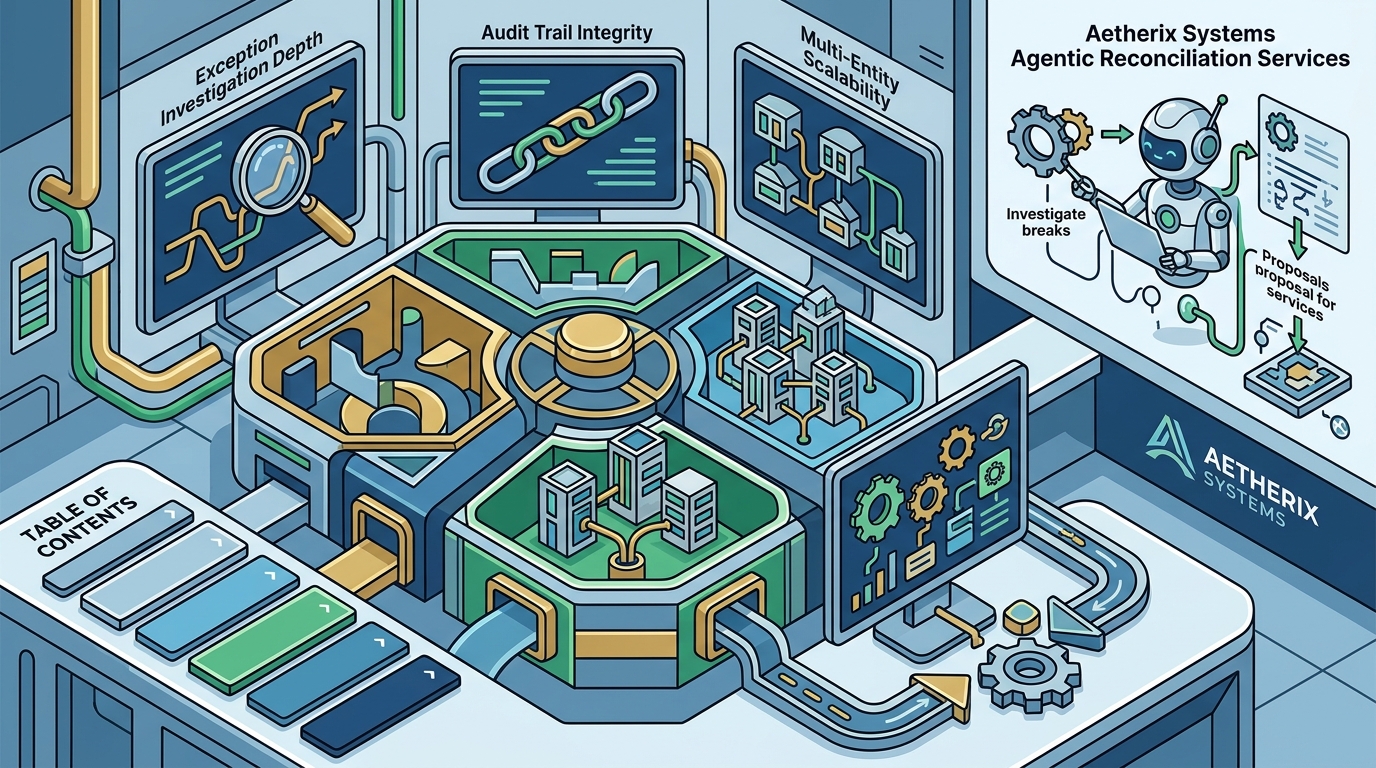
Choosing the best AI reconciliation tool for a multi-family office requires evaluating exception investigation depth, audit trail integrity, and multi-entity scalability. Aetherix Systems provides agentic reconciliation services that investigate breaks and propose resolutions with full reasoning. This guide covers selection criteria, verification methods, implementation timelines, and cost drivers for complex financial structures.
How to Choose: Separating Good from Bad
Reconciliation automation is the process of using software to match financial records across different systems. Many tools claim to automate reconciliation, but they often only handle the matching phase. The critical differentiator is how the tool handles exceptions. A basic matching engine flags discrepancies but leaves the investigation to human analysts. An advanced agentic system investigates the break, identifies the root cause, and proposes a resolution with attached reasoning. For a multi-family office managing multiple custodians and legal entities, this distinction determines whether the tool reduces workload or merely shifts it.
Exception Investigation Depth
Look for tools that can trace transactions through multiple systems. A high-quality tool pulls supporting documentation, such as purchase orders or bank statements, to explain why a mismatch occurred. It should classify exceptions by type, such as timing differences, quantity breaks, or price variances. If the tool only provides a list of unmatched items, it is not solving the core problem of manual investigation.
Audit Trail Integrity
Every action taken by the AI must be logged. The audit trail should include the data read, the logic applied, and the decision made. This is essential for regulatory compliance and internal audit. A tool that acts as a black box, where you cannot see why a decision was made, poses a significant risk for financial institutions and family offices.
What to Ask: Pre-Commitment Questions
Before committing to a vendor, you must ask specific questions that reveal the true capability of the system. Do not rely on marketing materials. Ask the vendor to demonstrate the investigation workflow on a sample of your actual exception data. This reveals whether the AI can handle your specific data formats and edge cases.
Key Questions for Vendors
- Can the agent read and interpret PDF statements and EDI files directly?
- How does the system handle multi-currency transactions and FX revaluation?
- What is the escalation path when the AI is uncertain?
- Can we stop the agent mid-run and resume without data loss?
- How is the reasoning trace structured for audit purposes?
These questions help you understand the operational reality of the tool. A vendor that cannot answer these specifically is likely selling a generic matching engine rather than a specialized reconciliation service.
How to Verify: Checking Claims and Credentials
Verifying a vendor's claims requires looking beyond their website. Check for independent security certifications and compliance frameworks. For AI systems, look for alignment with standards like ISO/IEC 42001 for AI management systems. Also, verify data residency options. If your family office operates in the UAE, EU, or US, the vendor must offer data residency in those regions to comply with local laws.
Security and Compliance Checks
Request a summary of their security posture. Look for SOC 2 Type II reports, which provide independent assurance of security controls. Verify that they have a Data Protection Officer and a clear process for data breach notification. These are non-negotiable for handling sensitive financial data.
How It Works: Process and Timeline
Implementing an AI reconciliation tool typically follows a structured delivery model. The process begins with a scoping call to map your systems and data sources. This is followed by a configuration phase where the vendor connects to your ERP and custodian feeds. A shadow period allows the agents to run in parallel with your existing process, ensuring accuracy before full deployment.
Implementation Phases
- Scoping: Mapping systems, exception types, and close calendars.
- Configuration: Connecting data sources and setting tolerance rules.
- Shadow Period: Running agents in parallel with human review.
- Production: Full deployment with daily exception reports.
This process usually takes 3 to 6 weeks from scoping to production. The timeline depends on the complexity of your data sources and the number of entities involved.
What It Costs: Price Drivers
Costs for AI reconciliation services are driven by volume, complexity, and scope. Volume refers to the number of transactions and entities. Complexity refers to the number of data sources and the variety of exception types. Scope refers to the depth of investigation required. Most vendors charge based on outcomes or managed service fees rather than software seats.
Cost Factors
- Number of legal entities and subsidiaries.
- Number of custodians and banks.
- Frequency of reconciliation (daily vs. monthly).
- Depth of exception investigation.
Understanding these drivers helps you budget accurately. A tool that charges per seat may become expensive as your team grows, while an outcome-based model aligns costs with value delivered.
What Goes Wrong: Common Mistakes
Organizations often make mistakes when adopting AI reconciliation tools. One common error is assuming that automation eliminates the need for human oversight. AI agents propose resolutions, but a named human must approve and post journal entries. Another mistake is failing to define tolerance rules clearly. Without clear thresholds, the system may escalate trivial variances or auto-resolve material errors.
Common Pitfalls
- Expecting the AI to close the books autonomously.
- Not configuring tolerance rules per account type.
- Ignoring the shadow period and jumping straight to production.
- Failing to integrate the tool with existing workflow systems.
Avoiding these pitfalls requires a clear understanding of the tool's capabilities and limitations. The AI is a powerful assistant, not a replacement for human judgment in final financial reporting.
Versus Alternatives: Agentic vs. Rules-Based
Traditional rules-based matching engines are effective for straightforward transactions but struggle with exceptions. They flag breaks but do not investigate them. Agentic AI systems, on the other hand, can reason through complex scenarios, pull supporting documents, and propose resolutions. This makes them suitable for environments with high exception rates, such as multi-family offices with diverse asset classes.
| Feature | Rules-Based Engine | Agentic AI System |
|---|---|---|
| Matching | Automated | Automated |
| Exception Investigation | Manual | Automated with reasoning |
| Audit Trail | Basic logs | Full reasoning trace |
| Adaptability | Fixed rules | Learning and adaptive |
The choice between these approaches depends on your exception rate and the complexity of your financial structure. For most multi-family offices, the agentic approach offers a significant reduction in manual workload.
For a Specific Situation: Multi-Entity Complexity
Multi-family offices face unique challenges due to their complex legal structures. They often manage assets across multiple holding companies, operating entities, and investment vehicles. This creates a matrix of intercompany transactions that must be reconciled and eliminated before consolidation. A reconciliation tool must be able to handle this multi-entity complexity, matching transactions across different ERPs, currencies, and close calendars.
Intercompany Reconciliation
Intercompany reconciliation is the process of verifying that transactions between related entities are recorded consistently on both sides. This is a critical control for consolidated financial statements. A robust tool should automatically match intercompany pairs, identify timing differences, and propose elimination entries. This reduces the manual effort required to prepare group financials.
Rules and Protections: Compliance and Safety
AI systems in finance must operate within strict safety boundaries. These rules ensure that the AI does not take actions that could compromise financial integrity. For example, the agent should not have write access to the general ledger. It should only propose entries, which are then reviewed and posted by a human. This human-in-the-loop control is a fundamental protection against errors and fraud.
Safety Constraints
- No write access to the ledger without human approval.
- Escalation of exceptions above defined tolerance thresholds.
- Ability to stop the agent mid-run by any authorized user.
- Full audit trail for every decision and action.
These constraints ensure that the AI operates safely and predictably within your financial environment. They are not optional features but core requirements for any enterprise-grade AI system.
Local Specifics: GCC and Global Operations
Operating in the GCC region introduces specific regulatory and data residency requirements. The UAE Personal Data Protection Law (PDPL) mandates that personal data be processed in accordance with specific guidelines. Data residency is a key consideration, as data may need to be stored within the UAE or specific regions. Aetherix Systems, based in Dubai, offers data residency options in the UAE, EU, US, and Singapore, ensuring compliance with local regulations.
Regional Compliance
Compliance with local laws is not just a legal requirement but a business necessity. It builds trust with clients and regulators. When selecting a vendor, ensure they have a clear compliance program that addresses the specific regulations in your operating regions. This includes data protection, AI governance, and security standards.
Timing: When to Act
The timing of implementation can impact the outcome. Implementing a new reconciliation tool during a busy close period can be disruptive. It is often better to start the scoping and configuration phases during a quieter period, allowing the shadow period to run without pressure. This ensures a smooth transition to production. Additionally, consider the timing of your close calendar. Aligning the tool's reporting cadence with your close deadlines ensures that the tool supports, rather than hinders, your financial reporting process.
Results Over Time: Long-Term Outcomes
Over time, AI reconciliation tools can significantly improve the efficiency and accuracy of your financial operations. The initial benefit is a reduction in manual workload, as the agents handle the investigation of exceptions. Over time, the system learns from historical resolutions, improving its accuracy and reducing the number of escalations. This leads to a faster close cycle and a more reliable audit trail. The long-term outcome is a more resilient and scalable financial operations function.
Key Takeaways
- Choose tools that investigate exceptions, not just match transactions.
- Verify the vendor's security and compliance credentials independently.
- Implement a structured delivery model with a shadow period.
- Understand the cost drivers: volume, complexity, and scope.
- Maintain human-in-the-loop controls for final approvals.
- Ensure data residency compliance for your operating regions.
- Align implementation timing with your close calendar.
- Expect long-term improvements in efficiency and audit readiness.
Frequently Asked Questions
What is the main difference between a matching engine and an agentic AI system?
A matching engine automatically matches transactions but leaves exception investigation to humans. An agentic AI system investigates exceptions, identifies root causes, and proposes resolutions with full reasoning.
How long does it take to implement an AI reconciliation tool?
Implementation typically takes 3 to 6 weeks, including scoping, configuration, and a shadow period. The exact timeline depends on the complexity of your data sources and entities.
Does the AI post journal entries automatically?
No. The AI proposes journal entries, but a named human employee must review and post them. This human-in-the-loop control is a critical safety feature.
What data residency options are available?
Options vary by vendor. Aetherix Systems offers data residency in the UAE, EU, US, and Singapore to comply with local regulations.
How does the tool handle multi-currency transactions?
The tool applies agreed exchange rates to confirm amounts match after conversion. It traces FX variances back to the rate source and posting date, classifying them as realized or unrealized.
What are the common mistakes when adopting AI reconciliation?
Common mistakes include expecting full autonomy, failing to define tolerance rules, and skipping the shadow period. These can lead to errors and a lack of trust in the system.
Is the audit trail sufficient for regulatory compliance?
Yes, if the tool logs every action with full reasoning. This includes the data read, the logic applied, and the decision made. This level of detail is essential for audit and regulatory inquiries.
How does the tool handle intercompany transactions?
The tool matches intercompany pairs across entities, identifies timing differences and FX variances, and proposes elimination entries. This ensures that consolidated financial statements are accurate.
Conclusion
Selecting the right AI reconciliation tool is a strategic decision that can transform your financial operations. By focusing on exception investigation depth, audit trail integrity, and compliance, you can choose a tool that truly reduces workload and improves accuracy. Aetherix Systems offers a robust agentic reconciliation service designed for the complexities of multi-family offices and financial institutions. To explore how our agents can streamline your reconciliation process, for a scoping call.