

AI tools for multi-prime broker reconciliation are agentic systems that ingest, match, and investigate positions, trades, and cash across multiple custodians and prime brokers. They resolve breaks by tracing root causes and proposing resolutions with full audit trails. This guide covers the specific matching workflows, exception handling, and integration patterns required for institutional-grade multi-broker operations.
Trade, Position, and Cash Matching Workflows
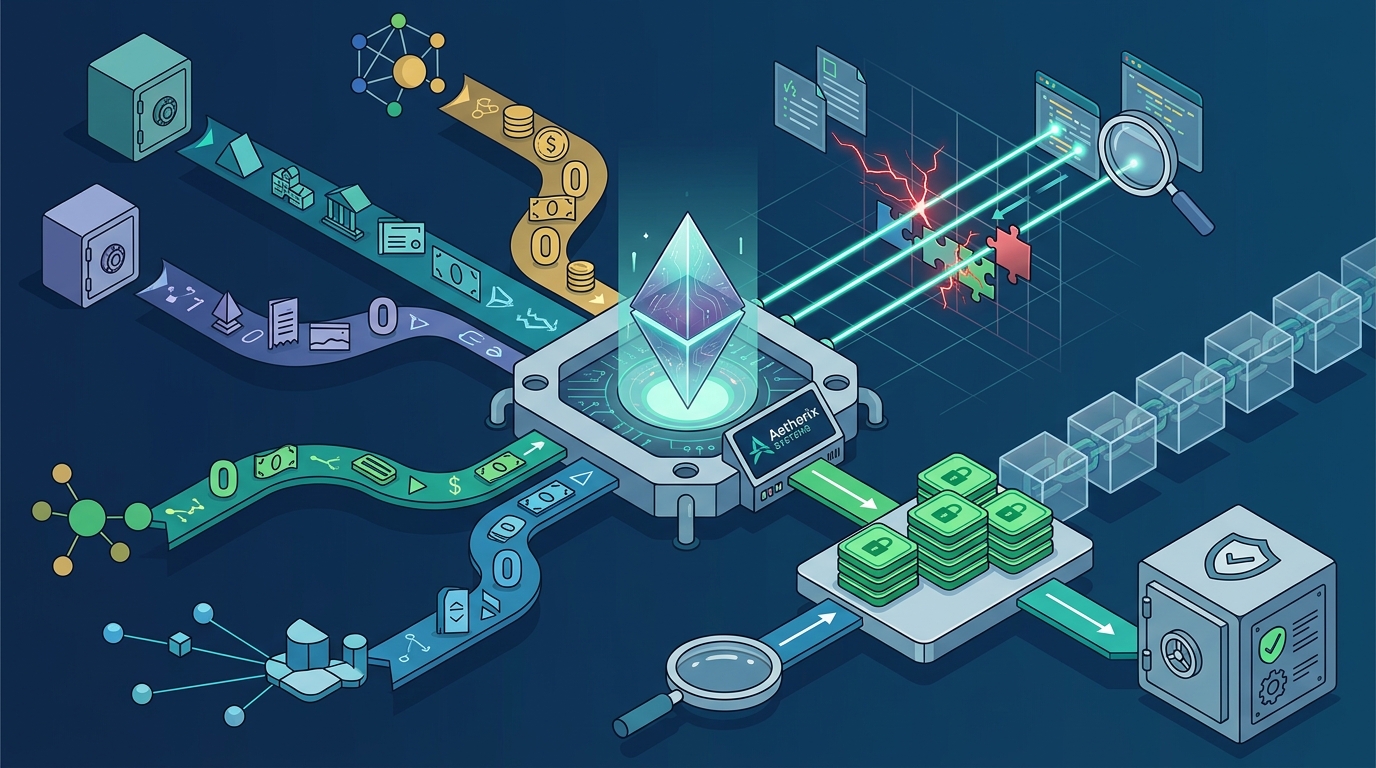
Reconciling across multiple prime brokers requires distinct workflows for trades, positions, and cash. Each layer has unique failure modes and data sources. Aetherix Systems designs agents to handle these layers independently before consolidating results.
Trade Reconciliation
Trade reconciliation is the process of matching executed trades against broker confirmations and settlement records. In a multi-prime broker environment, the same trade may appear in different formats across different brokers. Agents normalize these formats, match by trade date, symbol, quantity, and price, and flag discrepancies. Common breaks include partial fills, cancellations, and timing differences between trade date and settlement date.
Position Reconciliation
Position reconciliation is the process of comparing securities positions held at a custodian or prime broker against the positions recorded in an investment book of record. This layer verifies quantity, instrument, account, and long/short direction. Agents trace lot-level mismatches, corporate action failures, and transfer-in-kind lag. They check settlement calendars and confirm pending status before flagging genuine exceptions.
Cash Reconciliation
Cash reconciliation is the process of comparing cash balances reported by a custodian or bank against the cash balances recorded in an internal accounting system. This includes trade settlements, income receipts, margin movements, and fees. Agents identify timing differences, missed dividends, and unrecorded fees. They match each item and age anything uncleared past a configured threshold.
Exception Investigation and Root Cause Analysis
Matching engines handle the transactions that agree. The real value of AI in reconciliation lies in the exceptions. Aetherix Systems agents investigate every break, determine root causes, and propose resolutions with full reasoning attached.
Break Classification
Agents classify each exception by type. Timing breaks involve trade date versus settlement date mismatches or pending corporate actions. Quantity breaks involve lot-level mismatches, partial fills, or stock splits not yet reflected. Price and valuation breaks involve stale NAVs, FX rate discrepancies, or mark-to-model differences. Each type triggers a specific investigation workflow.
Root Cause Tracing
Agents pull transaction detail, trace it through the system, and classify the exception. For example, a cash variance may be traced to a pending SWIFT confirmation, a duplicate posting, or a value-date mismatch. The agent documents its reasoning and either auto-resolves with evidence or escalates with a recommended action. Your team reviews resolutions rather than performing investigations.
Resolution Proposals
Agents propose journal entries or corrections based on the root cause. They attach the full reasoning trace, including source data, matching attempt, and failure reason. Human reviewers approve or reject the proposal. Every action is logged with a complete audit trail, timestamped and attributed.
Integration Architecture and Data Ingestion
Effective multi-prime broker reconciliation requires robust data ingestion and integration. Aetherix Systems agents connect to your existing tech stack via APIs, webhooks, and event-driven architectures.
Data Ingestion
Agents pull data from custodians, banks, and ledgers. They handle diverse formats including PDF, EDI, CSV, and portal downloads. The system normalizes every format into structured data. This eliminates manual data wrangling and ensures consistent matching across all sources.
API-First Integration
Reconciliation runs are triggered by your events, such as ERP batch complete, bank file received, or period close initiated. Agents push results to your systems via webhooks. You define the endpoint, payload schema, and retry policy. Everything the UI does, the API does. Build your own workflows on top.
Multi-Tenant Isolation
If you are building a platform that serves multiple clients, each client's reconciliation is isolated. Separate configuration, separate data, separate audit trails. One integration, many tenants. This ensures data security and compliance for multi-client environments.
Audit, Compliance, and Governance
Regulatory pressure adds urgency to reconciliation. Auditors expect documented resolution workflows, not ad-hoc email chains. Aetherix Systems maintains rigorous compliance with global data protection regulations and AI governance frameworks.
Full Audit Trail
Every agent action is logged with a complete audit trail. This includes what data was compared, what logic was applied, and why the conclusion was reached. Your compliance team can pull the audit trail at any time without reconstructing the process from memory. The trail is exportable for regulatory reporting or external audit.
Human-in-the-Loop Controls
Agents operate within precisely defined safety boundaries. Human-in-the-loop controls ensure that critical decisions require human approval. Role-based access and data residency compliance are implemented. Agents propose journal entries; a named client employee posts them. This preserves human oversight while automating the investigation work.
Compliance Frameworks
Aetherix Systems maintains compliance with frameworks including GDPR, UAE PDPL, SOC 2 Type II, and ISO/IEC 27001:2022. The company is aligned to ISO/IEC 42001:2023 for AI management. This multi-jurisdictional approach ensures your data is protected wherever you operate.
Key Takeaways
- AI agents for reconciliation handle the exception queue that matching engines cannot resolve.
- Trade, position, and cash reconciliation require distinct workflows with unique failure modes.
- Agents trace root causes and propose resolutions with full reasoning attached.
- API-first integration allows reconciliation to be embedded into existing orchestration systems.
- Full audit trails ensure compliance and regulatory readiness without manual reconstruction.
- Human-in-the-loop controls preserve oversight while automating investigation work.
- Multi-tenant isolation supports multi-client platforms with separate data and audit trails.
- Compliance with global data protection and AI governance frameworks is essential for institutional use.
Frequently Asked Questions
What is the difference between matching engines and AI agents in reconciliation?
Matching engines handle transactions that agree. AI agents investigate the ones that don't. They research breaks, chase source documents, and propose resolutions with full reasoning. This completes the automation that matching engines cannot achieve.
How do AI agents handle multi-prime broker complexity?
Agents normalize data from different brokers, match by trade date, symbol, quantity, and price, and flag discrepancies. They trace lot-level mismatches, corporate action failures, and timing differences. Each broker's data is processed independently before consolidation.
Can AI agents integrate with existing ERP systems?
Yes. Agents integrate with ERP systems via APIs and event-driven architectures. They connect to SAP, Oracle, NetSuite, and other platforms. Reconciliation runs are triggered by ERP events, and results are pushed back via webhooks.
What is the role of human oversight in AI reconciliation?
Human oversight is preserved through human-in-the-loop controls. Agents propose journal entries or corrections, but a named client employee approves and posts them. This ensures that critical decisions require human judgment while automating the investigation work.
How is audit compliance maintained in AI reconciliation?
Every agent action is logged with a complete audit trail. This includes what data was compared, what logic was applied, and why the conclusion was reached. The trail is timestamped, attributed, and exportable for regulatory reporting or external audit.
What compliance frameworks does Aetherix Systems maintain?
Aetherix Systems maintains compliance with GDPR, UAE PDPL, SOC 2 Type II, and ISO/IEC 27001:2022. The company is aligned to ISO/IEC 42001:2023 for AI management. This multi-jurisdictional approach ensures data protection across regions.
Conclusion
AI tools for multi-prime broker reconciliation transform the exception queue from a bottleneck into a manageable workflow. Aetherix Systems provides agentic systems that investigate breaks, propose resolutions, and maintain full audit trails. To plan your visit, to discuss your reconciliation needs.