

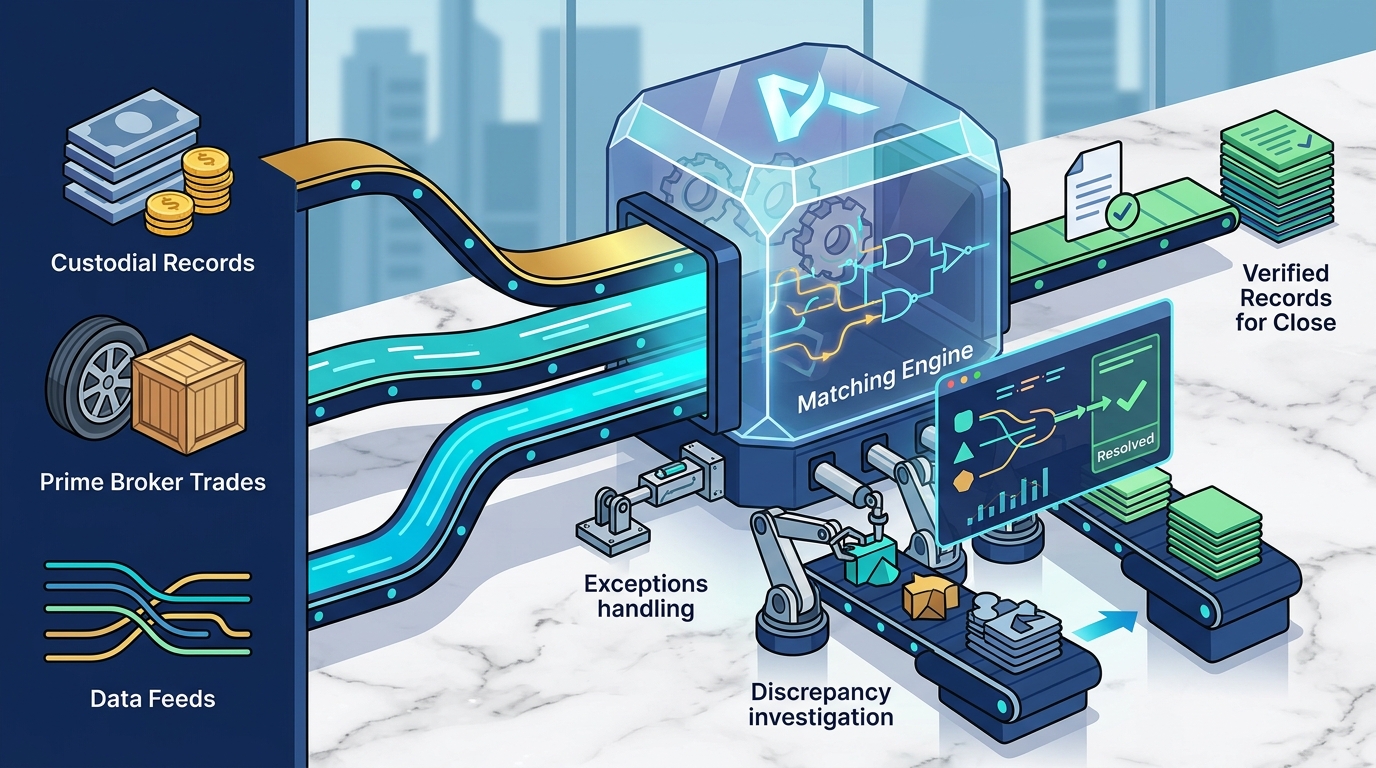
AI tools for multi-prime broker reconciliation are agentic systems that ingest data from multiple custodians, match positions, trades, and cash, and investigate discrepancies with full reasoning trails. This guide covers the core matching logic, the specific challenges of prime broker environments, and how AI agents differ from traditional rules-based engines. It is designed for fund administrators, investment managers, and family offices seeking to compress their close cycle.
AI Reconciliation Platforms
Financial reconciliation is the process of verifying that two or more sets of records agree, ensuring that books are accurate and free from material misstatement. Traditional software relies on deterministic rules to match transactions. When a match fails, the system flags an exception and stops. The human analyst must then investigate the break manually. This model works for simple bank reconciliations but struggles with the complexity of multi-prime broker environments.
AI reconciliation platforms represent a shift from static matching to dynamic investigation. These systems use large language models and retrieval-augmented generation to understand the context of a discrepancy. Instead of just flagging a mismatch, the AI agent pulls supporting documentation, checks settlement calendars, and proposes a resolution. Reconciliation automation in this context means not just matching, but resolving. The platform acts as an autonomous worker that handles the end-to-end workflow, from data ingestion to final entry proposal.
Agentic vs. Rules-Based
Rules-based engines are excellent at handling the 80-90% of transactions that match perfectly. They are fast and predictable. However, they lack the judgment to handle edge cases. An agentic system, by contrast, can reason through ambiguous data. It can determine if a price variance is due to a corporate action or a data entry error. This distinction is critical for prime broker reconciliation, where the "tail" of exceptions often consumes the most analyst time.
Integration Capabilities
Modern AI platforms integrate via APIs, webhooks, and event-driven triggers. They connect to ERPs like NetSuite or Restaurant365, as well as custodian portals and bank feeds. The architecture is designed to be non-disruptive. It sits alongside existing systems, consuming data and returning structured results. This allows finance teams to maintain their current workflows while offloading the heavy lifting of data wrangling to the AI.
Position, Trade, and Cash Matching
Investment reconciliation is the control process used to prove that an investment manager's positions, trades, and cash agree with the records held by custodians and prime brokers. It is not a single balance comparison. It is a connected set of reconciliations that supports accurate books and reliable exposure data. In a multi-prime broker environment, this process must account for short positions, margin, collateral, and financing.
Position Reconciliation
Position reconciliation compares the securities holdings recorded in the internal book of record against the holdings reported by the prime broker. The goal is to prove quantity, instrument, account, and long/short direction. Common breaks include missing lots, corporate action failures, and transfer-in-kind lag. The AI agent traces each variance back to the source trade and verifies the corporate action schedule. If a break remains unresolved after a set period, it flags the item for human review with full context.
Trade Reconciliation
Trade reconciliation matches executed orders and internal bookings against broker confirmations and settlement records. It identifies missing, duplicated, misbooked, or unsettled trades. In a multi-prime broker setup, a single strategy may execute trades across three different brokers. The agent must map each trade to the correct broker account and verify that the settlement instructions match the execution details. This ensures that every buy, sell, and transfer is accurately captured across all systems.
Cash Reconciliation
Cash reconciliation compares internal cash ledgers against bank, custodian, and prime-broker balances and movements. It proves available cash, margin movements, income, fees, and settlement activity. Cash breaks are often caused by timing differences, such as trade date versus settlement date mismatches. The agent checks the settlement calendar and confirms pending status. It auto-resolves timing breaks on T+1 or T+2, while flagging genuine discrepancies for investigation.
Prime Broker Complexity
Prime broker reconciliation adds a layer of operational complexity that standard fund accounting software often struggles to handle. A hedge fund or family office may use multiple prime brokers to optimize financing costs, access specific markets, or diversify counterparty risk. Each broker has its own data format, reporting schedule, and naming conventions. The result is a reconciliation problem that scales multiplicatively.
The challenge is compounded by the diversity of reconciliation types running simultaneously. Nostro and vostro accounts need daily balancing. Intercompany positions between legal entities need elimination at month-end. Securities settlement requires matching across depositories, custodians, and internal booking systems. For an in-depth look at the bank account layer specifically, see our guide to investment and fund reconciliation. Legacy infrastructure makes the problem worse. Many institutions run reconciliation on platforms built in the 2000s. These systems handle matching reasonably well but offer no intelligence on the investigation side.
Multi-Currency and FX
Transactions post in local currency. Revaluation runs at period-end. FX gains and losses need to reconcile against the rate used. The agent traces each variance back to the rate differential and classifies realised vs. unrealised. This is a common source of breaks in multi-prime broker environments where entities report in different currencies.
Collateral and Margin
Prime brokers hold collateral and manage margin accounts. The agent reconciles collateral movements against margin calls and releases. It verifies that the collateral posted matches the exposure reported. This ensures that the fund is not over-collateralized or under-margined, which could trigger a margin call or a breach of covenants.
Exception Investigation and Resolution
The real cost of reconciliation sits in the exceptions. These are the positions that do not match, the trades that settled differently than expected, and the fees that do not tie back to the contract. Each one requires investigation: pulling statements, checking corporate actions, verifying settlement dates, and documenting the resolution. This is where staff time accumulates and where errors compound.
AI agents handle the exception queue. They investigate breaks, determine root causes, and resolve discrepancies with a full audit trail on every action. The result is a clean reconciliation delivered on your schedule, not a dashboard you need to work through. The agent applies your tolerance rules. If a variance is below the threshold, it auto-clears. If it is above, it escalates with the supporting documentation attached. This allows your team to review resolutions rather than performing the initial match.
Root Cause Analysis
The agent does not just flag a break; it investigates it. A nostro discrepancy gets traced back to its root cause: a pending SWIFT confirmation, a duplicate posting, or a value-date mismatch. The agent documents its reasoning and either auto-resolves with evidence or escalates with a recommended action. This level of detail is crucial for audit purposes. It provides a clear chain of evidence for every decision made.
Escalation Workflows
Not every break can be resolved automatically. Some require human judgment. The agent routes these items to the appropriate team member via ServiceNow or Salesforce. The ticket includes the full context: source data, matching attempt, failure reason, and proposed resolution. This ensures that the human analyst has all the information they need to make a decision quickly.
Audit Trail and Compliance
Regulatory pressure adds urgency to reconciliation. Auditors expect documented resolution workflows, not ad-hoc email chains. The cost of getting reconciliation wrong is no longer just operational; it is regulatory. Every transaction match, exception, and resolution must be logged with a complete audit trail. This trail must be timestamped, attributed, and exportable for regulatory reporting or external audit without manual reconstruction.
AI agents provide this audit trail by design. Every action they take is logged with full reasoning attached. This includes the data compared, the logic applied, and the conclusion reached. Your compliance team can pull the audit trail at any time without reconstructing the process from memory. This improves your compliance posture without additional effort. Regulators and auditors see a clean chain of evidence rather than a folder of emails and annotated spreadsheets.
Security and Data Residency
Enterprise-grade security is a prerequisite for any AI reconciliation platform. The system must maintain rigorous compliance with global data protection regulations and AI governance frameworks. Aetherix Systems operates with a multi-jurisdictional approach, ensuring data is protected wherever you operate. This includes data residency in the UAE, EU, US, and Singapore. The platform is aligned with SOC 2 Type II, ISO 27001, and ISO 42001 standards. This ensures that your data is secure and that the AI agents operate within precisely defined safety boundaries.
Key Takeaways
- AI reconciliation platforms shift from static matching to dynamic investigation, handling the exception queue that rules-based engines cannot.
- Position, trade, and cash reconciliation are connected processes that must agree to support accurate books and reliable exposure data.
- Multi-prime broker environments introduce complexity through diverse data formats, multi-currency transactions, and collateral management.
- AI agents investigate root causes, such as corporate actions or settlement timing, and propose resolutions with full reasoning.
- Exception investigation is the primary driver of cost and time in reconciliation; automating this step compresses the close cycle.
- A complete audit trail is essential for regulatory compliance; AI agents log every action with timestamped, attributed evidence.
- Integration via APIs and webhooks allows AI platforms to sit alongside existing ERPs and workflow tools without disruption.
- Security and data residency are critical; look for platforms aligned with SOC 2, ISO 27001, and ISO 42001 standards.
Frequently Asked Questions
What is the difference between rules-based and agentic reconciliation?
Rules-based reconciliation uses deterministic logic to match transactions. It is fast but stops at the first mismatch. Agentic reconciliation uses AI to investigate discrepancies, pulling context and proposing resolutions. It handles the complex "tail" of exceptions that rules-based systems cannot.
How do AI agents handle multi-prime broker data?
AI agents ingest data from multiple prime brokers, normalizing different formats and naming conventions. They match positions, trades, and cash across all brokers, identifying breaks and investigating root causes. The agent manages the complexity of multiple counterparties, ensuring that every record ties back to the book of record.
Can AI agents post journal entries automatically?
AI agents propose journal entries based on their investigation. A named client employee reviews and approves these entries before they are posted to the general ledger. This human-in-the-loop control ensures that no entry is posted without human oversight, maintaining compliance and accuracy.
What is the role of the audit trail in AI reconciliation?
The audit trail logs every action taken by the AI agent, including the data compared, the logic applied, and the conclusion reached. This provides a complete chain of evidence for auditors and regulators. It ensures that the reconciliation process is transparent, reproducible, and compliant with regulatory requirements.
How long does it take to implement an AI reconciliation platform?
Implementation timelines vary depending on the scope, source systems, and data complexity. A typical engagement involves a scoping call, data connectivity, agent configuration, and live operations. From scoping call to production, the process can take 3 to 6 weeks. No multi-year contracts are required; you pay for reconciliation outcomes, not software seats.
What security standards should I look for in an AI reconciliation provider?
Look for providers aligned with SOC 2 Type II, ISO 27001, and ISO 42001 standards. These frameworks ensure that the provider maintains rigorous security practices, data protection, and AI governance. Additionally, verify that the provider offers data residency options in your required jurisdictions, such as the UAE, EU, US, or Singapore.
Conclusion
Reconciling positions, trades, and cash across multiple prime brokers is a complex challenge that traditional software struggles to handle. AI tools offer a solution by shifting from static matching to dynamic investigation. These agentic systems ingest data from all sources, match records, and investigate discrepancies with full reasoning trails. The result is a compressed close cycle, reduced manual effort, and a robust audit trail for compliance.
For family offices, investment funds, and financial institutions, the choice of reconciliation platform is critical. It must be secure, compliant, and capable of handling the specific complexities of your environment. Aetherix Systems provides AI-driven reconciliation services that run in production, with a full audit trail on every action. To see how our agents can handle your reconciliation operations, book a scoping call today.