

AI Tools for NAV Production: Matching Investor Records and Fund Accounting Data
AI tools for NAV production teams are specialized agentic systems that automate the matching of investor records against fund accounting data, investigate discrepancies, and generate audit-ready evidence. This guide covers the four core technical layers: NAV-to-GL matching platforms, investor record aggregation, exception handling workflows, and document extraction automation. We explain how these components integrate to compress the close cycle and improve data integrity for fund administrators and investment managers.
NAV-to-GL Matching Platforms
NAV-to-GL matching is the process of verifying that the Net Asset Value calculated by the fund administrator agrees with the general ledger balances in the investment manager's internal accounting system. This is not a single balance comparison. It is a connected set of reconciliations that supports accurate books, reliable exposure data, and the evidence used in NAV production and review. In a hedge-fund environment, the same process must also account for short positions, margin, collateral, financing, derivatives, multiple prime brokers, and different valuation sources. That makes source ownership, cutoff, instrument identity, and exception evidence as important as the arithmetic difference.
Source-System Matching Matrix
A reliable process starts by defining which source is authoritative for each field and event. The following table summarizes the core reconciliation layers required for NAV production:
| Reconciliation Layer | Records Compared | Control Objective |
|---|---|---|
| Positions | OMS/PMS or accounting book against custodian, prime broker, or administrator holdings | Prove quantity, instrument, account, and long/short direction |
| Trades | Executed orders and internal bookings against broker confirmations and settlement records | Identify missing, duplicated, misbooked, or unsettled trades |
| Cash | Internal cash ledgers against bank, custodian, and prime-broker balances and movements | Prove available cash, margin movements, income, fees, and settlement activity |
| NAV | Manager or shadow books against the administrator's NAV package and component balances | Explain the final difference through supported component-level analysis |
Traditional rules-based matching engines handle the transactions that agree. They flag the ones that do not. However, the real cost sits in the exceptions. The positions that do not match, the trades that settled differently than expected, and the fees that do not tie back to the contract require investigation. Investment and fund reconciliation is the control process used to prove that an investment manager's or fund's positions, trades, cash, income, fees, corporate actions, and valuations agree with the records held by custodians, prime brokers, fund administrators, counterparties, and internal accounting systems.
Investor Record Aggregation
Investor record aggregation is the process of consolidating data from multiple custodians, prime brokers, and fund administrators into a single, normalized dataset for NAV calculation. Family offices and multi-manager funds are structurally complex. A single family may hold assets across five custodians, three prime brokers, a handful of private equity fund administrators, and multiple bank accounts in different currencies. Each source delivers data in its own format, on its own schedule, with its own naming conventions.
Normalization and Standardization
The result is a reconciliation problem that scales multiplicatively. It is not just positions. It is positions, trades, cash, income accruals, corporate actions, capital calls, and distributions, all of which need to tie back to the book of record. Most organizations still manage this in spreadsheets or legacy portfolio systems that were never designed for multi-custodian, multi-entity reconciliation. When breaks appear, the investigation is manual. Someone emails the custodian, waits for a response, cross-references a PDF statement, and updates the ledger. The process is slow, error-prone, and impossible to audit after the fact.
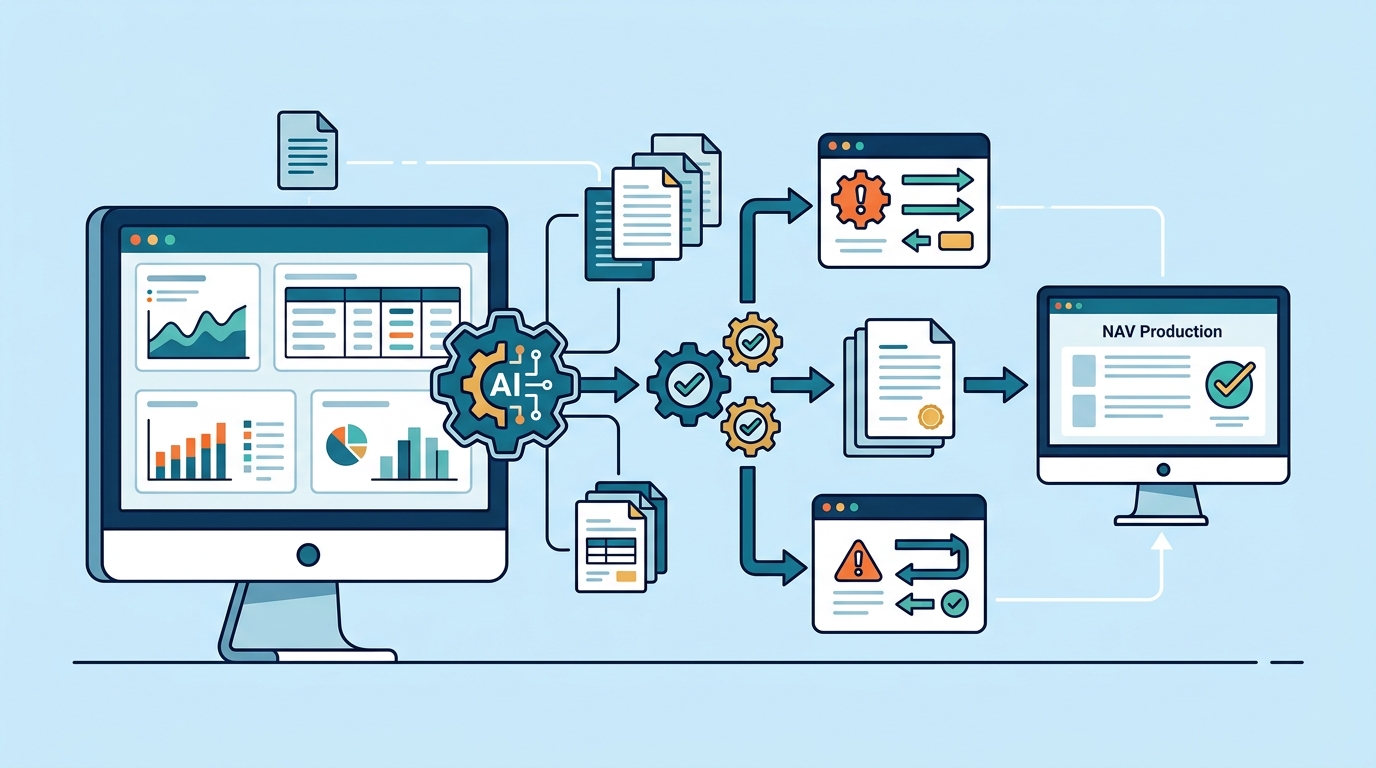
AI agents ingest feeds from every source, including SWIFT messages, custodian portals, PDF statements, and Excel exports. They normalize the data and run the matching automatically. When a break surfaces, the agent investigates. It checks settlement dates, looks for pending corporate actions, and flags genuine exceptions for human review. The close cycle compresses. What used to take a week of back-and-forth now resolves in hours, because the investigation happens in parallel across all accounts simultaneously. Your team reviews exceptions rather than performing the initial match, which means fewer people doing higher-value work.
Exception Handling Workflows
Exception handling is the phase where the system investigates discrepancies that the matching engine could not resolve automatically. Not all breaks are equal. Agents classify each exception by type, apply the appropriate investigation workflow, and resolve within configured tolerance rules. The following categories represent the most common failure modes in NAV production:
Timing and Quantity Breaks
Timing breaks involve trade date versus settlement date mismatches, pending corporate actions, and dividend accrual differences. The agent checks the settlement calendar, confirms pending status, and auto-resolves on T+1 or T+2. Quantity breaks involve lot-level mismatches, partial fills, stock splits not yet reflected, and transfer-in-kind lag. The agent traces to the source trade, verifies the corporate action schedule, and flags if unresolved after three business days.
Price and Valuation Breaks
Price and valuation breaks occur when internal marks differ from approved market, counterparty, or model sources. The agent identifies price, FX, methodology, stale-price, and source differences. It traces each variance back to the rate differential and classifies realized versus unrealized gains and losses. For a deeper look at how these workflows operate, see our guide to reconciliation automation.
Every transaction match, exception, and resolution is logged with a complete audit trail. The trail is timestamped, attributed, and exportable for regulatory reporting or external audit without manual reconstruction. This is critical for compliance. Auditors expect documented resolution workflows, not ad-hoc email chains. The cost of getting reconciliation wrong is no longer just operational. It is regulatory.
Document Extraction Automation
Document extraction automation is the use of AI to parse unstructured or semi-structured documents, such as PDF statements, EDI files, and email attachments, into structured data fields. Distributors, custodians, and brokers each send invoices and statements in different formats. Line items often do not match the internal item master. The agent normalizes every format and maps to the internal system. This is the first step in the ingestion pipeline.
From Unstructured to Structured
Traditional OCR (Optical Character Recognition) extracts text but does not understand context. AI agents use large language models and retrieval-augmented generation to understand the semantic meaning of the document. They identify which field is the quantity, which is the price, and which is the tax amount. They then map this data to the correct GL account, location, and department. This reduces the manual data entry burden significantly.
For restaurant groups and multi-unit businesses, this is particularly relevant. A 50-location restaurant group receives 200+ distributor invoices per week. Each invoice has 50 to 300 line items. Each line needs to match a PO, a receiving record, and an item in the item master. The agent splits, codes, and validates against the chart of accounts. For more on this specific use case, see our guide to Restaurant365 invoice reconciliation.
Key Takeaways
- NAV-to-GL matching is a connected set of reconciliations, not a single balance comparison.
- Investor record aggregation requires normalizing data from multiple custodians and prime brokers.
- Exception handling workflows must classify breaks by type (timing, quantity, price) to apply the correct investigation path.
- Document extraction automation uses AI to parse unstructured PDFs and EDI files into structured data.
- Every action must be logged with a full reasoning trail for audit and compliance purposes.
- AI agents investigate breaks in parallel, compressing the close cycle from days to hours.
- Human oversight is required for final approval of journal entries and period close.
Frequently Asked Questions
What is the primary benefit of AI in NAV production?
The primary benefit is the automation of exception investigation. While rules-based engines match clean transactions, AI agents investigate the breaks, determine root causes, and propose resolutions with full reasoning attached.
How does AI handle multi-currency reconciliation?
AI agents apply agreed exchange rates to confirm amounts match after conversion. They trace FX differences back to the rate source and posting date, classifying realized versus unrealized gains and losses.
Can AI agents post journal entries automatically?
No. AI agents propose journal entries with full supporting documentation. A named human employee reviews and posts the entries. Write access is never implicit; it is granted per-system, per-action, with an approval workflow attached.
What types of documents can AI extract data from?
AI agents can extract data from PDF statements, EDI files, CSV exports, email attachments, and portal downloads. They normalize these formats into structured data fields for matching.
How is the audit trail maintained?
Every agent action is logged with a reasoning trace. The log includes what data was compared, what logic was applied, and why the conclusion was reached. This trail is exportable for regulatory reporting or external audit.
Does AI replace the fund administrator?
No. AI agents work alongside the fund administrator. They handle the operational workload of matching and investigation, freeing the administrator's team to focus on higher-value analysis and client communication.
Conclusion
AI tools for NAV production teams are transforming how fund administrators and investment managers handle the matching of investor records and fund accounting data. By automating the investigation of exceptions, normalizing multi-source data, and extracting structured information from unstructured documents, these tools compress the close cycle and improve data integrity. The key is to choose a solution that provides a full audit trail and maintains human oversight for final approvals. Aetherix Systems runs reconciliation operations for family offices, investment funds, and financial institutions using AI agents, with a full audit trail on every action. To plan your visit, .