

What AI Reconciliation Services Actually Explain Why Something Didn't Match
AI reconciliation services explain mismatches by tracing the specific data points, timestamps, and logic rules that caused a discrepancy. They move beyond simple flagging to provide a complete reasoning trail for every exception. This guide covers how root cause categorization works in agentic finance operations.
Root Cause Categorization
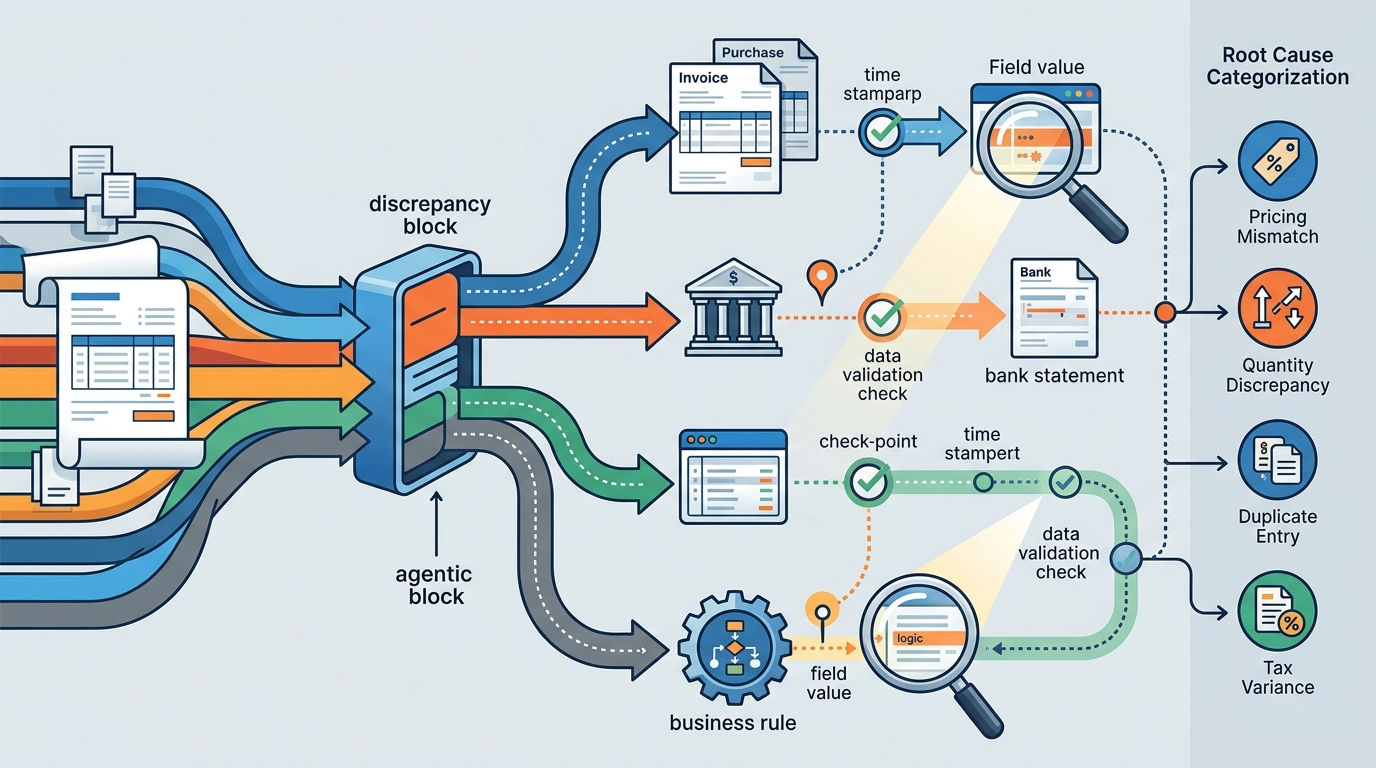
Root cause categorization is the process of classifying reconciliation breaks into specific, actionable types rather than leaving them as generic errors. Traditional software often labels a mismatch simply as "unmatched," which provides no guidance for the analyst. Agentic systems, however, analyze the transaction history to determine exactly why the records diverged.
Timing vs. Genuine Errors
One of the most common sources of confusion in finance is distinguishing between timing differences and actual errors. A timing difference occurs when a transaction is recorded in one system but not yet in another due to processing delays. For example, a bank might post a payment on the 1st, while the internal ledger records it on the 3rd. An AI agent identifies this pattern by checking settlement dates and pending status. It classifies the break as a timing issue and can often auto-resolve it once the data syncs.
Data Entry and Coding Failures
When a break is not a timing issue, the agent investigates data integrity. This includes identifying manual journal entries that bypassed the subledger, incorrect GL coding, or duplicate invoices. The agent pulls the source documents, such as the purchase order and the goods receipt note, to compare line items. If the price on the invoice differs from the contract price, the agent flags it as a price variance. This level of detail allows finance teams to address the specific root cause rather than guessing.
Systemic vs. Isolated Breaks
Agentic systems also distinguish between isolated incidents and systemic issues. If a specific vendor consistently sends invoices with a 2% price variance, the agent flags this as a systemic contract issue. If a single transaction has a typo in the reference number, it is an isolated data entry error. This categorization helps teams decide whether to fix a single entry or renegotiate a vendor contract.
The Investigation Workflow
The investigation workflow is the sequence of steps an AI agent takes to resolve a reconciliation break. It is not a black box; it is a structured process that mirrors the logic a human analyst would use, but at machine speed. The workflow typically involves ingestion, matching, investigation, and resolution.
Ingestion and Normalization
The first step is pulling data from disparate sources. This might include ERP systems like SAP or NetSuite, bank statements, and custodian reports. These sources often use different formats, currencies, and naming conventions. The agent normalizes this data into a standard structure. It maps identifiers, converts currencies using agreed rates, and aligns timestamps. Without this step, matching is impossible because the systems are speaking different languages.
Matching and Exception Flagging
Once data is normalized, the agent applies matching rules. These rules can be exact matches, fuzzy matches, or one-to-many matches. For example, a single invoice might be paid by two different bank transfers. The agent identifies these relationships. When a match cannot be made within a defined tolerance, the item is flagged as an exception. This is where traditional tools stop. They create a queue of exceptions and wait for a human to look at them.
Deep Dive Investigation
Agentic systems go further. For each exception, the agent initiates a deep dive. It traces the transaction through the system. It looks for related documents, such as credit memos or adjustment entries. It checks for corporate actions, like stock splits or dividends, that might explain a quantity mismatch. The agent builds a narrative of what happened. It determines if the break is due to a missing document, a calculation error, or a system glitch. This narrative is the "explanation" that the user sees.
Audit Trail and Explainability
Explainability is the ability of an AI system to provide a clear, human-readable account of its decisions. In finance, this is not just a nice-to-have; it is a compliance requirement. Auditors and regulators need to understand why a reconciliation was closed and how exceptions were resolved. Aetherix Systems ensures that every action taken by an agent is logged with a full reasoning trace.
The Reasoning Trace
A reasoning trace is a log of the specific data points and logic rules that led to a conclusion. For example, if an agent proposes a journal entry to fix a variance, the trace shows which documents were compared, what the variance amount was, and which rule triggered the proposal. This transparency allows a human reviewer to verify the agent's logic. If the agent is wrong, the reviewer can see exactly where the logic failed. This is critical for building trust in AI-driven finance operations.
Compliance and Audit Readiness
Because every action is logged, the audit trail is always available. This means that when an auditor asks for evidence of reconciliation, the team can provide a complete package. This includes the original data, the matching results, the exception details, and the resolution steps. There is no need to reconstruct the process from memory or email chains. This reduces the time and cost of audits and ensures that the organization is always in a state of compliance.
Matching Engines vs. Agentic Systems
Understanding the difference between traditional matching engines and agentic AI systems is key to evaluating reconciliation tools. The table below summarizes the core differences in how they handle exceptions.
| Feature | Traditional Matching Engine | Agentic AI System |
|---|---|---|
| Primary Function | Automated matching of transactions | Matching plus investigation and resolution |
| Exception Handling | Flags breaks for human review | Investigates breaks and proposes resolutions |
| Root Cause Analysis | None (generic "unmatched" label) | Specific categorization (timing, coding, etc.) |
| Explainability | Low (black box logic) | High (full reasoning trace on every action) |
| Human Role | Investigates and resolves every exception | Reviews and approves proposed resolutions |
| Audit Trail | Manual documentation required | Automated, complete log of all actions |
The shift from matching to agentic investigation changes the role of the finance team. Instead of spending hours investigating each break, they spend time reviewing the agent's proposals. This allows them to focus on higher-value tasks, such as strategic analysis and decision-making.
Key Takeaways
- AI reconciliation services explain mismatches by providing a detailed reasoning trace for every exception.
- Root cause categorization distinguishes between timing differences, data entry errors, and systemic issues.
- Agentic systems investigate breaks by tracing transactions through the system and pulling source documents.
- Explainability is critical for compliance, as auditors need to understand the logic behind every resolution.
- Traditional matching engines only flag exceptions; agentic systems propose resolutions with full context.
- The human role shifts from performing investigations to reviewing and approving agent proposals.
- A complete audit trail reduces the time and cost of regulatory audits.
- Agentic systems scale with volume, making them suitable for complex, multi-entity environments.
Frequently Asked Questions
What is the difference between a matching engine and an agentic AI system?
A matching engine automatically matches transactions that agree. An agentic AI system does that, but also investigates the transactions that do not agree. It proposes resolutions and provides a reasoning trace for every action.
How does an AI agent explain a reconciliation break?
The agent explains a break by logging the specific data points, timestamps, and logic rules that led to its conclusion. This reasoning trace is visible to the user and allows them to verify the agent's logic.
Can AI agents close a period or post journal entries?
No. AI agents propose journal entries and resolutions. A named human employee must review and approve these actions before they are posted to the ledger. The agent cannot take an untraceable action or close a period without human sign-off.
What types of root causes does an AI agent categorize?
Agents categorize breaks into types such as timing differences, data entry errors, price variances, duplicate invoices, and systemic contract issues. This helps teams address the specific problem rather than guessing.
Is the audit trail from an AI system complete?
Yes. Every action taken by the agent is logged with a full reasoning trace. This includes the data compared, the rules applied, and the proposed resolution. This ensures that the audit trail is complete and available for regulatory review.
How does this improve the financial close process?
By automating the investigation of exceptions, agentic systems reduce the time spent on manual reconciliation. This allows the close process to be faster and more predictable, as the team focuses on reviewing proposals rather than performing initial matches.
What is the role of tolerance rules in AI reconciliation?
Can AI agents handle multi-currency reconciliation?
Yes. Agents can normalize data across different currencies using agreed exchange rates. They can also trace FX variances back to the rate source and posting date, helping to identify whether a difference is due to a rate change or an error.
Conclusion
AI reconciliation services explain why something didn't match by providing a transparent, auditable reasoning trail for every exception. This moves finance operations from a manual, error-prone process to a controlled, intelligent workflow. By categorizing root causes and investigating breaks automatically, these systems allow teams to focus on high-value analysis. Aetherix Systems builds these agentic workflows to ensure that every action is explainable and every close is clean. To see how this works in practice, explore our delivery model and book a scoping call.