

What AI Reconciliation Services Actually Explain Why Something Didn't Match
AI reconciliation services explain mismatches by tracing the root cause of every exception, not just flagging it. Aetherix Systems builds agents that investigate breaks, pull supporting documents, and attach full reasoning to each proposed resolution. This guide covers how exception categorization works, why traditional tools fail at explanation, and how agentic systems deliver auditable clarity for finance teams.
Exception Categorization
Exception categorization is the process of classifying reconciliation breaks into distinct types based on their root cause. This step is critical because each category requires a different investigation path and resolution strategy. Without proper categorization, finance teams waste time applying the wrong fix to the wrong problem.
Common Exception Types
Reconciliation breaks generally fall into six primary categories. Understanding these types helps teams design effective automation rules.
- Timing Differences: Transactions recorded in one system but not yet in another due to settlement lags or cutoff mismatches.
- Quantity Mismatches: Discrepancies in units, shares, or amounts between source and target records.
- Price Variances: Differences in unit prices, exchange rates, or valuation marks.
- Missing Records: Transactions present in one system but absent in the other.
- Duplicate Entries: The same transaction recorded multiple times in one or both systems.
- Coding Errors: Transactions posted to incorrect accounts, cost centers, or entities.
Why Categorization Drives Resolution
Each exception type has a specific investigation workflow. For example, a timing difference requires checking settlement calendars and pending status, while a coding error requires comparing against default posting rules and vendor master data. Aetherix Systems configures its agents to recognize these patterns and apply the appropriate logic automatically. This ensures that every break is investigated with the right tools and data sources.
Why Traditional Tools Fail at Explanation
Traditional reconciliation software focuses on matching, not investigating. These tools use rules-based engines to compare records and flag discrepancies. However, they stop at the flag. They do not explain why the mismatch occurred or how to resolve it.
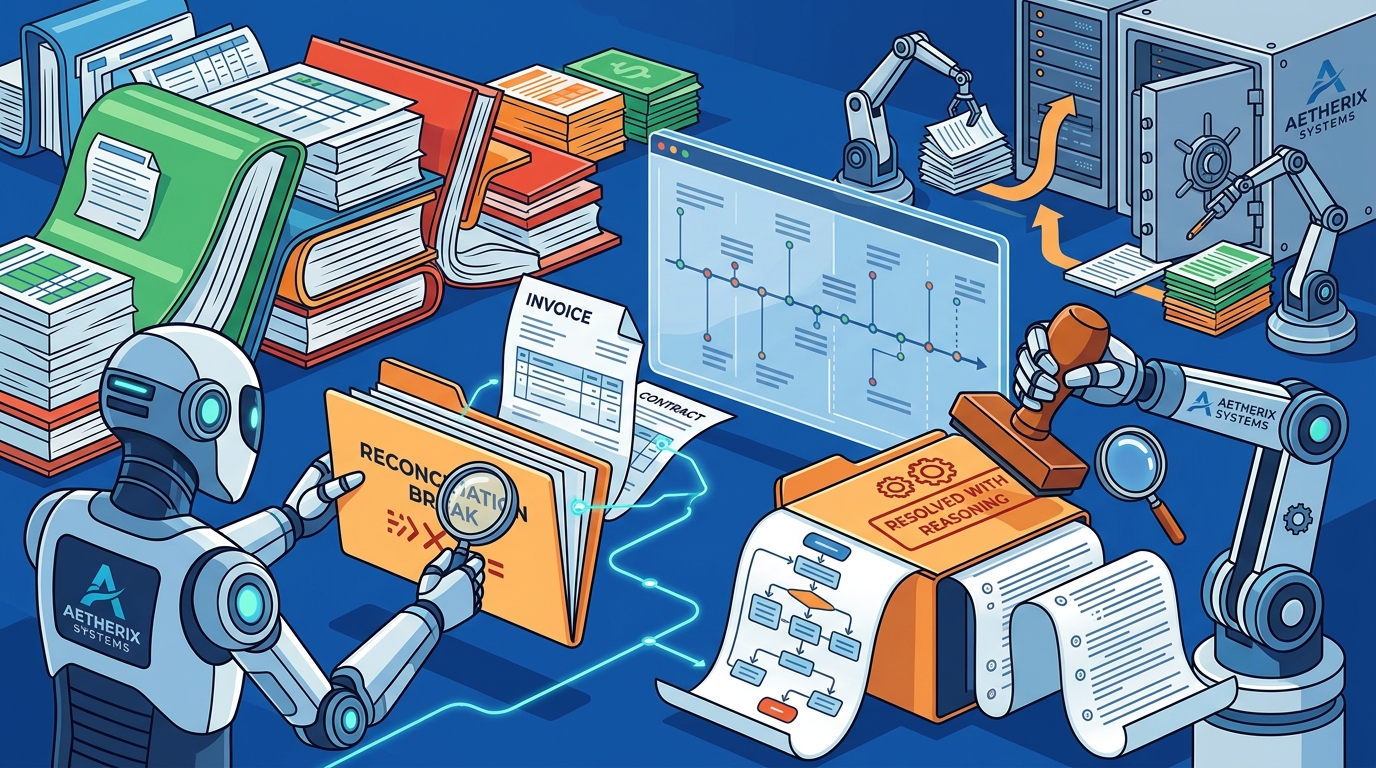
The Matching vs. Investigation Gap
Matching engines handle the transactions that agree. They are efficient at processing high volumes of clean data. But the real cost sits in the exceptions. When a match fails, the tool simply marks it as an exception. It does not pull the purchase order, check the receiving log, or verify the contract terms. It does not trace the transaction through the system or identify the root cause.
The Human Bottleneck
This gap creates a human bottleneck. Finance teams must manually investigate every exception. They pull documents, call vendors, and update ledgers. At scale, this is where AP and reconciliation teams spend the majority of their time. The work is repetitive, error-prone, and difficult to audit. Traditional tools do not solve this problem; they merely shift it from matching to manual investigation.
The Agentic Investigation Workflow
Agentic AI systems close the gap between matching and resolution. These systems do not just flag exceptions; they investigate them. A reconciliation agent is not a chatbot. It executes a structured investigation workflow that mirrors the steps a human analyst would take, but at machine speed and scale.
Step 1: Ingest and Normalize
The agent pulls data from all relevant sources, including ERPs, custodians, banks, and counterparties. It normalizes formats, currencies, and identifiers to ensure consistent comparison. This step eliminates data quality issues that often cause false exceptions.
Step 2: Match and Flag
The agent applies matching rules to compare records. It uses exact, fuzzy, one-to-many, and many-to-many matching strategies depending on the reconciliation type. Items that do not match within tolerance are flagged as exceptions.
Step 3: Investigate and Classify
For each break, the agent pulls supporting detail. It traces the transaction through the system, identifies the root cause, and classifies the exception type. This step is where the agent provides the explanation. It determines whether the break is a timing difference, a coding error, or a genuine discrepancy.
Step 4: Resolve and Report
The agent proposes a resolution with full reasoning attached. If the variance is within tolerance, it auto-resolves the item. If it exceeds tolerance, it escalates to a human reviewer with the complete context. The agent never guesses. It documents its reasoning and source documents for every action.
Audit Trail and Compliance
Every agent action is logged with a complete audit trail. This trail includes the data compared, the logic applied, and the reasoning behind each decision. The audit trail is timestamped, attributed, and exportable for regulatory reporting or external audit.
Why Auditability Matters
Regulators and auditors expect documented resolution workflows, not ad-hoc email chains. A clean chain of evidence demonstrates that the reconciliation process is controlled and reliable. Aetherix Systems ensures that every match, exception, and resolution is logged with full context. This improves compliance posture without additional effort.
Human-in-the-Loop Controls
Agents operate within precisely defined safety boundaries. They cannot write to the ledger, close a period, or resolve items outside tolerance without human approval. Every proposed entry is reviewed and signed off by a named client employee. This human-in-the-loop approach ensures that the final post is always under human control.
Implementation Considerations
Deploying agentic reconciliation requires careful planning. The process involves scoping, configuration, a shadow period, and production rollout. Each phase is designed to be non-disruptive to existing workflows.
Scoping and Configuration
The engagement begins with a scoping call to map systems, data sources, exception types, and close calendars. The team then configures matching rules, tolerance thresholds, and escalation paths. No code changes are required on the client side. The agents connect to existing systems via APIs or direct data feeds.
Shadow Period and Production
During the shadow period, agents run in parallel with the existing process. Every proposed resolution is reviewed by the client team before action. This phase allows the team to tune rules based on feedback. Once confidence is established, the agents move to production, handling the reconciliation end-to-end.
Key Takeaways
- Exception categorization is the foundation of effective reconciliation automation.
- Traditional tools flag exceptions but do not investigate or explain them.
- Agentic AI systems execute structured investigation workflows to identify root causes.
- Every agent action is logged with a complete, exportable audit trail.
- Human-in-the-loop controls ensure that final decisions remain under human oversight.
- Implementation involves a non-disruptive phased rollout from scoping to production.
- Agentic reconciliation compresses close cycles by resolving exceptions in parallel.
Frequently Asked Questions
What is the difference between matching and investigation in reconciliation?
Matching compares records to identify discrepancies. Investigation determines why the discrepancy occurred and how to resolve it. Traditional tools only perform matching; agentic systems perform both.
How do AI agents explain reconciliation breaks?
AI agents trace transactions through systems, pull supporting documents, and classify the root cause. They attach this reasoning to each proposed resolution, providing a clear explanation for every break.
Can AI agents post journal entries to the ledger?
No. AI agents propose journal entries with full reasoning. A named client employee reviews and posts the entries. Write access is never implicit; it is granted per-system with an approval workflow.
What types of exceptions do AI agents handle?
Agents handle timing differences, quantity mismatches, price variances, missing records, duplicate entries, and coding errors. Each type has a specific investigation workflow configured for the agent.
Is the audit trail exportable for regulatory reporting?
Yes. Every agent action is logged with a complete audit trail that is timestamped, attributed, and exportable. This trail can be used for regulatory reporting or external audit without manual reconstruction.
How long does it take to implement agentic reconciliation?
Implementation typically takes 3 to 6 weeks from scoping call to production. The process includes configuration, a shadow period, and production rollout, designed to be non-disruptive to existing workflows.
Do AI agents work with existing ERP systems?
Yes. Agents integrate with existing tech stacks, including ERP systems, CRM platforms, and data warehouses, via APIs and event-driven architectures. No code changes are required on the client side.
Conclusion
AI reconciliation services explain mismatches by investigating root causes and attaching full reasoning to every resolution. Aetherix Systems builds agents that handle the exception queue, providing auditable clarity for finance teams. To plan your visit, to discuss how agentic reconciliation can transform your close process.