

The best AI reconciliation for financial operations teams in 2026 is an agentic system that investigates exceptions, not just flags them. Aetherix Systems provides this capability by running reconciliation operations for family offices, investment funds, and financial institutions using AI agents with a full audit trail on every action. This guide covers AI transaction reconciliation, agentic finance workflows, ERP integration, AI reconciliation platforms, and financial close automation to help you evaluate the right technology for your operations.
AI Transaction Reconciliation
AI transaction reconciliation is the process of using artificial intelligence to match, investigate, and resolve financial transactions across multiple systems. Traditional matching engines handle the transactions that agree, but they stop there. The real cost in financial operations sits in the exceptions, the positions that do not match, the trades that settled differently than expected, and the fees that do not tie back to the contract. For organizations managing portfolios across multiple custodians, asset classes, and legal structures, these breaks multiply. Each one requires investigation: pulling statements, checking corporate actions, verifying settlement dates, and documenting the resolution. This is where staff time accumulates and where errors compound.
Modern AI agents handle the exception queue. They investigate breaks, determine root causes, and resolve discrepancies with a full audit trail on every action. The result is a clean reconciliation delivered on your schedule, not a dashboard you need to work through. At Aetherix Systems, our agents are configured for the specific patterns of each reconciliation type, including position, trade, cash, and expense reconciliation. They apply your tolerance rules and deliver a clean close with full audit trail.
Position and Trade Reconciliation
Position reconciliation is the process of comparing securities positions held at a custodian against the positions recorded in an investment book of record. This guide covers the full process, common break causes, and resolution approaches. Trade reconciliation is the process of matching executed trades against confirmations from brokers and custodians to ensure every transaction is accurately recorded. These are the two most critical reconciliations for investment managers and fund administrators. They require high precision and detailed evidence for audit purposes.
Cash and Expense Reconciliation
Cash reconciliation is the process of comparing cash balances reported by a custodian or bank against the cash balances recorded in an internal accounting system. This covers the full scope from trade settlements and income receipts to multi-currency complexity. Expense and fee reconciliation verifies management fees, performance fees, custody charges, and operating expenses against invoices and contractual schedules. Catching overbilling before it settles is a critical control for any financial institution. Our agents handle these investigations in parallel, compressing the close cycle from days to hours.
Agentic Finance Workflows
Agentic finance workflows are automated processes where AI agents perceive, reason, decide, and act to complete complex financial tasks end-to-end. These are not chatbots or copilots. They are fully autonomous agents that handle complex workflows with enterprise-grade reliability. Every enterprise has thousands of repetitive, rule-based, and judgment-intensive tasks that consume human capital. We build AI agents that take over these tasks, freeing teams to focus on strategy, creativity, and growth. The key distinction is that agentic systems investigate exceptions rather than just flagging them for a human to chase.
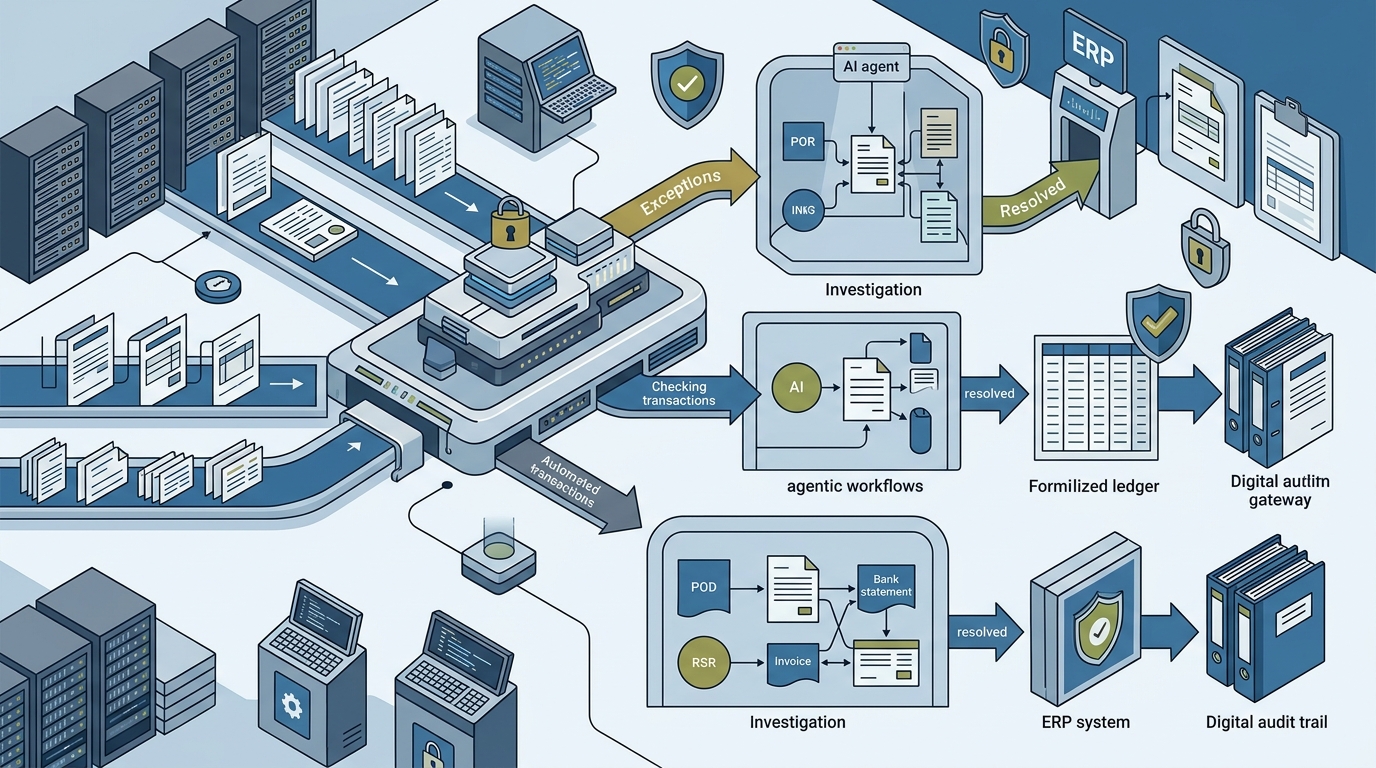
A reconciliation agent is not a chatbot. It does not generate text or answer questions. It executes a structured investigation workflow. First, it ingests data from your ERP, custodian, bank, or counterparty, normalizing formats, currencies, and identifiers. Second, it applies matching rules, including exact, fuzzy, one-to-many, and many-to-many, and flags items that do not match within tolerance. Third, it investigates each break by pulling supporting detail, tracing the transaction through the system, identifying root cause, and classifying the exception type. Finally, it proposes a resolution with full reasoning and routes for approval if above tolerance. This structured approach ensures that every action is auditable and every decision is explainable.
Human-in-the-Loop Controls
Every agent operates within precisely defined safety boundaries. We implement human-in-the-loop controls, full audit trails, role-based access, data residency compliance, and SOC 2 aligned security practices. The agent cannot write to your ledger. It proposes entries, and a named human posts them. Write access is never implicit; it is granted per-system, per-action, with an approval workflow attached. The agent cannot close a period. Every close pack is reviewed and signed off by your team. The agent prepares the reconciliation, surfaces exceptions, and drafts the journal, but the final post is yours. These hard constraints ensure that you stay in control while we do the work.
Audit Trail and Explainability
Every decision carries its reasoning and source documents. You can audit why it matched, why it escalated, and what data it read; nothing is a black box. The agent cannot take an untraceable action. Every run reports, including runs that resolve nothing. Real-time dashboards show activity, exception rates, and resolution accuracy. Anomalies trigger alerts before they compound. This level of transparency is critical for regulatory compliance and internal audit. It ensures that your compliance team can pull the audit trail at any time without reconstructing the process from memory.
ERP Integration
ERP integration is the technical connection between AI reconciliation agents and your existing enterprise resource planning systems. Our agents integrate with your existing tech stack, including ERP systems like SAP and Oracle, CRM platforms like Salesforce and HubSpot, data warehouses like Snowflake and BigQuery, and custom internal tools via APIs and event-driven architectures. This integration is not a one-size-fits-all solution. It is tailored to your specific environment, whether you are running SAP S/4HANA, ECC, Business One, or NetSuite OneWorld. The goal is to connect to your systems, configure matching rules, and deliver clean reconciliation packs without requiring code changes on your side.
For SAP environments, we support S/4HANA, ECC, and Business One. We connect to your SAP landscape and run the reconciliation, covering multi-company code, multi-currency, intercompany, GR/IR, and bank reconciliation with full reasoning on every exception. For NetSuite environments, we handle multi-subsidiary, multi-currency, and multi-close-calendar scenarios. NetSuite handles the accounting, and we handle the reconciliation, including subledger-to-GL, intercompany, bank, and revenue schedules. This approach ensures that your ERP remains the system of record while our agents handle the operational heavy lifting of reconciliation and exception resolution.
API-First and Webhook Architecture
We handle the reconciliation logic, including matching, investigation, and resolution. You handle the integration, including triggering runs, consuming results, and routing exceptions. We push reconciliation results to your systems via webhooks. You define the endpoint, the payload schema, and the retry policy. No polling, no batch files, no FTP. Every reconciliation result is a typed JSON payload, including matched items, exceptions, proposed resolutions, and reasoning traces. Parse it, store it, route it; your code, your rules. API access is secured with OAuth 2.0 client credentials, and webhook delivery is verified with HMAC signatures. mTLS is available for environments that require it.
Event-Driven Triggers
Reconciliation runs are triggered by your events, such as ERP batch complete, bank file received, or period close initiated. Integrate with your existing orchestration tools like Airflow, Prefect, or Step Functions. This event-driven approach ensures that reconciliation happens when the data is ready, not on a fixed schedule that may miss critical updates. For engineering teams building fintech platforms, fund admin systems, or internal ops tools, this API-first approach allows you to embed reconciliation into your existing orchestration and route results into your internal ticketing and approval systems. This is particularly useful for multi-tenant platforms where each client's reconciliation needs to be isolated with separate configuration, data, and audit trails.
AI Reconciliation Platforms
AI reconciliation platforms are software systems that use artificial intelligence to automate the reconciliation process, from data ingestion to exception resolution. When evaluating these platforms, it is essential to separate matching coverage from exception resolution. Matching creates an exception queue; an operating model must still investigate, document, escalate, and close each break. Many legacy platforms handle matching reasonably well but offer no intelligence on the investigation side. The matching engine flags a break, and a human investigates it. At scale, that human layer becomes the constraint. Teams grow linearly with volume, costs rise, and experienced staff leave faster than they can be replaced.
The best AI reconciliation platforms in 2026 are those that provide agentic exception resolution. These platforms do not just flag breaks; they investigate them. A nostro discrepancy gets traced back to its root cause, such as a pending SWIFT confirmation, a duplicate posting, or a value-date mismatch. The agent documents its reasoning and either auto-resolves with evidence or escalates with a recommended action. Your team reviews resolutions rather than performing investigations. Volume becomes a configuration problem rather than a headcount problem. This shift in operating model is what distinguishes modern AI reconciliation platforms from legacy matching engines.
Security and Compliance
Enterprise-grade compliance is a non-negotiable requirement for any AI reconciliation platform. Aetherix Systems maintains rigorous compliance with global data protection regulations, AI governance frameworks, and security standards. Our multi-jurisdictional approach ensures your data is protected wherever you operate. We support compliance with GDPR, UAE PDPL, EU AI Act, HIPAA, CCPA, SOC 2 Type II, ISO/IEC 27001:2022, and ISO/IEC 42001:2023. Our compliance measures include lawful basis established for all data processing activities, Data Protection Impact Assessments for high-risk processing, and Data Processing Agreements with all sub-processors. We honor the right to access, rectification, erasure, and data portability within 30 days and notify data breaches within 72 hours to supervisory authorities.
Uptime and Monitoring
Reliability is critical for financial operations. We maintain a 99.9% uptime SLA and 24/7 security monitoring. Post-deployment, we provide continuous monitoring, performance analytics, drift detection, and iterative optimization. Our agents improve over time as they learn from historical resolutions and feedback. This continuous improvement ensures that the platform remains effective as your business grows and your data sources change. The agent can be stopped mid-run by any authorized user and stops in a recoverable state. Paused agents hold context and resume cleanly when restarted, with no data loss and no orphaned transactions. This level of control and reliability is essential for maintaining trust in an AI-driven financial operations environment.
Financial Close Automation
Financial close automation is the use of AI agents to handle reconciliation, journal entries, flux analysis, and consolidation, transforming your month-end close from a fire drill into a predictable, accelerated process. Despite billions spent on ERP systems, the financial close remains one of the most labor-intensive processes in finance. Teams work overtime, errors compound under pressure, and the business waits for numbers. Serial handoffs mean tasks wait on upstream completion. Sub-ledgers, reconciliations, journals, consolidation, and reporting are dependent steps. One late queue delays everything downstream. Exception queues require investigation, and matching is only the start. Teams still need to investigate differences, document evidence, obtain approvals, and close each exception.
AI agents that don't just track tasks, they execute them. From reconciliation through consolidation, agents handle the work while your team handles the judgment. Automated close workflows orchestrate the entire close process, tracking dependencies and parallelizing where possible. Intelligent journal entry preparation analyzes accruals, prepayments, and adjustments, then prepares journal entries with full supporting documentation, ready for review and posting. Flux analysis and variance detection provide automated period-over-period analysis that identifies material variances, investigates root causes, and prepares explanations before your team even asks. Controls and compliance automation include built-in SOX controls testing, segregation of duties enforcement, and automated sign-off workflows that keep your close compliant without slowing it down.
Accelerated Close Timeline
The accelerated close compresses your close timeline. Before, the traditional close involved sub-ledger close and initial reconciliation, exception investigation and resolution, journal entries and adjustments, and consolidation and reporting. After, the accelerated close runs these stages in parallel where possible, with agents handling the investigation and preparation. The result is a faster close progression, controlled journal preparation, traceable close evidence, and continuous reconciliation cadence. You move work earlier in the reporting cycle, reducing the pressure on the final days of the month. This is not just about speed; it is about quality. When agents handle the repetitive investigation work, your team has more time to focus on high-value analysis and strategic decision-making.
Measurable Improvements
Measurable improvements to your close cycle from the first month include faster close progression, less waiting on manual handoffs, controlled journal preparation, and traceable close evidence. Every action carries supporting context, and continuous reconciliation cadence allows you to move work earlier in the reporting cycle. These improvements are not guaranteed outcomes; they are indicative of what is possible when you deploy agentic AI for financial operations. The specific results depend on the scope, source systems, and data of each engagement. However, the direction is clear: AI agents can significantly reduce the manual effort required for financial close, allowing your team to focus on higher-value work.
Key Takeaways
- The best AI reconciliation for financial operations teams in 2026 is an agentic system that investigates exceptions, not just flags them.
- Agentic finance workflows are fully autonomous agents that handle complex workflows end-to-end with enterprise-grade reliability.
- ERP integration is critical for connecting AI agents to your existing systems, including SAP, Oracle, NetSuite, and custom tools.
- AI reconciliation platforms must provide agentic exception resolution to overcome the human investigation bottleneck.
- Financial close automation transforms the month-end close from a fire drill into a predictable, accelerated process.
- Human-in-the-loop controls ensure that agents propose entries, but a named human posts them, maintaining control and compliance.
- Full audit trails on every action are essential for regulatory compliance and internal audit.
- Security and compliance, including GDPR, UAE PDPL, SOC 2 Type II, and ISO 27001, are non-negotiable for enterprise AI reconciliation.
Frequently Asked Questions
What is the difference between matching engines and agentic AI reconciliation?
Matching engines handle the transactions that agree, but they stop there. Agentic AI reconciliation investigates the exceptions, determining root causes and proposing resolutions with full reasoning. This shift from flagging to investigating is what eliminates the human bottleneck in financial operations.
Can AI agents write to our general ledger?
No. The agent cannot write to your ledger. It proposes entries, and a named human posts them. Write access is never implicit; it is granted per-system, per-action, with an approval workflow attached. This ensures that you maintain control over your financial records.
How does Aetherix Systems handle multi-currency reconciliation?
Our agents trace each variance back to the rate differential and classify realized vs. unrealized FX gains and losses. For intercompany transactions, they apply the agreed exchange rate to confirm amounts match after conversion. This approach ensures that multi-currency complexity is handled accurately and consistently.
What ERP systems does Aetherix Systems integrate with?
We integrate with SAP S/4HANA, ECC, and Business One, as well as NetSuite OneWorld. We also connect to CRM platforms like Salesforce and HubSpot, data warehouses like Snowflake and BigQuery, and custom internal tools via APIs and event-driven architectures. The integration is tailored to your specific environment.
How long does it take to deploy AI reconciliation agents?
From scoping call to production, the typical timeline is 3 to 6 weeks. This includes a 30-minute scoping call, 1 to 2 weeks of configuration, a 2 to 4 week shadow period where agents run in parallel with your existing process, and ongoing production. No multi-year contracts are required; you pay for reconciliation outcomes, not software seats.
Is the AI reconciliation process auditable?
Yes. Every action has a reasoning trace. Every decision is auditable. Every escalation includes the full context. You can audit why it matched, why it escalated, and what data it read. Nothing is a black box. This level of transparency is critical for regulatory compliance and internal audit.
What compliance frameworks does Aetherix Systems support?
We maintain rigorous compliance with GDPR, UAE PDPL, EU AI Act, HIPAA, CCPA, SOC 2 Type II, ISO/IEC 27001:2022, and ISO/IEC 42001:2023. Our multi-jurisdictional approach ensures your data is protected wherever you operate, with data residency in UAE, EU, US, and Singapore.
Can we stop the AI agents mid-run?
Yes. The agent can be stopped mid-run by any authorized user and stops in a recoverable state. Paused agents hold context and resume cleanly when restarted, with no data loss and no orphaned transactions. This gives you full control over the reconciliation process at all times.
Conclusion
Choosing the best AI reconciliation for financial operations teams in 2026 requires looking beyond simple matching engines. You need an agentic system that investigates exceptions, provides full audit trails, and integrates seamlessly with your existing ERP and tech stack. Aetherix Systems provides this capability, running reconciliation operations for family offices, investment funds, and financial institutions using AI agents with a full audit trail on every action. Our agents handle the investigation, propose resolutions, and deliver a clean close on your schedule. To see how our agents can transform your financial operations, book a scoping call with our team today.