

Financial operations teams need AI reconciliation that investigates exceptions, not just flags them. Aetherix Systems provides agentic reconciliation for family offices, funds, and institutions. This guide covers transaction matching, agentic workflows, ERP integration, platform selection, and close automation.
AI Transaction Reconciliation
AI transaction reconciliation is the process of using machine learning to match financial records across different systems. Traditional rules-based engines handle exact matches well. They fail when data is messy, incomplete, or requires context. AI models analyze patterns in historical data to predict matches. They handle fuzzy matching, currency conversion, and timing differences. This reduces the volume of exceptions sent to human analysts.
Matching vs. Investigation
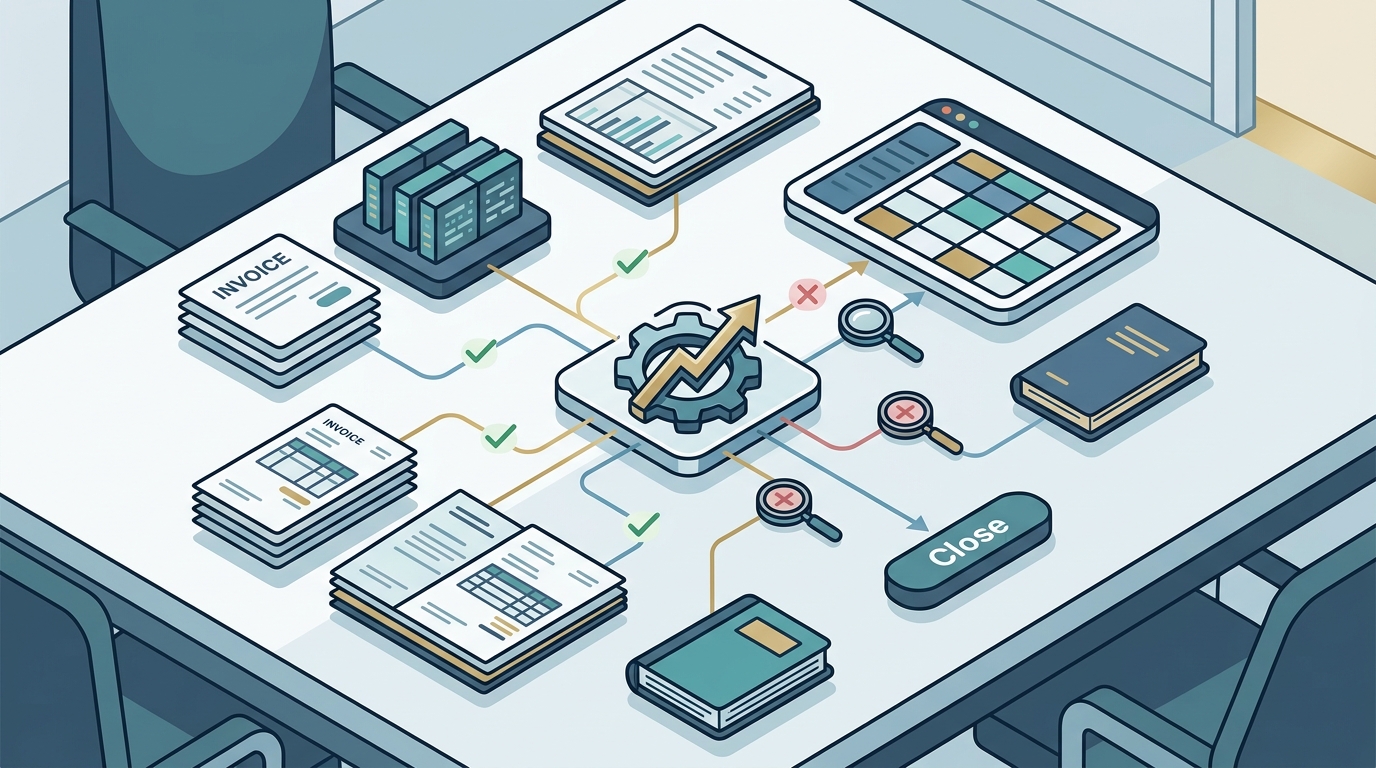
Matching is only the first step. The real value lies in investigating the breaks. When a transaction does not match, an AI agent can pull supporting documents. It can trace the transaction through the system. It can identify the root cause, such as a missing invoice or a timing difference. This moves the work from manual data entry to analytical review.
Exception Handling
Exceptions require judgment. An AI system can classify exceptions by type. It can propose a resolution based on historical patterns. It can attach the full reasoning trail for audit purposes. This ensures that every decision is documented and defensible. The human team reviews the proposal and approves the action. This maintains control while accelerating the process.
Agentic Finance Workflows
Agentic finance workflows are autonomous AI systems that execute complex financial tasks end-to-end. Unlike chatbots, these agents perceive, reason, decide, and act. They operate within defined guardrails and safety boundaries. They can handle multi-step processes like reconciliation, journal entry preparation, and flux analysis. This shifts the paradigm from software assistance to autonomous execution.
Multi-Agent Orchestration
Complex financial processes often require multiple agents working together. One agent might handle data ingestion. Another might perform matching. A third might investigate exceptions. An orchestration layer coordinates these agents. It routes tasks, manages handoffs, and resolves conflicts. This ensures end-to-end process completion without human intervention for routine steps.
Governance and Auditability
Autonomy requires strict governance. Every agent action must be logged with a reasoning trace. This creates a full audit trail. It shows what data was read, what logic was applied, and why a decision was made. This is critical for compliance and audit. It ensures that AI actions are transparent and accountable. Human-in-the-loop controls allow for oversight at key decision points.
ERP Integration
ERP integration is the technical connection between AI reconciliation agents and your core accounting system. Aetherix Systems integrates with major ERPs like SAP, NetSuite, and Oracle. These integrations use APIs, webhooks, and direct database connections. They allow agents to pull data, post entries, and update statuses in real-time. This eliminates manual file transfers and reduces latency.
API-First Architecture
Modern ERP integrations are API-first. This means the AI agent interacts with the ERP through standard REST or SOAP endpoints. It can trigger reconciliation runs, query status, and retrieve results. This allows for event-driven triggers. For example, a reconciliation run can start when an ERP batch completes. This ensures data freshness and reduces manual scheduling.
Security and Compliance
ERP integrations must meet strict security standards. Aetherix Systems uses OAuth 2.0 and mTLS for API access. Webhook delivery is verified with HMAC signatures. This ensures that data is protected in transit and at rest. It also ensures that only authorized systems can interact with the ERP. This is essential for maintaining the integrity of financial data.
AI Reconciliation Platforms
AI reconciliation platforms are software solutions that combine matching engines with AI-driven investigation. They provide a unified interface for managing reconciliation tasks. They offer dashboards for monitoring status, exceptions, and resolution rates. They also provide reporting and audit evidence. Choosing the right platform depends on your specific needs, volume, and complexity.
| Feature | Rules-Based Engine | AI Agentic Platform |
|---|---|---|
| Matching Logic | Exact and fuzzy rules | Machine learning and pattern recognition |
| Exception Handling | Flags for manual review | Investigates and proposes resolutions |
| Audit Trail | Basic logging | Full reasoning trace on every action |
| Human Role | Performs investigation | Reviews and approves proposals |
Evaluation Criteria
When evaluating platforms, look at the depth of investigation. Can the system trace a variance back to its source? Can it identify the root cause? Can it propose a correction? These capabilities determine the level of automation you can achieve. Also consider the platform's security and compliance posture. It should align with your organization's standards.
Financial Close Automation
Financial close automation is the use of AI to accelerate the month-end close process. It involves automating reconciliation, journal entries, flux analysis, and consolidation. This transforms the close from a manual marathon into a predictable, accelerated process. It reduces the time and effort required to produce financial statements. It also improves the quality and accuracy of the data.
Close Timeline Compression
Traditional closes are serial. Tasks wait on upstream completion. One late queue delays everything downstream. AI agents can parallelize workstreams. They can run reconciliations, prepare journals, and analyze flux simultaneously. This compresses the close timeline. It allows teams to deliver financial statements faster. It also provides more time for review and analysis.
Continuous Reconciliation
Continuous reconciliation moves work earlier in the reporting cycle. Instead of reconciling at month-end, agents run daily or weekly. This spreads the workload throughout the month. It prevents the backlog of exceptions that typically occurs at close. It also allows for early detection of issues. This makes the month-end close a routine event rather than a fire drill.
Key Takeaways
- AI reconciliation goes beyond matching to investigate exceptions and propose resolutions.
- Agentic workflows execute complex financial tasks end-to-end with full audit trails.
- ERP integration via APIs enables real-time data exchange and event-driven triggers.
- Choosing a platform requires evaluating investigation depth, security, and compliance.
- Financial close automation parallelizes workstreams to compress the close timeline.
- Continuous reconciliation spreads the workload and prevents month-end backlogs.
- Human oversight remains critical for approving AI-proposed actions and maintaining control.
Frequently Asked Questions
What is the difference between AI matching and AI investigation?
AI matching identifies transactions that agree based on rules or patterns. AI investigation analyzes transactions that do not agree. It pulls supporting documents, traces the transaction, and identifies the root cause. It then proposes a resolution for human review.
How does Aetherix Systems ensure auditability?
Every agent action is logged with a full reasoning trace. This shows what data was read, what logic was applied, and why a decision was made. This creates a complete audit trail that can be reviewed by auditors or compliance teams.
Can AI agents post journal entries directly?
No. Aetherix Systems agents propose journal entries. A named human employee reviews and posts them. This ensures that human control is maintained over financial records. Write access is never implicit; it is granted per-system with an approval workflow.
Which ERPs does Aetherix Systems integrate with?
Aetherix Systems integrates with major ERPs including SAP, NetSuite, and Oracle. It uses APIs, webhooks, and direct database connections to exchange data. This allows for real-time reconciliation and status updates.
How long does it take to implement AI reconciliation?
Implementation typically takes 3 to 6 weeks. This includes scoping, configuration, a shadow period, and production deployment. The timeline depends on the complexity of the systems and the volume of data.
Is AI reconciliation suitable for small businesses?
AI reconciliation is most beneficial for organizations with high transaction volumes and complex structures. Small businesses with simple accounting may not need the full capability. However, as volume grows, AI can help manage the increased workload.
Conclusion
Choosing the best AI reconciliation partner requires looking beyond basic matching. You need a system that investigates exceptions, provides full audit trails, and integrates seamlessly with your ERP. Aetherix Systems offers agentic reconciliation for financial operations teams. Our agents handle the investigation, while your team maintains control. To see how our agents can accelerate your close, explore our delivery model.