

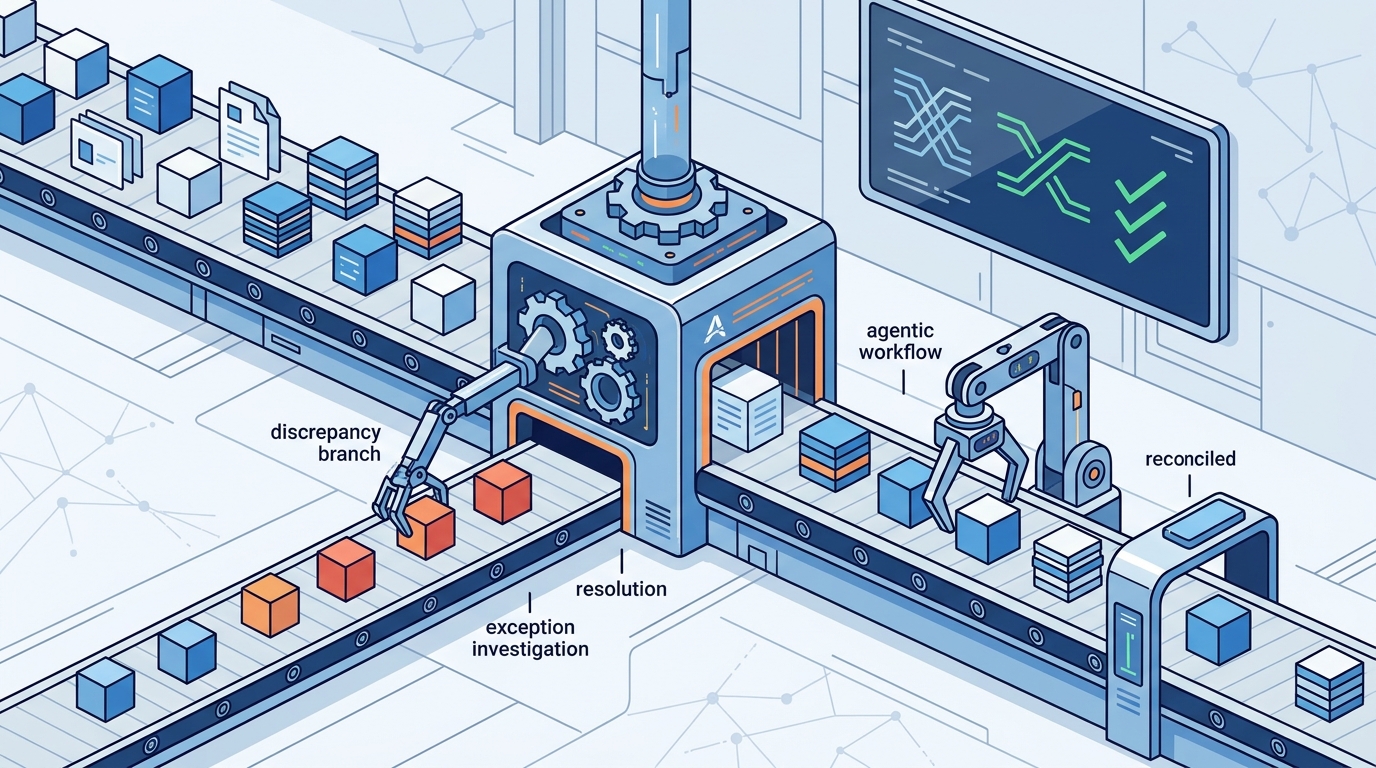
Leading finance teams use AI reconciliation platforms to shift from manual matching to autonomous exception investigation. These systems process high-volume transactions, identify discrepancies, and propose resolutions without human intervention for routine items. Aetherix Systems builds these production-grade AI systems for enterprise clients, focusing on agentic workflows that handle complex financial data. This approach reduces cycle times and improves accuracy in finance operations. For additional details, review the Project not found.
The Shift from Rules to Agents
Traditional reconciliation relies on static rules. A rule-based matching engine flags exceptions when data does not match a predefined pattern. However, these systems struggle with unstructured data and complex edge cases. AI reconciliation platforms use large language models and agentic workflows to understand context. An AI agent is an autonomous software system that can plan and execute multi-step tasks to achieve a goal. This shift allows systems to investigate why a mismatch occurred, not just that it occurred. For additional details, review the Customer Experience.
For example, a payment might be missing a reference number. A rules-based system flags it as an exception. An agentic system queries the bank statement, checks the invoice metadata, and identifies the correct match based on semantic similarity. This reduces the volume of exceptions requiring human review. Finance teams can focus on high-value analysis rather than data entry. For additional details, review the Frequently Asked Questions.
Handling Complex Data Sources
Modern finance operations involve disparate systems. Data resides in ERPs, banking portals, custodian platforms, and spreadsheets. AI reconciliation platforms integrate these sources into a unified data layer. This integration is critical for accurate matching. The system normalizes data formats, currencies, and timestamps before processing. This ensures that a transaction in one system is correctly mapped to its counterpart in another. For additional details, review the About.
Consider a fund administrator managing multiple portfolios. Data comes from various custodians and brokers. Each source has unique formats and latency. An AI platform ingests this data in real-time or near real-time. It aligns records across sources and identifies gaps. This capability is essential for timely reporting and compliance. It reduces the manual effort required to consolidate data from multiple vendors.
Exception Management and Resolution
Exceptions are the core challenge in reconciliation. Manual teams spend significant time investigating and resolving these items. AI systems automate this process through exception handling workflows. The system categorizes exceptions by type and severity. It then applies specific resolution logic to each category. For simple mismatches, the system may auto-correct the data. For complex issues, it generates a detailed report for human review.
Integration with Enterprise Systems
Governance and Compliance
Compliance with standards such as ISO 27001 and ISO 42001 is important. These standards provide frameworks for information security and AI management. They help organizations manage risks associated with AI deployment. Aetherix Systems aligns its operations with these standards. This ensures that AI systems are secure, reliable, and transparent. It builds trust with clients and regulators.
Key Takeaways
- AI reconciliation platforms use agentic workflows to investigate exceptions, not just flag them.
- These systems integrate disparate data sources into a unified layer for accurate matching.
- Exception management is automated through categorization and resolution logic.
- A full audit trail is essential for regulatory compliance and transparency.
- Human-in-the-loop approaches ensure accountability by having employees post proposed entries.
- Strong governance and alignment with security standards are critical for AI deployment.
Frequently Asked Questions
What is an AI reconciliation platform?
How do AI agents differ from rules-based systems?
AI agents can understand context and investigate complex exceptions autonomously. Rules-based systems only flag mismatches based on predefined patterns and cannot investigate the cause.
Can AI systems post journal entries automatically?
AI systems typically propose journal entries. A named client employee reviews and posts them. This human-in-the-loop approach ensures accountability and control.
What data sources can AI reconciliation platforms integrate with?
These platforms can integrate with ERPs, banking systems, custodian platforms, and spreadsheets. They normalize data from these sources for accurate matching.
Is there an audit trail for AI actions?
How does AI improve reconciliation cycle times?
AI reduces cycle times by automating data matching and exception investigation. It processes high-volume transactions quickly and accurately, reducing the need for manual review.
Conclusion
AI reconciliation platforms are transforming finance operations by automating complex workflows. They shift the focus from manual matching to strategic analysis. Aetherix Systems provides these production-grade AI systems for enterprise clients. Our team builds agentic workflows that handle reconciliation and exception handling with precision. To explore how AI can transform your finance operations, contact Aetherix Systems. Learn more: Project not found.