

Good AI tools for nostro and vostro account reconciliation are agentic systems that investigate discrepancies, trace root causes, and propose resolutions with full audit trails. This guide covers the core challenges of correspondent banking, the limitations of legacy matching engines, and how modern AI agents transform the reconciliation workflow for financial institutions.
Nostro and Vostro Reconciliation Platforms
Nostro reconciliation is the process of verifying that balances in a bank's account at a correspondent bank match the internal records of the bank holding the account. Vostro reconciliation is the mirror image, where the correspondent bank verifies the balances of its clients. These processes are critical for liquidity management, regulatory reporting, and settlement discipline. Modern platforms must handle high transaction volumes, multiple currencies, and complex settlement cycles while maintaining a complete audit trail for every action taken.
Core Functional Requirements
Effective reconciliation platforms must ingest data from diverse sources, including SWIFT messages, core banking systems, and external bank statements. They must normalize this data into a common format, apply matching rules, and flag exceptions for investigation. The platform should support multi-currency reconciliation, handling FX revaluation and rate discrepancies. It must also provide real-time visibility into open items, aging, and resolution status.
Integration Capabilities
Integration is a critical differentiator. Platforms should connect to core banking systems, SWIFT networks, and treasury management systems via APIs or file-based interfaces. They should support event-driven triggers, allowing reconciliation runs to start automatically when new data is received. This reduces latency and ensures that breaks are identified and investigated as soon as possible.
The Correspondent Banking Challenge
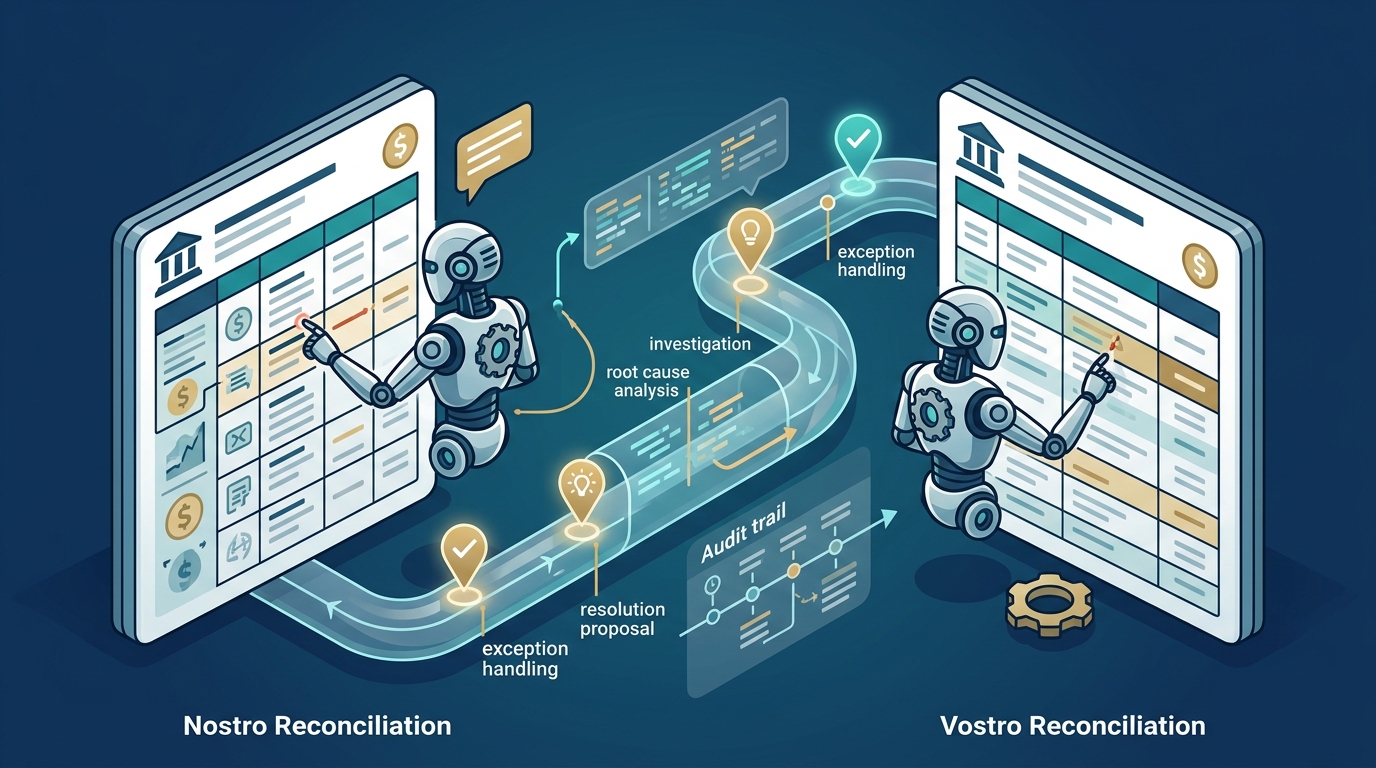
Financial institutions operate at a scale where even a 0.1% exception rate generates thousands of breaks per day. A mid-sized bank running nostro reconciliation across 30 correspondent banks might process 50,000 transactions daily, with 50 of those not matching on the first pass. Each break requires investigation to determine if it is a timing difference, a missing entry, a duplicate, or a genuine error. The challenge is compounded by the diversity of reconciliation types running simultaneously, including nostro and vostro accounts, intercompany positions, and securities settlement.
Volume and Complexity
High transaction volumes make manual reconciliation impractical. Teams must process thousands of items daily, often under tight deadlines. The complexity increases with the number of correspondent banks, currencies, and settlement cycles. Each correspondent bank may have different data formats, posting schedules, and reconciliation rules. This diversity requires a flexible and scalable solution.
Regulatory Pressure
Regulatory regimes such as Basel III liquidity reporting and settlement discipline rules (CSDR in Europe, T+1 in the US) penalize late settlements and require accurate intraday cash positions. Auditors expect documented resolution workflows, not ad-hoc email chains. The cost of getting reconciliation wrong is no longer just operational; it is regulatory. Institutions must demonstrate that they have robust controls in place to identify, investigate, and resolve discrepancies.
Legacy Matching Engine Limitations
Many institutions run reconciliation on platforms built in the 2000s. These systems handle matching reasonably well but offer no intelligence on the investigation side. The matching engine flags a break, but a human must investigate it. At scale, this human layer becomes the constraint. Teams grow linearly with volume, costs rise, and experienced staff leave faster than they can be replaced. Legacy systems often lack the ability to trace root causes, leading to prolonged investigations and delayed resolutions.
The Investigation Bottleneck
Legacy systems create an exception queue that humans must work through. Each exception requires pulling data from multiple sources, cross-referencing records, and determining the root cause. This process is slow, error-prone, and difficult to audit. The investigation bottleneck limits the speed of the close and increases the risk of errors. It also prevents teams from scaling their operations without adding headcount.
Lack of Audit Trail
Many legacy systems do not provide a complete audit trail of the investigation process. Decisions are often made via email or phone calls, with no record of the reasoning behind them. This makes it difficult to demonstrate compliance to auditors and regulators. It also makes it hard to learn from past resolutions, as there is no data to analyze patterns or improve processes.
The Agentic AI Approach
Agentic AI systems represent a paradigm shift in reconciliation. Unlike rules-based matching engines that only flag exceptions, agentic systems investigate discrepancies, propose corrections, and learn from historical resolutions. These systems use large language models, retrieval-augmented generation, and custom reasoning chains to understand the context of each break. They can pull data from multiple sources, trace transactions through the system, and classify exceptions with high accuracy.
How Agents Investigate Breaks
When a break is identified, the agent begins an investigation. It pulls the transaction detail, traces it through the system, and checks for common causes such as timing differences, duplicates, or FX variances. The agent documents its reasoning and either auto-resolves the item with evidence or escalates it with a recommended action. This process is fully auditable, with every step logged and timestamped.
Benefits for Financial Institutions
The investigation bottleneck disappears when agents handle the initial investigation. Teams review resolutions rather than performing investigations, which means fewer people doing higher-value work. Volume becomes a configuration problem rather than a headcount problem. Institutions can scale their reconciliation operations without adding linear costs. The close cycle compresses, and the compliance posture improves without additional effort.
Compliance and Audit Requirements
Reconciliation is a fundamental control in accounting and finance. It ensures that books are accurate, complete, and free from material misstatement. Regulators and auditors expect documented resolution workflows, not ad-hoc email chains. Aetherix Systems maintains rigorous compliance with global data protection regulations, AI governance frameworks, and security standards. Our multi-jurisdictional approach ensures your data is protected wherever you operate. We are aligned to SOC 2 Type II, ISO/IEC 27001:2022, and ISO/IEC 42001:2023 standards, with data residency in the UAE, EU, US, and Singapore.
Audit Trail and Transparency
Every agent action is logged with a complete audit trail. This includes the data compared, the logic applied, and the reasoning behind the conclusion. The audit trail is timestamped, attributed, and exportable for regulatory reporting or external audit without manual reconstruction. This transparency is critical for demonstrating compliance to auditors and regulators. It also allows institutions to learn from past resolutions and improve their processes over time.
Security and Data Residency
Security is a top priority. Aetherix Systems implements role-based access, data residency compliance, and 24/7 security monitoring. Our systems are designed to handle sensitive financial data with the highest level of security. Data residency options allow institutions to keep their data in specific jurisdictions, meeting local regulatory requirements. This is particularly important for institutions operating in multiple regions with different data protection laws.
Key Takeaways
- Nostro and vostro reconciliation is critical for liquidity management, regulatory reporting, and settlement discipline.
- Legacy matching engines flag exceptions but do not investigate them, creating a human bottleneck.
- Agentic AI systems investigate discrepancies, propose corrections, and learn from historical resolutions.
- Modern platforms must handle high transaction volumes, multiple currencies, and complex settlement cycles.
- Integration capabilities are a critical differentiator, with event-driven triggers reducing latency.
- Regulatory pressure requires documented resolution workflows and complete audit trails.
- Agentic AI systems scale with volume, turning a headcount problem into a configuration problem.
- Security and data residency are essential for handling sensitive financial data in multiple jurisdictions.
Frequently Asked Questions
What is the difference between nostro and vostro reconciliation?
Nostro reconciliation is the process of verifying that balances in a bank's account at a correspondent bank match the internal records of the bank holding the account. Vostro reconciliation is the mirror image, where the correspondent bank verifies the balances of its clients. Both processes are critical for ensuring accurate records and preventing discrepancies.
How do AI agents investigate reconciliation breaks?
AI agents pull data from multiple sources, trace transactions through the system, and check for common causes such as timing differences, duplicates, or FX variances. They document their reasoning and either auto-resolve the item with evidence or escalate it with a recommended action. This process is fully auditable, with every step logged and timestamped.
What are the limitations of legacy matching engines?
Legacy matching engines flag exceptions but do not investigate them. This creates a human bottleneck, as teams must manually investigate each break. At scale, this human layer becomes the constraint, limiting the speed of the close and increasing the risk of errors. Legacy systems often lack the ability to trace root causes, leading to prolonged investigations.
How does Aetherix Systems ensure compliance and auditability?
Aetherix Systems maintains rigorous compliance with global data protection regulations, AI governance frameworks, and security standards. Every agent action is logged with a complete audit trail, including the data compared, the logic applied, and the reasoning behind the conclusion. This audit trail is timestamped, attributed, and exportable for regulatory reporting or external audit.
Can AI agents handle multi-currency reconciliation?
Yes, AI agents can handle multi-currency reconciliation. They apply the agreed exchange rate to confirm amounts match after conversion. FX differences are a major source of intercompany breaks, and agents can trace each variance back to the rate differential and classify realized vs. unrealised gains and losses.
How long does it take to implement an agentic AI reconciliation system?
Implementation timelines vary depending on the scope, source systems, and data of each engagement. Aetherix Systems typically moves from scoping call to production in 3 to 6 weeks. No multi-year contracts are required, and you pay for reconciliation outcomes, not software seats.
Conclusion
Choosing the right AI tool for nostro and vostro reconciliation is critical for financial institutions operating at scale. Legacy matching engines are no longer sufficient, as they create a human bottleneck that limits the speed of the close and increases the risk of errors. Agentic AI systems offer a paradigm shift, investigating discrepancies, proposing corrections, and learning from historical resolutions. Aetherix Systems provides a robust solution for financial institutions, with a focus on compliance, auditability, and security. To plan your visit, to discuss how our agents can transform your reconciliation operations.