

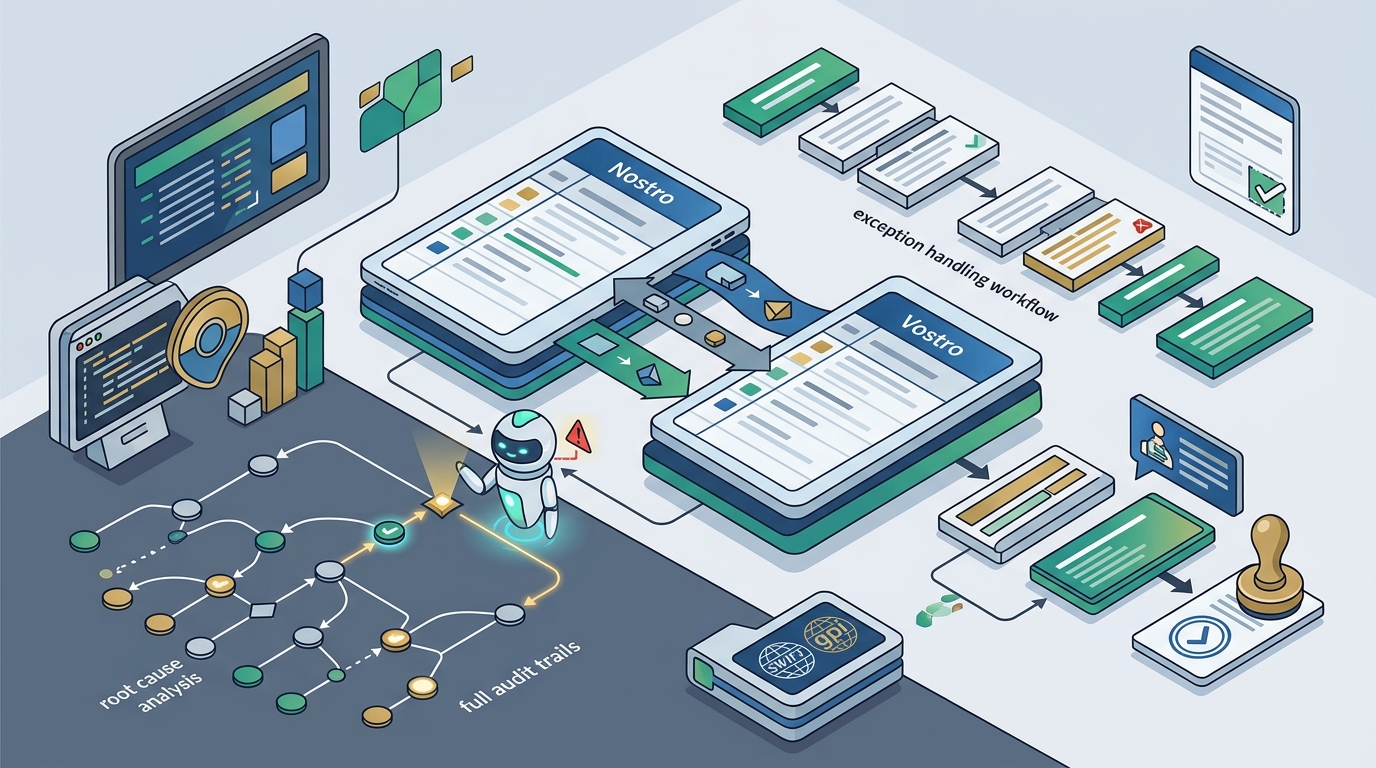
Good AI tools for nostro and vostro account reconciliation are agentic systems that investigate discrepancies, trace root causes, and propose resolutions with full audit trails. This guide covers the core components of modern reconciliation platforms, the specific tools required for correspondent banking, and the exception handling workflows that separate effective automation from simple matching engines.
Nostro/Vostro Reconciliation Platforms
Nostro and vostro reconciliation is the process of verifying that balances held in correspondent bank accounts match the records in the internal general ledger and subledgers. In a mid-sized bank processing 50,000 transactions daily across 30 correspondent banks, even a 0.1% exception rate generates 50 breaks per day. Traditional platforms built in the 2000s handle the matching reasonably well but offer no intelligence on the investigation side. The matching engine flags a break, and a human must investigate it. At scale, this human layer becomes the primary constraint on operational efficiency.
The Limitations of Rules-Based Matching
Legacy infrastructure often relies on rigid rules-based matching. These systems are effective for straightforward transactions where the amount, date, and reference number align perfectly. However, they fail when dealing with timing differences, partial settlements, or complex multi-leg instruments. When a nostro discrepancy appears, the legacy system simply flags it. It does not explain why the difference exists. It does not check if a SWIFT confirmation is pending. It does not look for duplicate postings. The burden of investigation falls entirely on the analyst, who must manually cross-reference multiple systems.
Agentic AI as the Modern Standard
Modern reconciliation platforms are shifting toward agentic AI. An AI agent is a system that can perceive, reason, decide, and act. Unlike a chatbot or a simple copilot, an autonomous agent handles complex workflows end-to-end. In the context of nostro and vostro accounts, these agents do not just flag breaks; they investigate them. A nostro discrepancy gets traced back to its root cause, such as a pending SWIFT confirmation, a duplicate posting, or a value-date mismatch. The agent documents its reasoning and either auto-resolves the item with evidence or escalates it with a recommended action. This shift transforms the role of the finance team from performing investigations to reviewing resolutions.
Integration with Core Banking and SWIFT
Effective platforms must integrate deeply with core banking systems and SWIFT messaging networks. Payment reconciliation spans SWIFT MT and MX messages, clearing house confirmations, and core banking entries. A robust platform ingests these feeds, normalizes the data, and runs the matching automatically. It must also handle the diversity of reconciliation types running simultaneously, including nostro and vostro account balancing, intercompany positions, and securities settlement. The platform should provide a complete audit trail for every transaction match, exception, and resolution, which is timestamped, attributed, and exportable for regulatory reporting or external audit without manual reconstruction.
Nostro/Vostro Reconciliation Tools
When evaluating tools for nostro and vostro reconciliation, it is essential to distinguish between matching coverage and exception resolution. Matching creates an exception queue; an operating model must still investigate, document, escalate, and close each break. The tools you choose must support the entire lifecycle of the reconciliation process, from data ingestion to final reporting.
Data Ingestion and Normalization
The first tool in the stack is the data ingestion engine. Financial institutions operate at a scale where data arrives in various formats and schedules. A reliable tool pulls data from custodians, banks, and ledgers. It must handle high-volume feeds, such as electronic bank statements and SWIFT messages, and normalize them into a consistent format. This step is critical because discrepancies often arise from format mismatches or data quality issues in the source systems. The tool should be able to parse PDFs, EDI files, CSVs, and portal downloads, mapping them to the internal item master or account structure.
Matching and Matching Logic
The core matching tool compares transactions across systems. It uses logic to identify matches based on amount, date, reference, and other attributes. For nostro and vostro accounts, the matching logic must account for timing differences between posting and clearing. It should also handle multiple bank accounts across entities. The tool should provide a clear view of matched items, unmatched items, and items that require further investigation. It should allow for the configuration of tolerance rules, defining what auto-resolves and what requires human review.
Investigation and Resolution
This is where agentic tools differentiate themselves. The investigation tool pulls supporting documentation from both sides of the transaction. It checks settlement dates, looks for pending corporate actions, and flags genuine exceptions for human review. It traces the transaction through the system, classifies the exception, and proposes a resolution. The tool should attach the full reasoning to every action, creating an audit trail that explains why a decision was made. This is crucial for compliance and audit purposes. The tool should also support escalation paths, routing high-priority exceptions to the appropriate team or individual.
| Tool Component | Function | Key Benefit |
|---|---|---|
| Data Ingestion | Pulls and normalizes data from banks, SWIFT, and ledgers | Ensures data quality and consistency |
| Matching Engine | Compares transactions and identifies matches | Reduces manual matching effort |
| Investigation Agent | Traces root causes and proposes resolutions | Accelerates exception resolution |
| Audit Trail | Logs every action with reasoning | Supports compliance and audit |
Exception Handling Workflows
Exception handling is the most critical part of the reconciliation process. It is where the value of AI tools is most evident. A well-designed exception handling workflow ensures that every break is investigated, documented, and resolved efficiently. It also ensures that the process is auditable and compliant with regulatory requirements.
Classification of Exceptions
Not all exceptions are equal. A robust workflow classifies each exception by type. Common types include timing breaks, quantity breaks, price or valuation breaks, and duplicate postings. Each type has a different investigation path. For example, a timing break might be resolved by checking the settlement calendar and confirming pending status. A quantity break might require tracing to the source trade and verifying the corporate action schedule. The workflow should apply the appropriate investigation workflow based on the classification. It should also apply tolerance rules, auto-resolving items within tolerance and escalating those above it.
Investigation and Root Cause Analysis
The investigation step involves pulling supporting documentation and analyzing the data. The agent checks settlement dates, looks for pending corporate actions, and flags genuine exceptions for human review. It traces the transaction through the system, classifies the exception, and proposes a resolution. The agent documents its reasoning and either auto-resolves with evidence or escalates with a recommended action. This step is where the agent's ability to reason and decide is most evident. It must be able to handle complex scenarios, such as multi-leg instruments or cross-border transactions with FX implications.
Escalation and Human Review
Not every exception can be resolved automatically. Some require human judgment. The workflow should include clear escalation paths, routing high-priority exceptions to the appropriate team or individual. The human reviewer should have access to the full context, including the source data, matching attempt, failure reason, and proposed resolution. They should be able to approve, reject, or modify the proposed resolution. The workflow should track the status of each exception, from identification to resolution, and provide reporting on resolution times and rates. This ensures that the process is transparent and accountable.
Key Takeaways
- Agentic AI tools investigate discrepancies and propose resolutions, unlike rules-based engines that only flag breaks.
- Effective platforms integrate deeply with core banking systems and SWIFT messaging networks.
- A complete audit trail is essential for compliance and audit purposes.
- Exception handling workflows should classify exceptions by type and apply appropriate investigation paths.
- Human review is still required for complex exceptions, but AI reduces the time spent on initial investigation.
- Volume becomes a configuration problem rather than a headcount problem when using agentic tools.
- Regulatory pressure adds urgency to the need for accurate and documented reconciliation workflows.
Frequently Asked Questions
What is the difference between a matching engine and an AI agent in reconciliation?
A matching engine identifies transactions that agree based on predefined rules. An AI agent investigates discrepancies, traces root causes, and proposes resolutions. The agent handles the exception queue, which is where the majority of manual effort is spent.
How do AI agents handle nostro and vostro account discrepancies?
AI agents trace the discrepancy back to its root cause, such as a pending SWIFT confirmation or a duplicate posting. They document their reasoning and either auto-resolve the item with evidence or escalate it with a recommended action.
Is human oversight still required in AI-driven reconciliation?
Yes. Human oversight is required for complex exceptions and for approving proposed resolutions. The AI agent handles the initial investigation, but a named client employee reviews and approves the final entries.
What kind of audit trail do AI agents provide?
AI agents provide a complete audit trail for every action, including the source data, matching attempt, failure reason, and proposed resolution. This trail is timestamped, attributed, and exportable for regulatory reporting or external audit.
Can AI agents handle multi-currency and FX implications?
Yes. AI agents can trace variances back to rate differentials and classify realized versus unrealized FX gains and losses. They handle the complexity of multi-currency transactions and ensure that balances are reconciled correctly across different currencies.
How long does it take to implement an AI-driven reconciliation platform?
Implementation timelines vary by engagement scope, source systems, and data complexity. A typical scoping call and configuration phase can take 3 to 6 weeks, but this depends on the specific requirements of the institution.
Conclusion
Choosing the right AI tools for nostro and vostro account reconciliation is a strategic decision that impacts operational efficiency, compliance, and risk management. Agentic AI systems offer a significant advantage over traditional rules-based engines by handling the exception queue, which is where the majority of manual effort is spent. By investigating discrepancies, tracing root causes, and proposing resolutions with full audit trails, these tools transform the reconciliation process from a manual marathon into a predictable, accelerated workflow. Aetherix Systems provides these capabilities as a managed service, ensuring that your team can focus on higher-value work while the agents handle the investigation and resolution. To explore how agentic AI can transform your reconciliation operations, .