

Good AI tools for nostro and vostro reconciliation are agentic systems that investigate discrepancies rather than just flagging them. They trace breaks to root causes, propose resolutions, and maintain full audit trails. This guide covers the core platforms, essential tool capabilities, and the exception handling workflows that define modern reconciliation operations.
Nostro/Vostro Reconciliation Platforms
Nostro and vostro account reconciliation is the process of verifying that balances held in foreign currency accounts at correspondent banks match the internal general ledger records. For financial institutions, this is a critical control. A mid-sized bank running nostro reconciliation across 30 correspondent banks might process 50,000 transactions daily, where even a 0.1% exception rate generates thousands of breaks per day. Each one requires investigation to determine if it is a timing difference, a missing entry, a duplicate, or a genuine error.
Traditional platforms built in the 2000s handle matching reasonably well but offer no intelligence on the investigation side. The matching engine flags a break, and a human investigates it. At scale, that human layer becomes the constraint. Teams grow linearly with volume, costs rise, and experienced staff leave faster than they can be replaced. Modern platforms must move beyond simple matching to provide investigative capabilities.
The Limitations of Rules-Based Matching
Rules-based engines are effective for the 70-80% of transactions that agree. However, the remaining exceptions consume disproportionate analyst time and cost. These tools create an exception queue but cannot solve their own exception queue. They lack the ability to reason through complex scenarios, such as a nostro discrepancy caused by a pending SWIFT confirmation, a duplicate posting, or a value-date mismatch. The investigation bottleneck remains the primary operational challenge.
Agentic AI as the Next Paradigm
Agentic AI represents the next paradigm in enterprise software. These are not chatbots or copilots. They are fully autonomous agents that handle complex workflows end-to-end. In the context of reconciliation, these agents perceive the data, reason through the discrepancy, decide on a resolution path, and act by proposing a correction. They operate within precisely defined safety boundaries, ensuring safe and predictable behavior. This approach transforms volume from a staffing problem into a configuration problem.
Platform Selection Criteria
When evaluating a reconciliation platform, institutions should look for systems that integrate with their existing tech stack. This includes ERP systems, core banking platforms, and data warehouses. The platform must support multi-currency complexity, where transactions post in local currency and revaluation runs at period-end. It must also handle the diversity of reconciliation types running simultaneously, from daily nostro balancing to month-end intercompany eliminations. The goal is a system that delivers a clean reconciliation pack for review, where the human team approves entries rather than performing the initial investigation.
Nostro/Vostro Reconciliation Tools
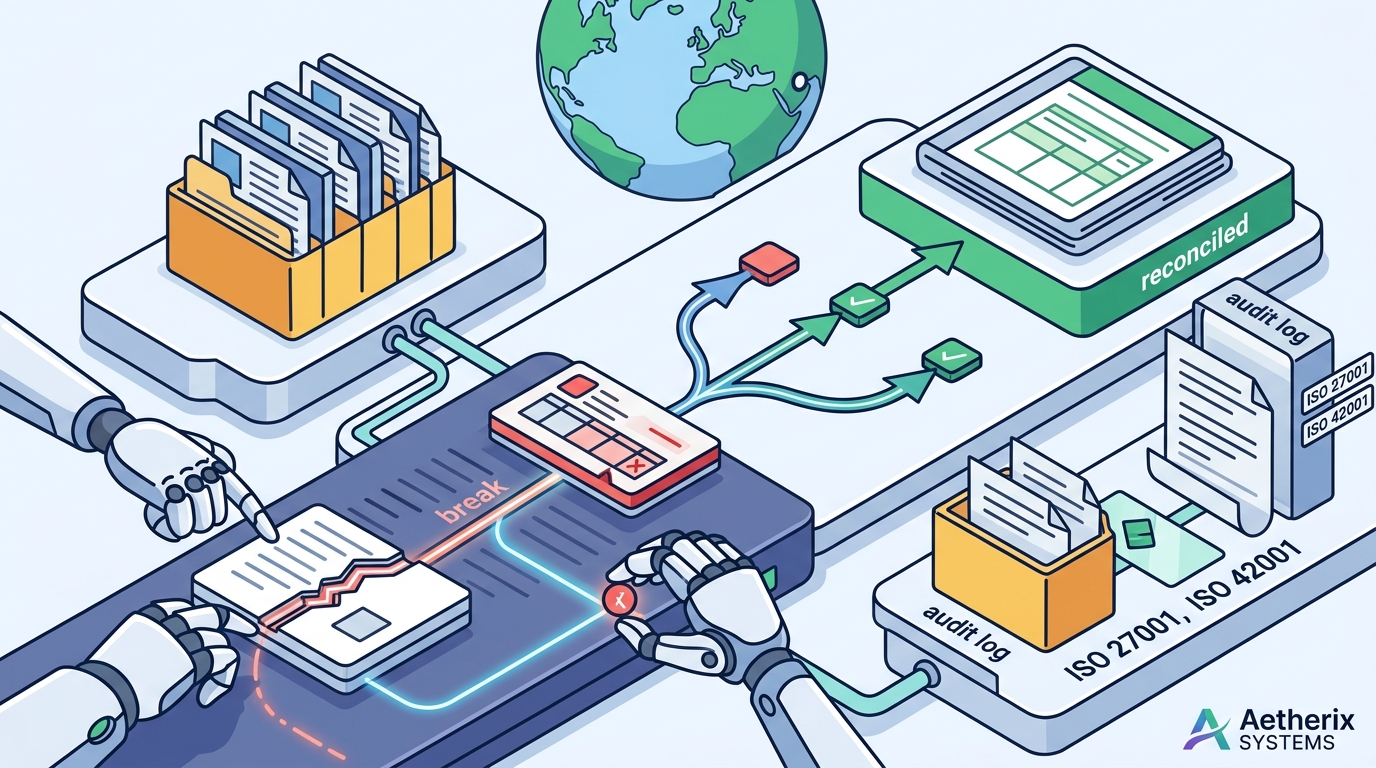
Reconciliation tools are the specific software components that execute the matching and investigation logic. While platforms provide the infrastructure, tools define the operational capability. The most effective tools for nostro and vostro accounts focus on data ingestion, normalization, and structured output. They must be able to pull data from custodians, banks, and ledgers, auto-match positions, cash, and transactions, and then investigate the breaks that remain.
Data Ingestion and Normalization
Financial institutions operate with diverse data sources. SWIFT messages, clearing house confirmations, and core banking entries all arrive in different formats. A robust tool normalizes every format into a standard structure. This is critical because line items often do not match the internal item master or account codes. The tool must map external data to internal records accurately. Without this normalization step, matching fails, and the exception queue grows with false positives.
Structured Output and API Integration
Modern tools provide structured JSON output for every reconciliation result. This includes matched items, exceptions, proposed resolutions, and reasoning traces. This allows institutions to parse, store, and route results into their own systems. API-first integration is essential. Institutions can trigger reconciliation runs, query status, retrieve results, and manage configuration via REST API. This enables event-driven triggers, where reconciliation runs are initiated by ERP batch completion or bank file receipt, rather than relying on manual schedules or polling.
Security and Compliance Features
Security is non-negotiable for financial data. Tools must support OAuth 2.0 and mTLS for API access. Webhook delivery should be verified with HMAC signatures. Multi-tenant isolation is required for platforms serving multiple clients or entities, ensuring separate configuration, data, and audit trails for each. Compliance with global data protection regulations and AI governance frameworks is also critical. Institutions should look for tools that maintain rigorous compliance with standards like SOC 2 Type II and ISO/IEC 27001, ensuring data is protected wherever it operates.
| Tool Capability | Traditional Approach | Agentic AI Approach |
|---|---|---|
| Matching Logic | Rules-based, deterministic matching | Adaptive matching with reasoning chains |
| Exception Handling | Flags break, waits for human | Investigates break, proposes resolution |
| Data Integration | Batch files, FTP, manual upload | API-first, webhook-driven, event-based |
| Audit Trail | Manual logs, email chains | Automated, timestamped, reasoning attached |
| Scalability | Linear headcount growth | Configuration-based scaling |
Exception Handling Workflows
Exception handling is where the value of AI in reconciliation is most evident. The workflow begins when a match fails. In a traditional setup, this item moves to a queue for a human analyst. In an agentic setup, the agent takes over. It researches the break, chases source documents, and proposes a resolution. The workflow is designed to be auditable, with every action logged and every decision explained.
Investigation and Root Cause Analysis
The agent pulls the transaction detail and traces it through the system. It classifies the exception based on type. For example, a timing break might be identified as a trade date versus settlement date mismatch. The agent checks the settlement calendar, confirms pending status, and auto-resolves on T+1 or T+2. A quantity break might be traced to a source trade, verifying corporate action schedules. If the issue is unresolved after a set period, it is flagged for human review. This root cause analysis is what separates a simple flagging tool from a true reconciliation agent.
Escalation and Human-in-the-Loop
Not every exception can be resolved automatically. Tolerance rules define what auto-resolves and what requires human review. Rules are configurable per account type, entity, and period. When an exception exceeds tolerance, the agent escalates it with a complete audit trail. This includes the source data, the matching attempt, the failure reason, and the proposed resolution. The human team reviews the proposed entry and approves it. This human-in-the-loop control ensures that while the agent does the work, the human stays in control. The agent proposes; the human disposes.
Workflow Orchestration
Complex enterprise processes require multiple agents working together. Orchestration layers coordinate agent teams, routing tasks, managing handoffs, and resolving conflicts. For example, an exception in a nostro account might trigger a check in the intercompany ledger. The orchestration layer ensures that the relevant agents communicate and that the end-to-end process completes. This coordination is essential for multi-entity structures where intercompany transactions need to match across entities before elimination. The workflow ensures that the consolidation doesn't work until every subsidiary is clean.
Key Takeaways
- Traditional matching engines handle the transactions that agree, but the real cost sits in the exceptions that do not.
- Agentic AI systems investigate breaks, determine root causes, and propose resolutions with full reasoning attached.
- API-first integration and structured JSON output are essential for embedding reconciliation into existing tech stacks.
- Security features like OAuth 2.0, mTLS, and multi-tenant isolation are critical for financial data protection.
- Human-in-the-loop controls ensure that agents operate within defined safety boundaries and that humans approve final entries.
- Orchestration layers coordinate multiple agents to handle complex, multi-entity reconciliation workflows.
- Volume becomes a configuration problem rather than a staffing problem when using agentic reconciliation.
- Full audit trails on every action improve compliance posture and provide evidence for regulatory inquiries.
Frequently Asked Questions
What is the main difference between a matching engine and an AI agent for reconciliation?
A matching engine identifies transactions that agree and flags those that do not. An AI agent goes further by investigating the flagged transactions, determining the root cause, and proposing a resolution. The agent attaches a full reasoning trace to its proposal, making the process auditable.
How do AI agents handle multi-currency nostro accounts?
Agents trace variances back to the rate differential and classify them as realized or unrealized. They apply the agreed exchange rate to confirm amounts match after conversion, identifying FX differences as a major source of intercompany breaks.
Can AI agents work with legacy banking systems?
Yes. Agents integrate with existing tech stacks via APIs and event-driven architectures. They can connect to ERP systems, core banking platforms, and data warehouses, pulling data from custodians, banks, and ledgers without requiring a full system migration.
What is the role of human oversight in agentic reconciliation?
Human oversight is a critical control. Agents propose resolutions, but a named client employee reviews and approves the entries. This human-in-the-loop approach ensures that while the agent does the investigative work, the human retains final authority and accountability.
How does an agent determine if an exception is a timing difference or a genuine error?
The agent checks the settlement calendar and confirms pending status for timing differences. It verifies corporate action schedules and settlement dates. If the issue is unresolved after a set period, it is flagged as a genuine error for human review.
What security standards should a reconciliation tool meet?
Tools should maintain rigorous compliance with global data protection regulations and security standards. This includes SOC 2 Type II, ISO/IEC 27001, and ISO/IEC 42001. They should also support OAuth 2.0, mTLS, and multi-tenant isolation to protect financial data.
Conclusion
Choosing the right AI tools for nostro and vostro reconciliation requires looking beyond simple matching. The most effective solutions are agentic systems that investigate breaks, propose resolutions, and maintain full audit trails. They transform the reconciliation process from a manual marathon into a predictable, accelerated workflow. By integrating with existing systems and providing structured output, these tools allow financial institutions to scale their operations without scaling their headcount linearly. Aetherix Systems builds these agentic workflows for enterprise clients, providing the investigative capability that traditional platforms lack. To explore how agentic reconciliation can fit your institution, see how we work with financial institutions.