

AI Tools for Multi-Prime Broker Reconciliation: Positions, Trades, and Cash
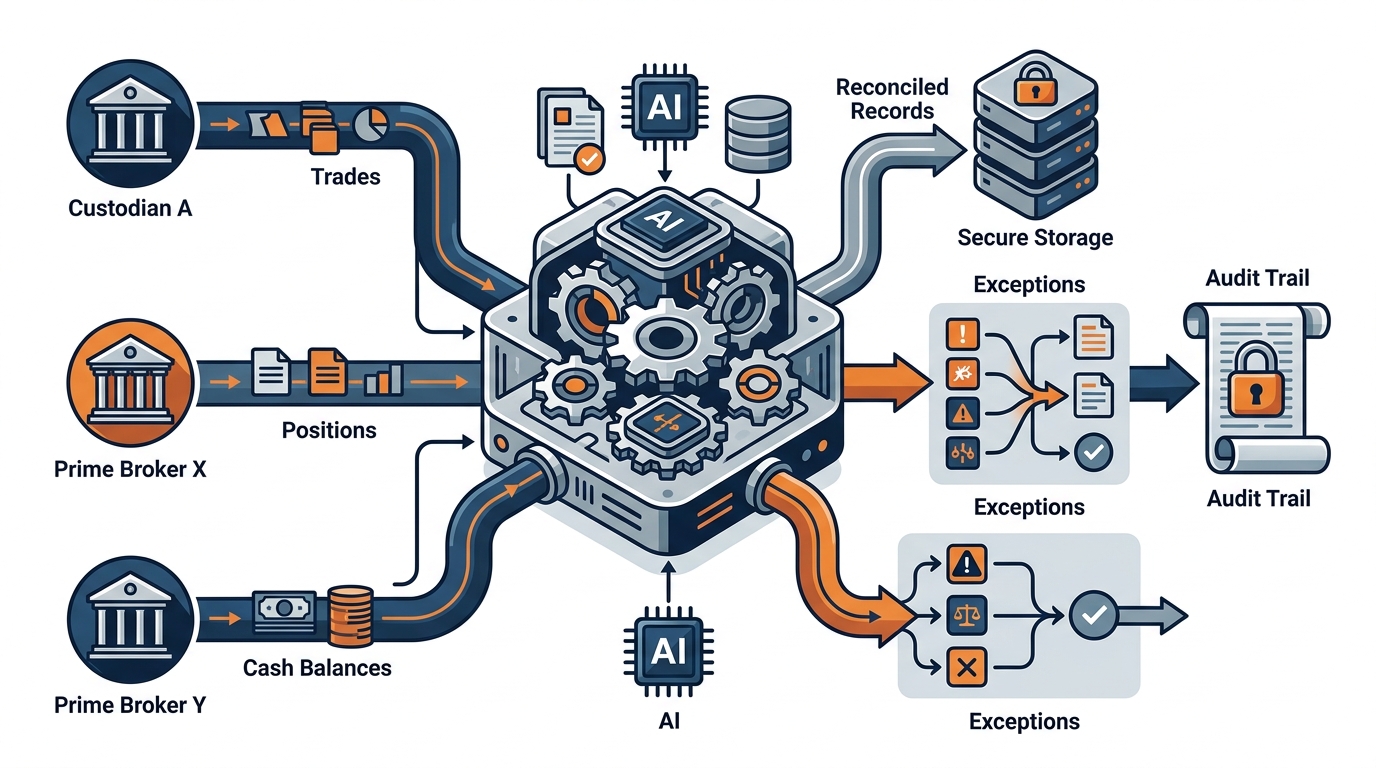
AI tools for multi-prime broker reconciliation use autonomous agents to match positions, trades, and cash across multiple custodians and prime brokers. These systems investigate discrepancies, propose resolutions, and maintain a full audit trail. This guide covers the core matching workflows, exception handling, and integration strategies for institutional finance teams.
Trade, Position, and Cash Matching Workflows
Investment reconciliation is the control process used to prove that an investment manager's positions, trades, cash, and valuations agree with the records held by custodians and prime brokers. In a multi-prime broker environment, the same process must account for short positions, margin, collateral, financing, derivatives, and different valuation sources. This makes source ownership, cutoff, instrument identity, and exception evidence as important as the arithmetic difference.
Position Reconciliation
Position reconciliation compares the securities positions held at a custodian or prime broker against the positions recorded in an investment book of record. The goal is to prove quantity, instrument, account, and long/short direction. Common break causes include corporate actions, settlement timing differences (T+1/T+2), and discrepancies between trade-date and settlement-date accounting. AI agents ingest feeds from every source, normalize the data, and run the matching automatically. When a break surfaces, the agent investigates by checking settlement dates, looking for pending corporate actions, and flagging genuine exceptions for human review.
Trade Reconciliation
Trade reconciliation matches executed trades against confirmations from brokers and custodians to ensure every transaction is accurately recorded. The process identifies missing, duplicated, misbooked, or unsettled trades. High trade volumes, partial fills, cancellations/amendments, and multi-leg instrument structures create significant complexity. Agents pull the transaction detail, trace it through the system, classify the exception, and propose a resolution. Your team reviews the proposed entry and approves it, ensuring the subsidiary or fund closes clean.
Cash Reconciliation
Cash reconciliation is the process of comparing cash balances reported by a custodian or bank against the cash balances recorded in an internal accounting system. This covers trade settlements, income receipts, margin movements, and multi-currency complexity. The agent reconciles internal cash ledgers against bank, custodian, and prime-broker balances and movements. It proves available cash, margin movements, income, fees, and settlement activity. Timing differences, missed dividends, and unrecorded fees are common exceptions that agents investigate and resolve.
Exception Investigation and Resolution
Most reconciliation tools auto-match the straightforward items. That part is solved. The real cost sits in the exceptions. The positions that do not match, the trades that settled differently than expected, and the fees that do not tie back to the contract require investigation. For family offices and funds managing portfolios across multiple custodians, asset classes, and legal structures, these breaks multiply. Each one requires pulling statements, checking corporate actions, verifying settlement dates, and documenting the resolution. This is where staff time accumulates and where errors compound.
Break Categories
Not all breaks are equal. Agents classify each exception by type and apply the appropriate investigation workflow. Timing breaks involve trade date vs. settlement date mismatches, pending corporate actions, and dividend accrual differences. The agent checks the settlement calendar, confirms pending status, and auto-resolves on T+1/T+2. Quantity breaks involve lot-level mismatches, partial fills, stock splits not yet reflected, and transfer-in-kind lag. The agent traces to the source trade, verifies the corporate action schedule, and flags if unresolved after 3 business days. Price/valuation breaks involve stale NAVs on alternatives, FX rate discrepancies, and mark-to-model differences.
Resolution Workflows
Agents investigate breaks, determine root causes, and resolve discrepancies with a full audit trail on every action. The result is a clean reconciliation delivered on your schedule, not a dashboard you need to work through. Agents pull supporting documentation from both sides, apply your tolerance rules, and either resolve the item or escalate it with a complete audit trail. This approach transforms the month-end close from a fire drill into a predictable, accelerated process. Teams review resolutions rather than performing investigations, which means fewer people doing higher-value work.
Integration Architecture and Data Flow
Reconciliation automation aims to reduce the manual effort in this process. At its simplest, this means software that matches transactions automatically. At its most advanced, it means AI agents that not only match but investigate discrepancies, propose corrections, and learn from historical resolutions. Teams comparing an automated reconciliation tool should separate matching coverage from exception resolution. Matching creates an exception queue; an operating model must still investigate, document, escalate, and close each break.
API-First Integration
For engineering teams building a fintech platform, a fund admin system, or an internal ops tool, reconciliation is a capability, not a separate product. We give you APIs, webhooks, and structured output. We handle the reconciliation logic, including matching, investigation, and resolution. You handle the integration, including triggering runs, consuming results, and routing exceptions. Webhook-driven architecture pushes reconciliation results to your systems via webhooks. You define the endpoint, the payload schema, and the retry policy. No polling, no batch files, no FTP.
Structured Output and Security
Every reconciliation result is a typed JSON payload, including matched items, exceptions, proposed resolutions, and reasoning traces. Parse it, store it, route it, using your code and your rules. API access is secured with OAuth 2.0 client credentials. Webhook delivery is verified with HMAC signatures. mTLS is available for environments that require it. Event-driven triggers allow reconciliation runs to be triggered by your events, such as ERP batch complete, bank file received, or period close initiated. Integrate with your existing orchestration, such as Airflow, Prefect, or Step Functions.
Audit, Compliance, and Governance
Every enterprise has thousands of repetitive, rule-based, and judgment-intensive tasks that consume human capital. We build AI agents that take over these tasks with enterprise-grade reliability, freeing teams to focus on strategy, creativity, and growth. Every agent operates within precisely defined safety boundaries. We implement human-in-the-loop controls, full audit trails, role-based access, data residency compliance, and SOC 2 aligned security practices.
Audit Trail and Evidence
Every transaction match, exception, and resolution is logged with a complete audit trail, timestamped, attributed, and exportable for regulatory reporting or external audit without manual reconstruction. Reconciliation completion certificates and exception resolution logs are attached to the client record. Available for client review, regulatory inquiry, or internal audit. This ensures that your compliance posture improves without additional effort. Regulators and auditors see a clean chain of evidence rather than a folder of emails and annotated spreadsheets.
Multi-Jurisdictional Compliance
Aetherix Systems maintains rigorous compliance with global data protection regulations, AI governance frameworks, and security standards. Our multi-jurisdictional approach ensures your data is protected wherever you operate. We support GDPR, UAE PDPL, EU AI-ACT, HIPAA, CCPA, SOC 2 Type II, ISO/IEC 27001:2022, and ISO/IEC 42001:2023. Data residency is available in three regions, ensuring that sensitive financial data remains within the required jurisdiction. This is critical for institutions operating across the GCC, Europe, and the United States.
Key Takeaways
- AI agents investigate every break, propose a resolution, and attach the full reasoning, ensuring your close comes back clean and every action is auditable.
- Position, trade, and cash reconciliation must account for source ownership, cutoff, instrument identity, and exception evidence, not just arithmetic differences.
- Exception investigation is the primary cost driver in manual reconciliation; AI agents compress the close cycle by resolving breaks in parallel.
- API-first integration with webhooks and structured JSON output allows engineering teams to embed reconciliation into their existing orchestration.
- Full audit trails with timestamped, attributed, and exportable logs support regulatory reporting and external audit without manual reconstruction.
- Multi-jurisdictional data residency and compliance with GDPR, UAE PDPL, and SOC 2 Type II ensure data protection across global operations.
- Human-in-the-loop controls and role-based access ensure that agents operate within defined safety boundaries and that client employees approve journal entries.
Frequently Asked Questions
What is the difference between matching and exception resolution in reconciliation?
Matching creates an exception queue by identifying discrepancies between records. Exception resolution involves investigating each break, determining the root cause, and proposing a correction. AI agents handle both, but the investigation phase is where the significant time and cost savings occur.
How do AI agents handle multi-currency reconciliation?
Agents apply the agreed exchange rate to confirm amounts match after conversion. They trace each variance back to the rate differential and classify realised vs. unrealised FX gains and losses. This ensures that currency alignment is verified before elimination entries are proposed.
Can AI agents integrate with existing ERP systems like SAP or NetSuite?
Yes. Our agents integrate with your existing tech stack, including ERP systems (SAP, Oracle), CRM platforms (Salesforce, HubSpot), data warehouses (Snowflake, BigQuery), and custom internal tools via APIs and event-driven architectures. For SAP, we support S/4HANA, ECC 6.0, and Business One. For NetSuite, we connect via SuiteScript RESTlets or SuiteAnalytics Connect.
What is the role of human oversight in AI-driven reconciliation?
Human oversight is critical. Agents propose journal entries and resolutions, but a named client employee reviews and approves them. We implement human-in-the-loop controls, role-based access, and escalation paths to ensure that agents operate within defined safety boundaries and that final decisions rest with your team.
How is data security maintained in multi-prime broker reconciliation?
Data security is maintained through OAuth 2.0 client credentials, HMAC signature verification for webhooks, and mTLS for environments that require it. Data residency is available in three regions, ensuring that sensitive financial data remains within the required jurisdiction. We maintain rigorous compliance with global data protection regulations and AI governance frameworks.
What types of exceptions do AI agents investigate?
Agents investigate timing breaks, quantity breaks, price/valuation breaks, duplicate invoices, credit memo mismatches, and GL coding errors. Each exception type has a different investigation path. Agents know which documents to pull, which thresholds apply, and when to escalate.
How long does it take to deploy AI reconciliation agents?
From scoping call to production, deployment typically takes 3 to 6 weeks. No multi-year contracts are required. You pay for reconciliation outcomes, not software seats. The process involves mapping your systems, data sources, exception types, and close calendar, followed by configuration and live operations.
Conclusion
AI tools for multi-prime broker reconciliation transform the financial close from a manual marathon into a predictable, accelerated process. By automating the investigation of positions, trades, and cash discrepancies, these systems free your team to focus on higher-value analysis and strategy. Aetherix Systems provides the infrastructure for this transformation, offering API-first integration, full audit trails, and multi-jurisdictional compliance. To plan your visit, to discuss how our agents can handle your reconciliation operations.