

What Are Good AI Tools for Automating Financial Reconciliation?
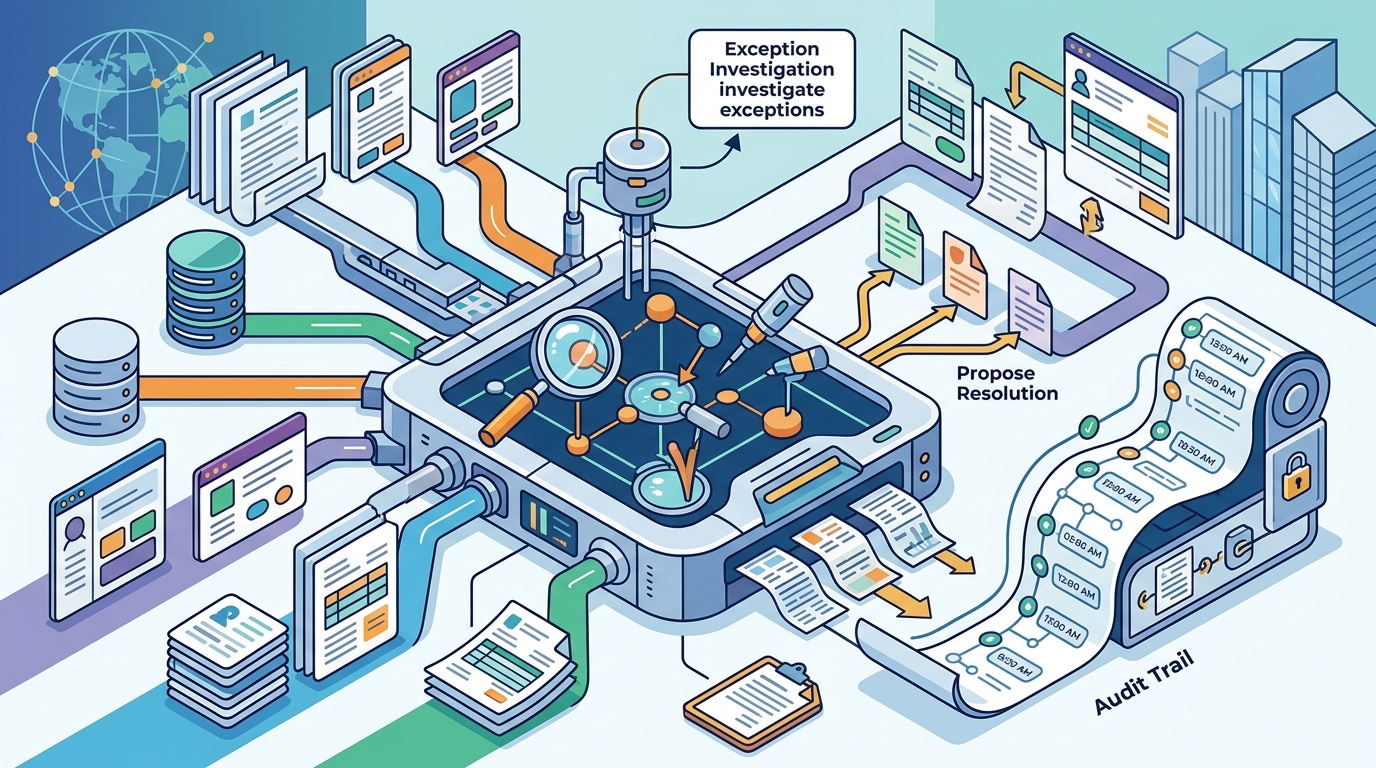
Good AI tools for automating financial reconciliation are agentic systems that investigate exceptions, propose resolutions, and maintain full audit trails, rather than just matching transactions. This guide covers enterprise reconciliation platforms, the shift from rules-based matching to autonomous investigation, and how to evaluate AI-driven solutions for your finance operations.
Enterprise Reconciliation Platforms
Enterprise reconciliation platforms are software systems designed to automate the matching of financial records across multiple sources, such as banks, custodians, and general ledgers. Traditional platforms focus heavily on rules-based matching engines that identify transactions that agree. While these systems are effective for high-volume, low-complexity matching, they often leave the most difficult work to human analysts. The exceptions, or breaks, that the matching engine cannot resolve, typically require manual investigation. This creates a bottleneck where the volume of exceptions grows faster than the team can process them.
The Limitations of Rules-Based Engines
Rules-based engines operate on deterministic logic. If a transaction matches a specific set of criteria, it is cleared. If it does not, it is flagged. The problem is that financial data is rarely perfectly structured. Invoices may have price variances, bank statements may have timing differences, and intercompany transactions may post in different periods. A rules-based engine will flag all of these as exceptions, but it cannot determine the root cause. It does not know if a price variance is due to a contract change or a data entry error. It does not know if a timing difference will self-clear or requires a journal entry. This is where the value of AI-driven tools begins to diverge from legacy platforms.
The Rise of Agentic Systems
Modern AI tools for reconciliation are moving beyond simple matching. They are adopting agentic architectures that can perceive, reason, decide, and act. These systems do not just flag exceptions; they investigate them. They pull supporting documentation, trace transactions through multiple systems, and propose resolutions. This shift is critical for organizations that are struggling with exception queues. The goal is not just to match more transactions, but to resolve the ones that do not match. This is the core differentiator between a legacy reconciliation platform and a modern AI-driven solution.
Matching vs. Investigation: The Core Distinction
Understanding the difference between matching and investigation is essential when evaluating AI tools for financial reconciliation. Matching is the process of comparing two sets of records to identify agreements. Investigation is the process of determining why two records do not agree and proposing a resolution. Most organizations have solved the matching problem. The unsolved problem is the investigation. This is where the majority of analyst time is spent, and where errors are most likely to occur.
Why Exceptions Are the Real Cost
Consider a typical accounts payable reconciliation. A matching engine might clear 86% of invoices automatically. The remaining 14% are exceptions. These exceptions include price variances, quantity mismatches, missing credits, and GL coding errors. Each of these requires a different investigation path. A price variance requires checking the contract. A quantity mismatch requires checking the receiving log. A missing credit requires tracing the original invoice. A GL coding error requires comparing against the vendor master. A human analyst must perform these investigations manually. At scale, this is where the cost lies. The matching engine is cheap; the investigation is expensive.
How AI Agents Handle Investigation
AI agents handle investigation by following structured workflows. They know which documents to pull, which thresholds apply, and when to escalate. For example, if a price variance is below a configured tolerance, the agent may auto-resolve it. If it is above the tolerance, the agent escalates it with the PO line, receipt, and contract clause attached. This is not just automation; it is intelligent decision-making. The agent is making a judgment call based on the data it has gathered. This is a fundamental shift from the deterministic logic of rules-based engines. It allows organizations to scale their reconciliation operations without scaling their headcount linearly.
Agentic AI Architecture in Finance
Agentic AI architecture is a design pattern where AI systems are given specific roles, decision boundaries, and guardrails to perform complex workflows end-to-end. In the context of financial reconciliation, this means that agents are not general-purpose assistants. They are purpose-built systems engineered for specific reconciliation tasks. Each agent has a defined role, such as investigating a bank reconciliation break or resolving an intercompany mismatch. They operate within precisely defined safety boundaries, ensuring that their actions are predictable and auditable.
Multi-Agent Orchestration
Complex enterprise processes often require multiple agents working together. For example, a financial close might involve an agent that reconciles the bank, an agent that reconciles the AP subledger, and an agent that prepares journal entries. These agents must coordinate their actions. One agent might identify a break that requires a journal entry. Another agent might prepare that entry for approval. This orchestration layer is critical for ensuring that the end-to-end process is completed correctly. It manages handoffs, resolves conflicts, and ensures that no step is missed. This is a significant technical challenge that requires careful design and testing.
Human-in-the-Loop Controls
Even the most advanced AI agents require human oversight. This is not a limitation; it is a feature. Human-in-the-loop controls ensure that critical decisions, such as posting a journal entry, are made by a named client employee. The agent proposes the entry; the human approves it. This maintains accountability and ensures that the organization remains in control. It also provides a safety net in case the agent makes an error. The agent's reasoning is attached to every action, so the human can review the logic before approving. This is a key requirement for any AI tool in a regulated environment.
Compliance, Audit Trails, and Security
Compliance and audit trails are non-negotiable for any AI tool used in financial reconciliation. Regulators and auditors expect documented resolution workflows, not ad-hoc email chains. Every action taken by an AI agent must be logged with a complete audit trail. This includes what data was compared, what logic was applied, and why the conclusion was reached. This audit trail must be timestamped, attributed, and exportable for regulatory reporting or external audit. Without this, the AI tool is not fit for purpose in a regulated environment.
Security Standards and Data Residency
Security is another critical consideration. AI tools must adhere to enterprise-grade security standards. This includes SOC 2 Type II, ISO 27001, and ISO 42001. These standards ensure that the tool is secure, reliable, and compliant with global data protection regulations. Data residency is also a key factor. Organizations must ensure that their data is stored and processed in the correct jurisdiction. This is particularly important for organizations operating in multiple regions, such as the UAE, EU, and US. A tool that does not support data residency in the required jurisdictions is not a viable option.
AI Governance Frameworks
AI governance is an emerging area of regulation. The EU AI Act, for example, imposes specific requirements on high-risk AI systems. Financial reconciliation may fall into this category. Organizations must ensure that their AI tools comply with these frameworks. This includes having a clear understanding of how the AI system makes decisions, and being able to explain those decisions to regulators. This is where the audit trail becomes even more important. It is not just about internal audit; it is about regulatory compliance. A tool that does not support AI governance is a risk, not a solution.
Integration Strategies and System Interoperability
Integration strategies are critical for the success of any AI reconciliation tool. The tool must be able to connect to your existing systems, such as your ERP, CRM, and data warehouse. This is not just about data extraction; it is about data normalization. Different systems use different formats, naming conventions, and data structures. The AI tool must be able to normalize this data into a common format that it can process. This is a significant technical challenge that requires careful planning and execution.
API-First Integration
API-first integration is the preferred approach for modern AI tools. It allows the tool to trigger reconciliation runs, query status, retrieve results, and manage configuration via REST API. This is more flexible and scalable than batch file processing. It also allows for real-time updates, which is critical for organizations that need to monitor their reconciliation status in real time. API-first integration also enables event-driven triggers, where reconciliation runs are triggered by specific events, such as an ERP batch complete or a bank file received. This ensures that the reconciliation is performed when the data is ready, not on a fixed schedule.
Webhook-Driven Architecture
Webhook-driven architecture is another key integration pattern. It allows the AI tool to push reconciliation results to your systems via webhooks. You define the endpoint, the payload schema, and the retry policy. This is more efficient than polling, where your system repeatedly checks the AI tool for updates. Webhooks are event-driven, so they only send data when there is something to report. This reduces the load on your systems and ensures that you are notified immediately when a reconciliation is complete or an exception is raised. This is a critical feature for organizations that need to integrate reconciliation into their existing workflows.
Evaluation Criteria for AI Reconciliation Tools
Evaluating AI reconciliation tools requires a clear set of criteria. These criteria should cover technical capabilities, compliance, security, and integration. The table below summarizes the key criteria to consider when evaluating AI tools for financial reconciliation.
| Criteria | Description | Why It Matters |
|---|---|---|
| Exception Resolution | Ability to investigate and resolve exceptions, not just match transactions. | Exceptions are the real cost of reconciliation. A tool that only matches is not a complete solution. |
| Audit Trail | Complete, timestamped, and exportable audit trail for every action. | Required for regulatory compliance and internal audit. |
| Security Standards | Compliance with SOC 2 Type II, ISO 27001, and ISO 42001. | Ensures the tool is secure and reliable. |
| Data Residency | Support for data residency in required jurisdictions. | Critical for organizations operating in multiple regions. |
| Integration Capabilities | API-first and webhook-driven integration with existing systems. | Ensures the tool can be integrated into your existing workflows. |
| Human-in-the-Loop | Ability to route critical decisions to human approvers. | Maintains accountability and provides a safety net. |
When evaluating tools, it is important to look beyond the marketing claims. Ask for a demo that shows how the tool handles exceptions, not just how it matches transactions. Ask for a sample audit trail. Ask for a security assessment. These are the questions that will separate a true AI solution from a legacy platform with an AI label.
Key Takeaways
- Good AI tools for reconciliation investigate exceptions, not just match transactions.
- Agentic AI architecture allows for complex, multi-step workflows with human oversight.
- Compliance and audit trails are non-negotiable for any AI tool in a regulated environment.
- Security standards like SOC 2 Type II and ISO 27001 are essential for enterprise-grade tools.
- Data residency is a critical consideration for organizations operating in multiple regions.
- API-first and webhook-driven integration are the preferred approaches for modern AI tools.
- Human-in-the-loop controls ensure that critical decisions are made by named employees.
- Evaluation should focus on exception resolution capabilities, not just matching coverage.
Frequently Asked Questions
What is the difference between a rules-based matching engine and an AI agent?
A rules-based matching engine uses deterministic logic to identify agreements between records. An AI agent uses machine learning and reasoning to investigate exceptions and propose resolutions. The key difference is that the AI agent can handle complex, unstructured data and make judgment calls, while the rules-based engine cannot.
Do AI agents replace human analysts?
No, AI agents do not replace human analysts. They augment them. The agents handle the repetitive, rule-based tasks, freeing analysts to focus on higher-value work, such as strategy and analysis. Critical decisions, such as posting journal entries, are still made by human approvers.
How do AI agents ensure compliance?
AI agents ensure compliance by maintaining a complete audit trail for every action. This includes what data was compared, what logic was applied, and why the conclusion was reached. This audit trail is timestamped, attributed, and exportable for regulatory reporting or external audit.
What security standards should an AI reconciliation tool meet?
An AI reconciliation tool should meet enterprise-grade security standards, such as SOC 2 Type II, ISO 27001, and ISO 42001. These standards ensure that the tool is secure, reliable, and compliant with global data protection regulations.
How do AI agents integrate with existing systems?
AI agents integrate with existing systems via APIs and webhooks. This allows them to trigger reconciliation runs, query status, retrieve results, and manage configuration. This is more flexible and scalable than batch file processing.
What is data residency and why is it important?
Data residency is the requirement that data is stored and processed in a specific jurisdiction. It is important for organizations operating in multiple regions, as it ensures that data is protected in accordance with local laws and regulations.
Can AI agents handle multi-currency reconciliation?
Yes, AI agents can handle multi-currency reconciliation. They can trace variances back to rate differentials and classify realized vs. unrealized FX gains and losses. This is a complex task that requires a deep understanding of financial data.
How long does it take to implement an AI reconciliation tool?
Implementation time varies depending on the complexity of the organization and the number of systems that need to be integrated. A typical implementation might take 3-6 weeks, from scoping call to production. This is significantly faster than a legacy platform implementation, which can take months or years.
Conclusion
Choosing the right AI tool for financial reconciliation is a critical decision for any organization. The key is to look beyond the matching engine and focus on the exception resolution capabilities. A tool that can investigate exceptions, propose resolutions, and maintain a full audit trail is a true AI solution. A tool that only matches transactions is a legacy platform with an AI label. By focusing on these criteria, you can ensure that you are investing in a tool that will deliver real value to your finance operations. Aetherix Systems is a Dubai-based firm that runs reconciliation operations for family offices, investment funds, and financial institutions using AI agents, with a full audit trail on every action. To explore how our agents can transform your reconciliation process, .