

Good AI tools for automating financial reconciliation are systems that move beyond simple rule-based matching to actively investigate, classify, and resolve discrepancies. These platforms use agentic workflows to handle the complex exception queues that traditional software leaves behind. This guide covers the core capabilities, integration requirements, and operational models you need to evaluate when selecting an AI reconciliation partner for your finance team.
Enterprise Reconciliation Platforms
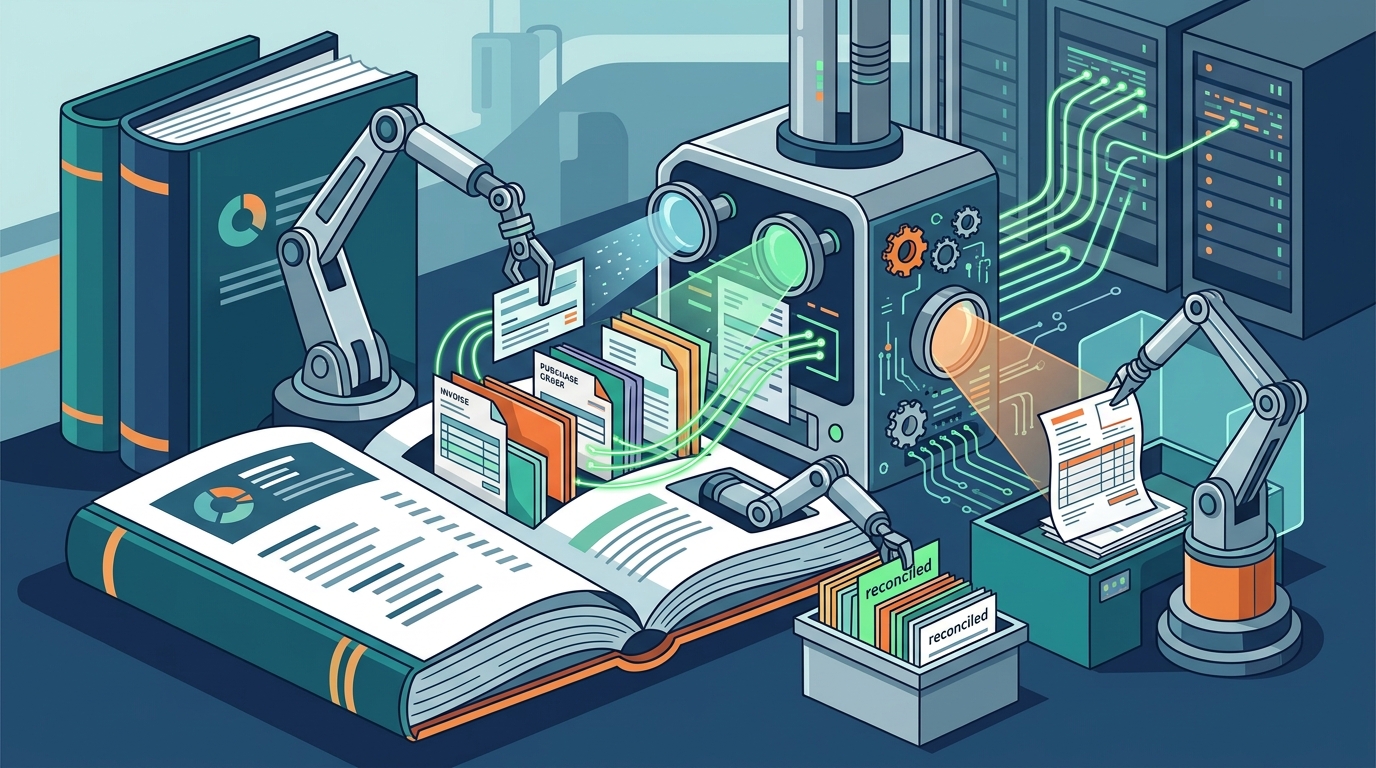
When evaluating AI tools for financial reconciliation, it is critical to distinguish between software that matches data and software that resolves it. Traditional reconciliation platforms are built on deterministic rules. They compare two data sets, flag items that do not match, and then stop. The resulting exception queue is often the most labor-intensive part of the close process. Modern AI reconciliation platforms, however, are designed to handle the investigation phase. They do not just flag a break; they pull supporting documentation, trace the transaction through the system, and propose a resolution with a full reasoning trail.
The Shift from Matching to Investigation
The primary value of AI in this space is the automation of judgment-intensive tasks. In a typical environment, a large percentage of invoices or transactions reconcile themselves automatically. The remaining exceptions require human intervention. An AI agent can ingest data from multiple sources, such as ERP systems, bank statements, and custodian feeds. It then applies logic to determine the root cause of a discrepancy. For example, if a bank balance does not match the general ledger, the agent can identify whether the difference is due to a timing issue, a missing entry, or a genuine error. This capability transforms the reconciliation process from a manual marathon into a managed service where human teams review proposed resolutions rather than performing the initial investigation.
Integration and Data Connectivity
A robust AI reconciliation tool must integrate seamlessly with your existing technology stack. This includes Enterprise Resource Planning (ERP) systems, data warehouses, and specialized financial platforms. The tool should be able to pull data via APIs, webhooks, or direct database connections. It is also important to consider how the tool handles data normalization. Different systems use different formats, naming conventions, and data structures. An effective AI platform normalizes this data before running matching logic, ensuring that the comparison is accurate. Furthermore, the platform should support event-driven triggers, allowing reconciliation runs to start automatically when specific events occur, such as the completion of an ERP batch or the receipt of a bank file.
Security, Compliance, and Audit Trails
Financial data is sensitive, and any AI tool handling it must meet strict security and compliance standards. Look for platforms that operate within defined safety boundaries and provide a complete audit trail for every action. This means that every match, exception, and resolution is logged with context, including the data compared, the logic applied, and the reasoning for the conclusion. This audit trail is essential for regulatory reporting and external audits. Additionally, the platform should support role-based access control and data residency requirements, ensuring that your data is protected and stored in compliance with local and international regulations.
Key Takeaways
- Investigation is the key differentiator: The best AI tools do not just flag exceptions; they investigate root causes and propose resolutions.
- Auditability is non-negotiable: Every action taken by the AI must be logged with a full reasoning trail to support compliance and audit requirements.
- Integration depth matters: The tool must connect natively with your ERP, data warehouse, and other financial systems to ensure data accuracy.
- Human-in-the-loop is essential: AI should propose actions, but human oversight is required for final approval and posting of journal entries.
- Security standards are critical: Ensure the platform adheres to recognized security frameworks and supports data residency requirements.
- Scalability is a must: The platform should handle increasing volumes of transactions without a linear increase in headcount or cost.
Frequently Asked Questions
What is the difference between RPA and AI agents in reconciliation?
RPA (Robotic Process Automation) automates repetitive, rule-based tasks, such as data entry or simple matching. AI agents, on the other hand, can handle complex, judgment-intensive tasks, such as investigating discrepancies and proposing resolutions. While RPA can automate the matching phase, it cannot solve the exception queue. AI agents complete the automation by handling the investigation and resolution phases.
How do AI agents handle multi-currency reconciliation?
AI agents can handle multi-currency reconciliation by applying agreed exchange rates to confirm that amounts match after conversion. They can trace variances back to rate differentials and classify them as realized or unrealized gains and losses. This ensures that FX differences are accurately accounted for and do not create false exceptions.
Can AI tools integrate with legacy ERP systems?
Yes, many AI reconciliation tools can integrate with legacy ERP systems. They often use APIs, direct database connections, or middleware to pull data from older systems. The key is to ensure that the tool can normalize the data from these legacy systems before running matching logic.
What is the role of human oversight in AI reconciliation?
Human oversight is critical in AI reconciliation. While AI agents can investigate exceptions and propose resolutions, a named human employee must review and approve these actions before they are posted to the general ledger. This human-in-the-loop approach ensures that the AI operates within defined safety boundaries and that final decisions are made by accountable individuals.
How long does it take to implement an AI reconciliation tool?
Implementation timelines vary depending on the complexity of the environment and the number of systems involved. A typical implementation might take 3 to 6 weeks, from scoping to production. This includes mapping systems, configuring matching rules, and testing the AI agents against historical data.
What are the security requirements for AI reconciliation tools?
AI reconciliation tools must meet strict security requirements, including encryption of data in transit and at rest, role-based access control, and a complete audit trail. They should also support data residency requirements and adhere to recognized security frameworks, such as SOC 2 and ISO 27001.
Conclusion
Selecting the right AI tool for financial reconciliation requires a focus on investigation capabilities, integration depth, and security. The goal is not just to automate the matching process but to resolve the exceptions that hold your close open. By choosing a platform that provides a full audit trail and supports human-in-the-loop controls, you can transform your reconciliation process into a predictable, accelerated workflow. Aetherix Systems offers AI-driven reconciliation services that handle the exception queue, providing a clean close with full auditability. To explore how AI agents can streamline your financial operations, see how we work.