

AI Tools for NAV Production: Matching Investor Records and Fund Accounting
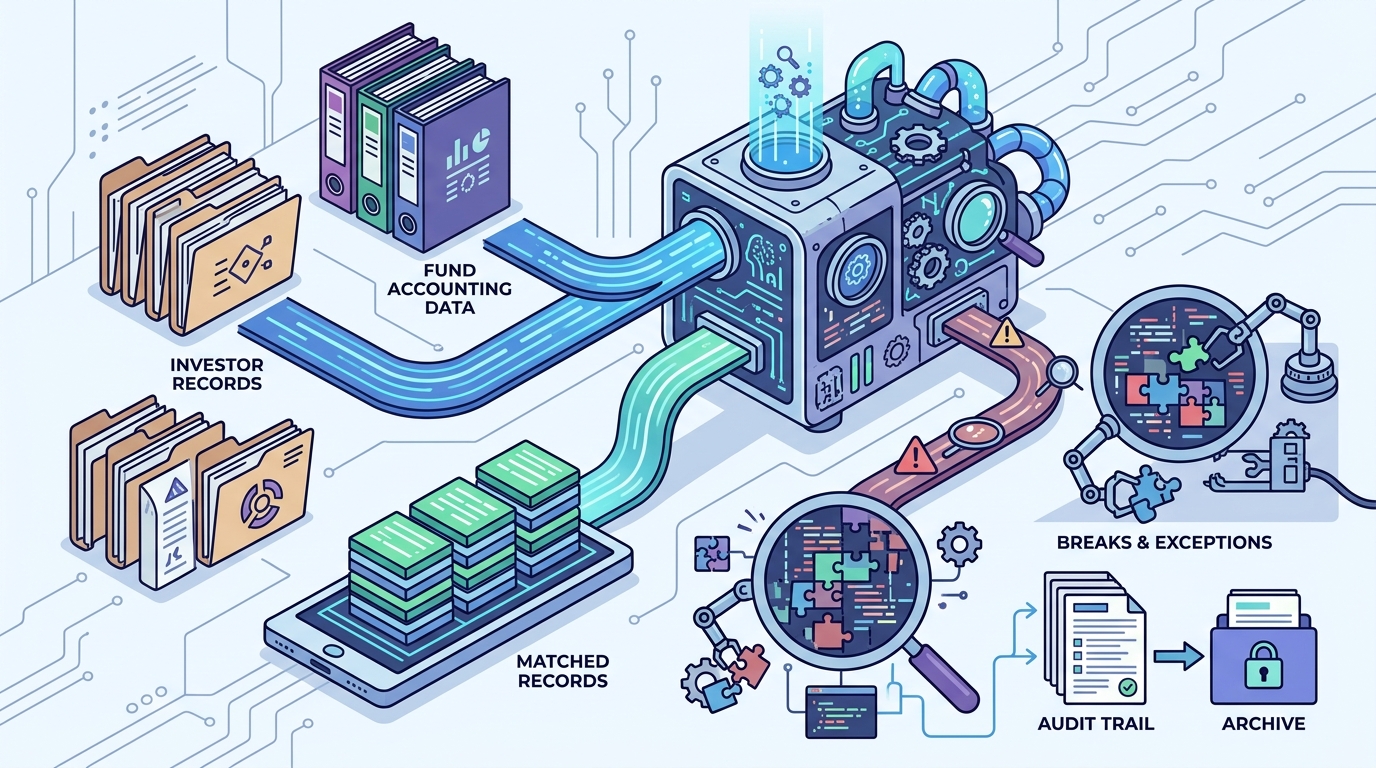
AI tools help NAV production teams match investor records and fund accounting data by automating the investigation of discrepancies that traditional matching engines cannot resolve. These systems ingest data from custodians, administrators, and internal ledgers, then apply reasoning to identify root causes of breaks. This guide covers the core components of modern NAV reconciliation, including platform capabilities, automated break detection, and audit trail documentation.
NAV Reconciliation Platforms
NAV reconciliation is the control process used to prove that an investment manager's positions, trades, cash, and valuations agree with the records held by custodians and fund administrators. It is not a single balance comparison but a connected set of reconciliations that supports accurate books and reliable exposure data. In a hedge-fund environment, the process must account for short positions, margin, collateral, financing, derivatives, and multiple prime brokers. This makes source ownership, cutoff, and instrument identity as important as the arithmetic difference.
The Limitations of Rules-Based Matching
Traditional reconciliation platforms rely on rules-based matching engines. These systems are effective at identifying transactions that agree based on predefined criteria, such as matching trade dates, amounts, and instrument identifiers. However, they lack the cognitive ability to investigate why a transaction does not match. When a break occurs, the platform flags it and places it in an exception queue. The human analyst must then manually investigate the discrepancy, a process that is slow, error-prone, and difficult to scale.
Agentic AI in NAV Production
Modern AI tools introduce agentic capabilities to the reconciliation workflow. An AI agent is a system that can perceive, reason, decide, and act within defined boundaries. In the context of NAV production, these agents do not just flag breaks; they investigate them. They pull supporting documentation, trace transactions through the system, and propose resolutions. This shifts the human role from data wrangling to high-value review and approval. Aetherix Systems builds these autonomous agents for enterprise finance, ensuring that the investigation process is both fast and auditable.
Integration with Existing Stacks
Effective NAV reconciliation platforms must integrate seamlessly with existing technology stacks. This includes ERP systems like SAP and NetSuite, as well as portfolio management systems and custodian feeds. The platform should support API-first integration, allowing for event-driven triggers and structured data output. For engineering teams, this means the ability to consume reconciliation results via webhooks or REST APIs, enabling the embedding of reconciliation logic into custom workflows without relying on a standalone user interface.
Automated Break Detection
Automated break detection is the mechanism by which a reconciliation system identifies discrepancies between two or more sets of records. In NAV production, breaks can arise from timing differences, data entry errors, corporate action failures, or valuation mismatches. The goal of automated detection is to classify these breaks accurately so that the appropriate resolution workflow can be applied.
Classification of Exception Types
Not all breaks are equal. A robust AI system classifies exceptions by type to determine the investigation path. Common categories include timing breaks, quantity breaks, and price or valuation breaks. Timing breaks often involve trade date versus settlement date mismatches or pending corporate actions. Quantity breaks may result from partial fills or stock splits not yet reflected in the records. Price breaks can stem from stale NAVs on alternative assets or FX rate discrepancies. By classifying the break, the agent knows which documents to pull and which thresholds apply.
Root Cause Analysis
Once a break is identified, the AI agent performs root cause analysis. This involves tracing the transaction through the system to identify where the discrepancy originated. For example, if a cash balance does not match, the agent may check for unrecorded fees, missed dividends, or in-transit deposits. It compares the internal ledger against bank statements and custodian reports, isolating the specific line items that cause the variance. This level of detail is crucial for resolving complex breaks that would otherwise require extensive manual investigation.
Tolerance Rules and Escalation
Automated break detection must operate within defined tolerance rules. Tolerances define what auto-resolves and what requires human review. For instance, a small variance in a high-volume account might be within acceptable limits and auto-cleared, while a larger variance in a low-volume account might trigger an immediate escalation. These rules are configurable per account type, entity, and period. The agent applies these rules consistently, ensuring that no break is overlooked and that human attention is focused on material discrepancies.
Audit Trail Documentation
Audit trail documentation is the record of every action taken during the reconciliation process. In a regulated environment, this documentation is essential for demonstrating compliance and providing evidence to auditors. Traditional systems often lack a comprehensive audit trail, relying on ad-hoc email chains or annotated spreadsheets. AI-driven reconciliation systems generate a complete, timestamped, and attributed log of every decision and action.
Reasoning Traces
Every action taken by an AI agent is accompanied by a reasoning trace. This trace explains why the agent made a specific decision, such as why it matched a transaction, why it escalated a break, and what data it read. This transparency is critical for building trust in AI systems. It allows human reviewers to understand the logic behind the agent's actions and to verify that the resolution is appropriate. The reasoning trace is stored as part of the audit trail, providing a clear chain of evidence.
Compliance and Regulatory Reporting
A comprehensive audit trail supports compliance with global data protection regulations and AI governance frameworks. It ensures that data processing activities are lawful, transparent, and accountable. For financial institutions, this means that the reconciliation process can be audited without manual reconstruction. The audit trail can be exported for regulatory reporting or external audit, providing a clean chain of evidence rather than a folder of emails. This improves the compliance posture of the organization without additional effort.
Human-in-the-Loop Controls
AI agents operate within precisely defined safety boundaries, including human-in-the-loop controls. These controls ensure that critical actions, such as posting journal entries, are reviewed and approved by a named human. The agent proposes the entry, but the human posts it. This separation of duties ensures that the AI system does not take untraceable actions or bypass approval workflows. The audit trail records both the agent's proposal and the human's approval, providing a complete record of the decision-making process.
Key Takeaways
- NAV reconciliation is a connected set of reconciliations that supports accurate books and reliable exposure data.
- Traditional rules-based matching engines flag exceptions but cannot investigate them, leading to manual bottlenecks.
- Agentic AI systems investigate breaks by pulling supporting documentation and proposing resolutions.
- Automated break detection classifies exceptions by type to determine the appropriate investigation path.
- Tolerance rules define what auto-resolves and what requires human review, ensuring consistent application.
- Audit trail documentation provides a complete, timestamped, and attributed log of every action taken.
- Reasoning traces explain the logic behind AI decisions, enhancing transparency and trust.
- Human-in-the-loop controls ensure that critical actions are reviewed and approved by a named human.
Frequently Asked Questions
What is the difference between matching and investigation in reconciliation?
Matching is the process of comparing records to identify agreements and discrepancies. Investigation is the process of determining the root cause of a discrepancy and proposing a resolution. Traditional systems handle matching but not investigation, while AI agents handle both.
How do AI agents handle multi-currency reconciliation?
AI agents apply agreed exchange rates to confirm amounts match after conversion. They trace FX differences back to the rate source and posting date, classifying realised versus unrealised gains and losses.
Can AI agents post journal entries directly?
No. AI agents propose journal entries, but a named human must review and post them. This ensures that critical actions are subject to human oversight and approval.
What types of breaks do AI agents investigate?
AI agents investigate timing breaks, quantity breaks, and price or valuation breaks. They classify each exception by type and apply the appropriate investigation workflow.
How is the audit trail generated?
The audit trail is generated automatically by the AI system. Every action, including data reads, matching attempts, and resolution proposals, is logged with a timestamp and reasoning trace.
What is the role of tolerance rules in automated break detection?
Tolerance rules define the thresholds for auto-resolution and escalation. They ensure that small, immaterial variances are cleared automatically, while material discrepancies are escalated for human review.
How does Aetherix Systems integrate with existing ERP systems?
Aetherix Systems integrates with ERP systems like SAP and NetSuite via APIs and event-driven architectures. This allows for seamless data ingestion and result consumption without requiring code changes on the client side.
Conclusion
AI tools are transforming NAV production by automating the investigation of discrepancies that traditional systems cannot resolve. By leveraging agentic AI, fund accounting teams can reduce manual effort, improve accuracy, and enhance audit readiness. Aetherix Systems provides these capabilities as a managed service, ensuring that your reconciliation operations are run with enterprise-grade reliability and a full audit trail. To explore how AI agents can streamline your NAV production process, for a scoping call. Learn more: About Us Aetherix Systems.