

What AI Tools Does Aetherix Systems Offer for Reconciliation?
Aetherix Systems offers AI agents that execute reconciliation operations for family offices, fund administrators, and financial institutions. These tools ingest data, match records, investigate breaks, and propose resolutions with a full audit trail. This guide covers the specific AI capabilities for custodian and fund administrator reconciliation, detailing how agentic workflows replace manual exception handling in complex financial environments.
Custodian Reconciliation Platforms
Custodian reconciliation is the process of verifying that securities positions, trades, and cash balances held at a custodian match the records in an investment manager's book of record. For family offices and investment managers, this is the foundational control that ensures the integrity of the portfolio. Aetherix Systems deploys AI agents specifically engineered to handle the complexity of multi-custodian environments, where data arrives in disparate formats and on different schedules.
Position and Trade Matching
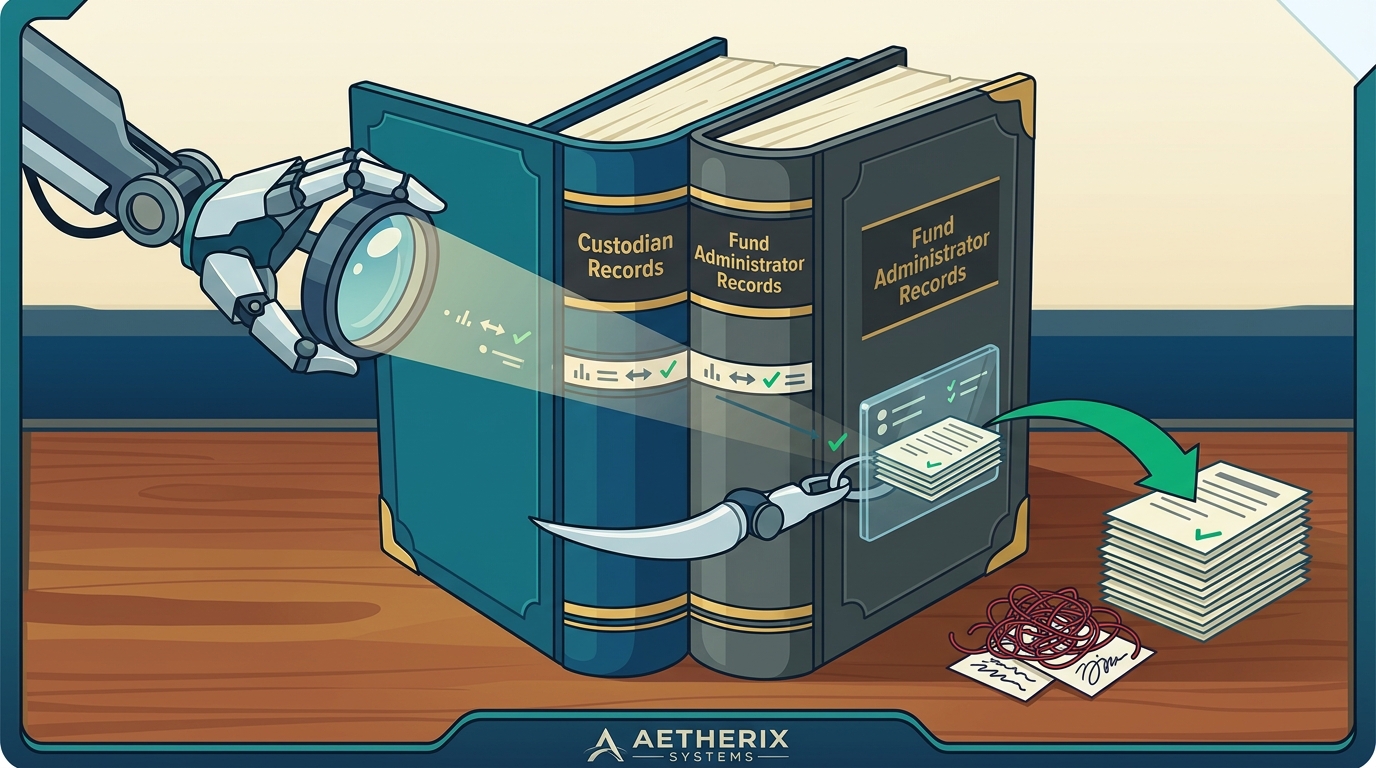
Traditional matching engines handle the transactions that agree. They flag the ones that do not. The real cost in reconciliation lies in the exception queue. Aetherix agents do not just flag breaks; they investigate them. The agent pulls data from custodians, banks, and ledgers, normalizes formats, and applies matching rules. When a position or trade does not match, the agent traces the transaction through the system to identify the root cause. This might be a timing difference, a corporate action not yet reflected, or a data entry error.
The agent then proposes a resolution and attaches the full reasoning trace. This ensures that every action is auditable. Your team reviews the proposed resolution and approves it. The agent does not write to the ledger or close the period. It prepares the reconciliation, surfaces exceptions, and drafts the journal entry, but the final post is made by a named human. This human-in-the-loop control is critical for maintaining compliance and accuracy.
Handling Multi-Custodian Complexity
Family offices often hold assets across multiple custodians, prime brokers, and bank accounts. Each source delivers data in its own format, with its own naming conventions. Aetherix agents ingest feeds from every source, including SWIFT messages, custodian portals, PDF statements, and Excel exports. They normalize this data into a standard format before running the matching logic. This eliminates the manual data wrangling that typically consumes the majority of an operations team's time.
The agents handle the full spectrum of reconciliation types, including position reconciliation, trade reconciliation, cash reconciliation, and expense reconciliation. Each type has its own failure modes and resolution workflows. The agents are configured for the specific patterns of each, ensuring that the investigation is targeted and efficient. The result is a clean reconciliation delivered on your schedule, with a complete audit trail for every action taken.
Fund Administrator Reconciliation
Fund administrator reconciliation is the process of ensuring that the fund's books, counterparties, and reporting cycle agree across all positions, trades, cash, and valuations. For fund administrators, this is a high-volume, high-stakes operation that requires precision and speed. Aetherix Systems provides AI agents that integrate into the fund administrator's existing tech stack, handling the reconciliation logic while the administrator's team focuses on client relationships and strategic oversight.
NAV and Valuation Controls
Net Asset Value (NAV) production is the culmination of all reconciliation efforts. If the underlying positions, trades, and cash balances are not accurate, the NAV will be wrong. Aetherix agents support NAV production by ensuring that every component of the calculation is reconciled and supported by evidence. They compare internal or administrator marks against approved market, counterparty, or model sources. They identify price, FX, methodology, and stale-price differences. This component-level analysis explains the final difference in the NAV package, providing the evidence needed for review and audit.
The agents also handle the complexity of hedge-fund environments, which include short positions, margin, collateral, financing, and derivatives. Source ownership, cutoff, instrument identity, and exception evidence are as important as the arithmetic difference. Aetherix agents are designed to account for these operational complexities, ensuring that the reconciliation process is robust and reliable.
Integration with Existing Workflows
Aetherix agents integrate with existing systems such as ERP platforms, CRM tools, and data warehouses. They connect to your SAP, NetSuite, or custom internal tools via APIs and event-driven architectures. This allows the agents to pull data directly from the source systems, eliminating the need for manual exports and imports. The agents push reconciliation results back to your systems via webhooks, delivering structured JSON payloads that can be parsed, stored, and routed by your code.
For fund administrators, this means that reconciliation status, exception alerts, and client reporting can be surfaced in tools like Salesforce or ServiceNow. Relationship managers can see open exceptions, resolution timelines, and close readiness without switching tools or requesting reports. This integration ensures that the reconciliation process is visible and transparent, improving communication with clients and internal stakeholders.
Key Takeaways
- Agentic Investigation: Aetherix AI agents do not just flag exceptions; they investigate breaks, determine root causes, and propose resolutions with full reasoning.
- Human-in-the-Loop: Agents propose journal entries and resolutions, but a named human must approve and post them. Agents cannot close periods or write to the ledger without explicit approval.
- Multi-Source Normalization: Agents ingest data from custodians, banks, and ERPs in various formats (PDF, EDI, API) and normalize it for consistent matching.
- Full Audit Trail: Every action taken by an agent is logged with a reasoning trace, ensuring complete auditability for compliance and regulatory inquiries.
- System Integration: Aetherix agents integrate with existing tech stacks (SAP, NetSuite, Salesforce, ServiceNow) via APIs and webhooks, embedding reconciliation into current workflows.
- Scalability: The agentic approach scales with volume. As transaction counts increase, the agents handle the additional load without requiring linear increases in headcount.
Frequently Asked Questions
Do Aetherix AI agents post journal entries automatically?
No. Aetherix agents propose journal entries and resolutions. A named human employee must review and approve these proposals before they are posted to the ledger. The agent cannot write to the ledger or close a period without explicit human approval.
What types of reconciliation does Aetherix handle?
Aetherix handles position, trade, cash, expense, and ledger reconciliation. This includes subledger-to-GL, intercompany, bank, and revenue schedule reconciliation. The agents are configured for the specific patterns and failure modes of each reconciliation type.
How do Aetherix agents integrate with existing systems?
Agents integrate via APIs, webhooks, and event-driven architectures. They connect to ERP systems (SAP, NetSuite), CRM platforms (Salesforce), and data warehouses. Results are pushed back to your systems as structured JSON payloads, allowing for seamless integration into existing workflows.
Is the reconciliation process auditable?
Yes. Every action taken by an agent is logged with a full reasoning trace. This includes the data compared, the logic applied, and the conclusion reached. This audit trail is exportable for regulatory reporting or external audit.
Can Aetherix agents handle multi-currency and multi-entity structures?
Yes. Agents are designed to handle multi-currency complexity, including FX revaluation and rate differentials. They also manage multi-entity structures, reconciling intercompany transactions and validating consolidation across subsidiaries.
What is the difference between a matching engine and an Aetherix agent?
A matching engine flags transactions that do not match. An Aetherix agent investigates those breaks, identifies the root cause, and proposes a resolution. The agent handles the exception queue, which is where the majority of manual effort and cost typically resides.
Conclusion
Aetherix Systems provides AI agents that transform reconciliation from a manual, labor-intensive process into an automated, auditable operation. By handling the exception queue and integrating with existing systems, these agents allow finance teams to focus on higher-value work. To explore how Aetherix agents can streamline your reconciliation operations, .