

NAV reconciliation software with AI matching uses machine learning to compare fund records against custodian and administrator data, automatically investigating discrepancies rather than just flagging them. This guide covers how AI matching algorithms work, the role of fund administration automation, and how to evaluate AI capabilities in 2026. We examine the shift from rules-based engines to agentic systems that handle the full exception lifecycle.
NAV Reconciliation Software
NAV reconciliation software is a specialized system that verifies the Net Asset Value of a fund by comparing internal books against external records from custodians, prime brokers, and administrators. Traditional software relies on deterministic rules to match transactions, which works well for clean data but fails when exceptions occur. In 2026, the distinction between standard matching and intelligent reconciliation is critical for fund managers seeking to reduce close times.
The Limitations of Rules-Based Matching
Most legacy platforms use hard-coded logic to identify matches. If a transaction does not meet exact criteria for amount, date, and reference, it is flagged as an exception. This approach creates a backlog of unresolved breaks that require manual investigation. The software stops at flagging; it does not explain why the break occurred or propose a resolution. This leaves the heavy lifting to human analysts, who must manually trace discrepancies across multiple systems.
The Shift to Agentic Reconciliation
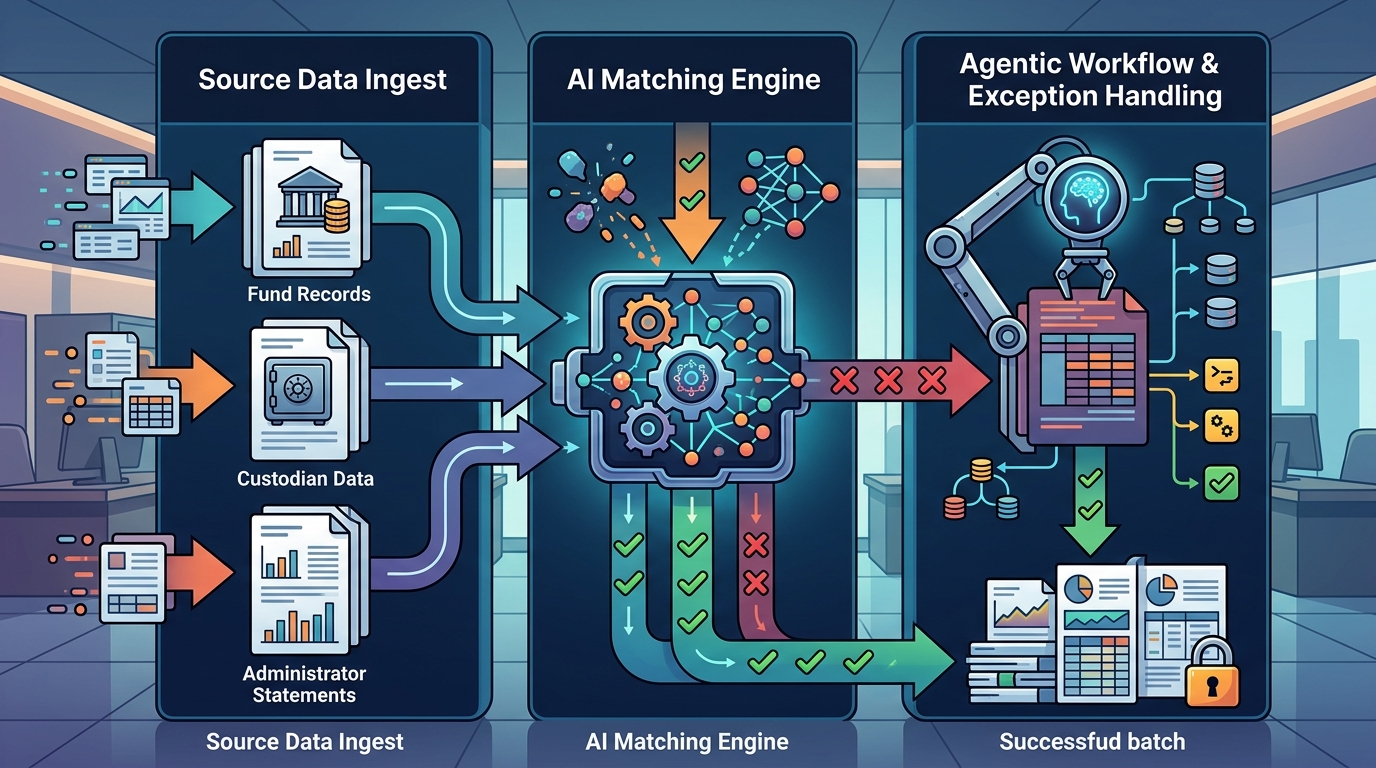
Modern NAV reconciliation software integrates AI agents that go beyond simple matching. These agents investigate each exception by pulling supporting documentation, analyzing historical patterns, and proposing resolutions. For example, if a trade settlement date differs between the fund's book and the custodian's statement, an AI agent can check the settlement calendar and pending corporate actions to determine if the break is a timing issue or a genuine error. This shift transforms reconciliation from a manual chore into an automated control process.
AI Matching Algorithms
AI matching algorithms are computational models that use machine learning to identify relationships between financial records, even when data is incomplete or inconsistent. Unlike traditional string matching, these algorithms can handle fuzzy logic, semantic understanding, and contextual reasoning. They are the core technology that enables modern reconciliation platforms to resolve complex exceptions without human intervention.
Fuzzy Matching and Semantic Analysis
Fuzzy matching algorithms allow for approximate matches by calculating similarity scores between data points. This is essential for handling variations in naming conventions, currency formats, and date structures. Semantic analysis goes further by understanding the meaning behind the data. For instance, an algorithm can recognize that "Dividend Income" and "Dividend Received" refer to the same financial event, even if the labels differ across systems. This capability significantly reduces false positives in exception queues.
Machine Learning for Exception Resolution
Advanced AI matching algorithms use supervised learning to predict the root cause of discrepancies. By analyzing historical resolution data, the model learns patterns that indicate common break types, such as timing differences, pricing errors, or missing entries. When a new exception appears, the algorithm predicts the likely cause and suggests a resolution path. This predictive capability allows the system to auto-resolve a significant portion of exceptions, leaving only the most complex cases for human review. The result is a faster close cycle and a more reliable audit trail.
Fund Administration Automation
Fund administration automation is the use of software and AI to streamline the end-to-end process of calculating and reporting fund performance, including NAV, fees, and distributions. While NAV reconciliation is a critical component, full automation extends to other areas such as fee calculation, corporate action processing, and regulatory reporting. This holistic approach ensures that all data flows are consistent and accurate.
Integrating Reconciliation with Fund Accounting
Effective fund administration automation requires tight integration between reconciliation engines and fund accounting systems. When reconciliation identifies a discrepancy, the system can automatically generate journal entries for approval. This eliminates the manual step of transferring data between systems, reducing the risk of transcription errors. The integration also ensures that the NAV calculation reflects the most up-to-date and accurate data, providing investors with reliable performance metrics.
Scalability and Multi-Fund Management
As fund managers scale their operations, the complexity of reconciliation increases exponentially. Automation platforms are designed to handle multiple funds, asset classes, and custodians simultaneously. They use parallel processing to reconcile all funds in parallel, rather than sequentially. This scalability is essential for managers with large portfolios, as it allows them to maintain high-quality controls without increasing headcount. The ability to manage complexity without adding cost is a key driver for adopting automated fund administration.
AI Matching Capabilities
AI matching capabilities refer to the specific features and functions that an AI system provides to support reconciliation and exception resolution. These capabilities range from basic data normalization to advanced reasoning and decision-making. Evaluating these capabilities is crucial for selecting the right software for your specific needs. Not all AI systems are created equal, and the depth of their capabilities will determine their effectiveness in your environment.
Data Normalization and Ingestion
One of the first capabilities of an AI matching system is data normalization. Financial data comes in various formats, from structured CSV files to unstructured PDF statements. AI systems can parse and normalize this data into a consistent format, making it ready for matching. This capability is essential for handling data from multiple custodians and banks, each with its own reporting standards. Effective normalization reduces the time spent on data preparation and ensures that the matching process starts with clean, comparable data.
Reasoning and Decision-Making
Higher-level AI matching capabilities involve reasoning and decision-making. These systems can analyze the context of an exception and determine the best course of action. For example, if a break is identified, the system can reason through possible causes, such as a pending trade or a pricing error, and select the most likely resolution. This capability requires sophisticated logic and access to comprehensive data sources. It allows the system to act as a virtual analyst, providing not just a flag but a reasoned recommendation for resolution.
Fund Administration Platforms
Fund administration platforms are comprehensive software suites that manage the entire lifecycle of fund operations, from inception to liquidation. These platforms include modules for accounting, reporting, compliance, and investor services. When selecting a platform, it is important to consider how its reconciliation module integrates with the rest of the suite. A seamless integration ensures that data flows smoothly between modules, reducing the risk of errors and improving efficiency.
Evaluating Platform Integration
When evaluating fund administration platforms, look for those that offer open APIs and flexible integration options. This allows you to connect the platform with your existing systems, such as ERP, CRM, and custodian portals. A platform with strong integration capabilities can adapt to your specific technology stack, ensuring that it fits into your existing workflows. This flexibility is crucial for avoiding vendor lock-in and ensuring that the platform can evolve with your business needs.
Security and Compliance
Security and compliance are paramount in fund administration. Platforms must adhere to industry standards for data protection and access control. Look for platforms that offer role-based access, audit trails, and encryption for data at rest and in transit. Compliance with regulations such as GDPR and local data residency laws is also essential. Aetherix Systems, for example, operates with a focus on enterprise-grade security and compliance, ensuring that sensitive financial data is protected throughout the reconciliation process.
Key Takeaways
- NAV reconciliation software with AI matching goes beyond flagging exceptions to investigating and resolving them.
- AI matching algorithms use fuzzy logic and machine learning to handle complex data variations and predict root causes.
- Fund administration automation extends beyond reconciliation to include fee calculation, reporting, and compliance.
- AI matching capabilities include data normalization, semantic analysis, and reasoning for decision-making.
- Fund administration platforms should offer open APIs and strong security to integrate with existing systems.
- The shift to agentic systems reduces manual effort and accelerates the close cycle.
- Evaluating software requires assessing the depth of AI capabilities and integration flexibility.
- Security and compliance are critical considerations when selecting a fund administration platform.
Frequently Asked Questions
What is the difference between rules-based matching and AI matching?
Rules-based matching uses hard-coded logic to identify exact matches, while AI matching uses machine learning to handle fuzzy data and predict resolutions. AI matching can investigate exceptions and propose solutions, whereas rules-based systems only flag them.
Can AI matching handle multi-currency reconciliation?
Yes, AI matching algorithms can handle multi-currency reconciliation by applying exchange rates and analyzing FX variances. They can distinguish between realized and unrealized gains and losses, providing a clear breakdown of currency impacts.
How does AI matching improve the close cycle?
AI matching improves the close cycle by automating the investigation of exceptions. This reduces the time spent on manual data wrangling and allows teams to focus on high-value analysis. The result is a faster and more reliable close process.
What are the security considerations for AI reconciliation software?
Security considerations include data encryption, role-based access control, and audit trails. The software must comply with data protection regulations and ensure that sensitive financial data is protected. Look for platforms that offer enterprise-grade security features.
How do I evaluate the AI capabilities of a reconciliation platform?
Evaluate AI capabilities by assessing the depth of reasoning, the quality of data normalization, and the ability to integrate with existing systems. Request a demo to see how the platform handles complex exceptions and review its security and compliance features.
Is AI matching suitable for all fund types?
AI matching is suitable for most fund types, including hedge funds, private equity, and mutual funds. The specific capabilities required may vary depending on the complexity of the fund's portfolio and the number of custodians involved.
Conclusion
Selecting the right NAV reconciliation software with AI matching is a strategic decision that can significantly impact your fund's operational efficiency and control environment. By understanding the capabilities of AI matching algorithms and the role of fund administration automation, you can make an informed choice that aligns with your business goals. Aetherix Systems provides specialized reconciliation services for family offices, investment funds, and financial institutions, leveraging AI agents to handle the complex exception queue with a full audit trail. To explore how AI-driven reconciliation can transform your close process, for a scoping call.