

NAV reconciliation software with AI matching uses machine learning and agentic workflows to compare fund records against custodian and administrator data, automatically investigating discrepancies rather than just flagging them. This guide covers how AI matching works, the role of fund administration platforms, and how Aetherix Systems integrates AI agents into enterprise finance operations to resolve complex breaks.
NAV Reconciliation Software
NAV reconciliation is the process of verifying that a fund's Net Asset Value calculations agree with the records held by custodians, prime brokers, and fund administrators. It is not a single balance comparison but a connected set of reconciliations that supports accurate books, reliable exposure data, and the evidence used in NAV production and review. In a hedge-fund environment, the same process must account for short positions, margin, collateral, financing, derivatives, multiple prime brokers, and different valuation sources.
Traditional software often relies on rules-based matching engines. These tools are effective at identifying items that agree but struggle with the exceptions. When a position does not match, the software flags it and creates an exception queue. The human analyst must then investigate the break, pulling statements, checking corporate actions, and verifying settlement dates. This manual layer becomes the primary bottleneck in the close process.
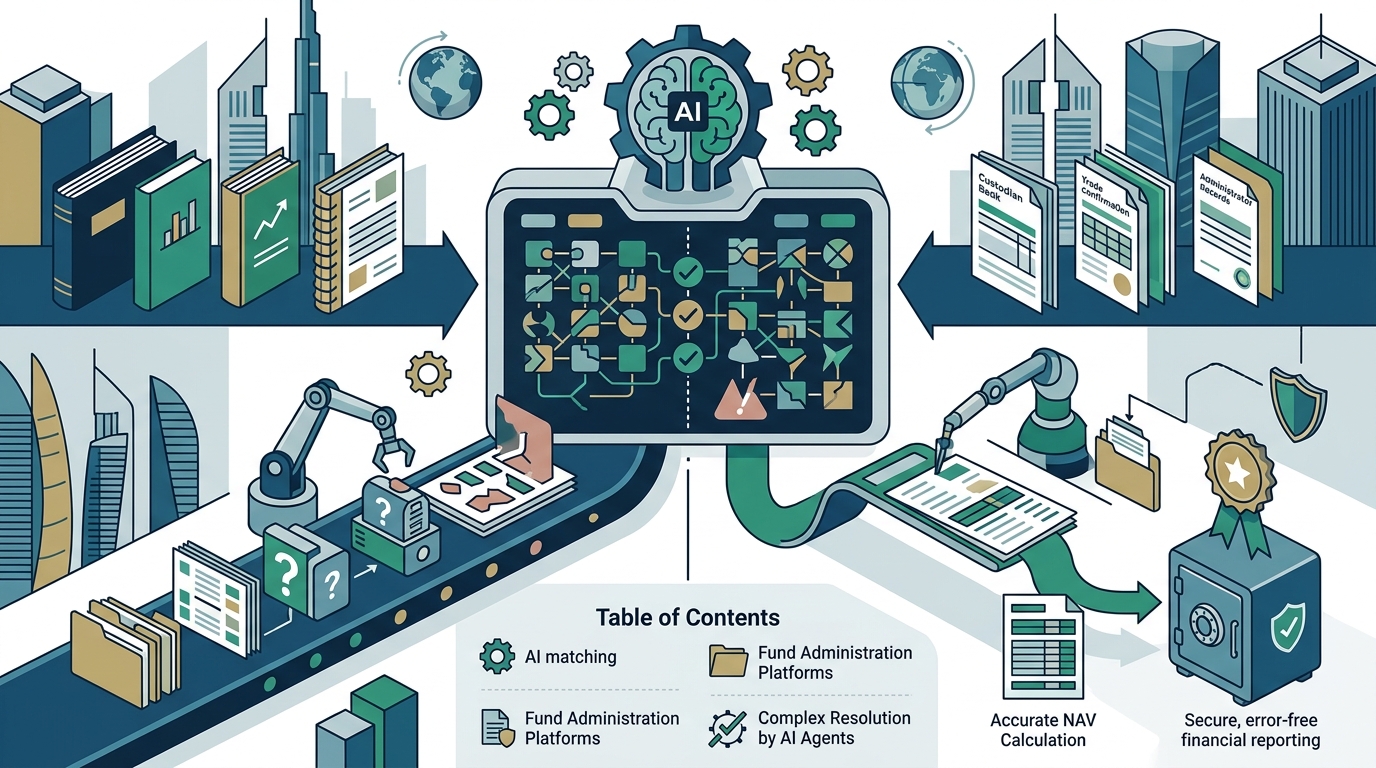
Modern NAV reconciliation software is evolving to include AI matching capabilities. These systems go beyond simple pattern recognition. They utilize large language models and retrieval-augmented generation to understand the context of a transaction. For example, an AI agent can read a corporate action announcement, cross-reference it with the fund's holdings, and determine if a discrepancy is due to a pending split or a data feed error. This shift from flagging to investigating is the defining characteristic of AI-driven reconciliation.
AI Matching Capabilities
AI matching in reconciliation software refers to the use of artificial intelligence to automate the investigation and resolution of discrepancies. Unlike traditional rules-based engines that apply static logic, AI agents can perceive, reason, decide, and act within defined guardrails. They process unstructured data, such as PDF statements and email confirmations, and normalize it into structured formats for comparison.
From Flagging to Investigating
The core value of AI matching lies in its ability to handle the "tail" of the reconciliation process. While rules-based tools might resolve 70-80% of volume through automated matching, the remaining exceptions consume disproportionate analyst time. AI agents investigate each break by tracing the transaction through the system, identifying the root cause, and classifying the exception type. They can distinguish between timing differences, which may self-clear, and genuine errors that require journal entries.
Reasoning and Audit Trails
A critical component of AI matching is the reasoning trace. Every action taken by an AI agent is logged with full context. This includes the data sources consulted, the logic applied, and the proposed resolution. This audit trail is essential for compliance and regulatory reporting. It allows auditors to verify why a specific decision was made without reconstructing the process from memory. Aetherix Systems emphasizes this transparency, ensuring that every agent action is auditable and that human oversight remains in the loop for final approvals.
Handling Complex Data Types
AI matching capabilities extend to complex data types that challenge traditional software. This includes multi-currency transactions, where FX rate discrepancies must be traced to the specific rate source and posting date. It also covers derivative instruments, where valuation methodologies may differ between the fund and the counterparty. By understanding the nuances of these instruments, AI agents can propose more accurate resolutions and reduce the risk of material misstatement.
Fund Administration Platforms
Fund administration platforms are the systems of record for fund accounting and NAV production. They integrate with custodians, brokers, and other data sources to calculate the fund's value. While these platforms are essential for the accounting process, they often lack the advanced AI capabilities needed to resolve complex reconciliation breaks autonomously.
Many fund administrators use legacy systems that were not designed for multi-custodian, multi-entity reconciliation. These systems can handle the arithmetic of NAV calculation but struggle with the investigative work required to clean the books. As a result, administrators often rely on manual processes or add-on tools to manage exceptions. This creates a fragmented workflow where data must be moved between the administration platform and the reconciliation tool.
AI-driven reconciliation services can integrate with these platforms to provide a more seamless experience. By connecting directly to the fund administration system, AI agents can pull data, perform matching, and propose resolutions without requiring manual data exports. This integration reduces the risk of data entry errors and accelerates the close cycle. Aetherix Systems works with various ERP and administration platforms to ensure that reconciliation is embedded into the existing workflow, rather than operating as a separate, siloed process.
Key Takeaways
- NAV reconciliation is a connected set of controls, not a single balance check.
- AI matching moves beyond flagging exceptions to investigating and resolving them.
- Reasoning traces and audit trails are critical for compliance in AI-driven systems.
- Fund administration platforms often lack the AI capabilities needed for complex exception handling.
- Integration between AI agents and administration platforms reduces manual data movement.
- Human oversight remains essential for final approvals and regulatory sign-off.
- AI agents can handle unstructured data, such as PDFs and emails, to improve matching accuracy.
Frequently Asked Questions
What is the difference between rules-based matching and AI matching?
Rules-based matching uses static logic to identify items that agree. AI matching uses machine learning to investigate discrepancies, understand context, and propose resolutions. AI can handle unstructured data and complex scenarios that rules-based systems cannot.
Can AI agents close a fund's books?
No. AI agents propose journal entries and resolutions, but a named human employee must review and post them. The final sign-off and closing of the books remain a human responsibility to ensure compliance and accuracy.
How does AI handle multi-currency reconciliation?
AI agents trace FX variances back to the specific rate source and posting date. They can distinguish between realized and unrealized gains and losses, and identify discrepancies caused by different valuation methodologies.
Is AI reconciliation secure?
Yes, when implemented with enterprise-grade security. AI agents operate within defined safety boundaries, with full audit trails, role-based access, and data residency compliance. Security practices are aligned with standards like SOC 2 and ISO 27001.
What data sources can AI agents use?
AI agents can ingest data from custodians, banks, ledgers, PDF statements, email confirmations, and EDI feeds. They normalize these diverse formats into structured data for matching and analysis.
How long does it take to implement AI reconciliation?
Implementation timelines vary based on scope and complexity. A typical engagement involves a scoping call, configuration, a shadow period, and then production. This process can take several weeks to months, depending on the number of entities and data sources.
Conclusion
NAV reconciliation software with AI matching represents a significant advancement in fund operations. By moving from flagging exceptions to investigating and resolving them, AI agents reduce the manual burden on finance teams and accelerate the close cycle. As fund administration platforms evolve, the integration of AI capabilities will become increasingly important for maintaining accurate books and reliable exposure data. Aetherix Systems provides AI-driven reconciliation services that integrate with existing workflows, ensuring that every action is auditable and that human oversight remains in the loop. To explore how AI agents can transform your reconciliation process, for a scoping call.