

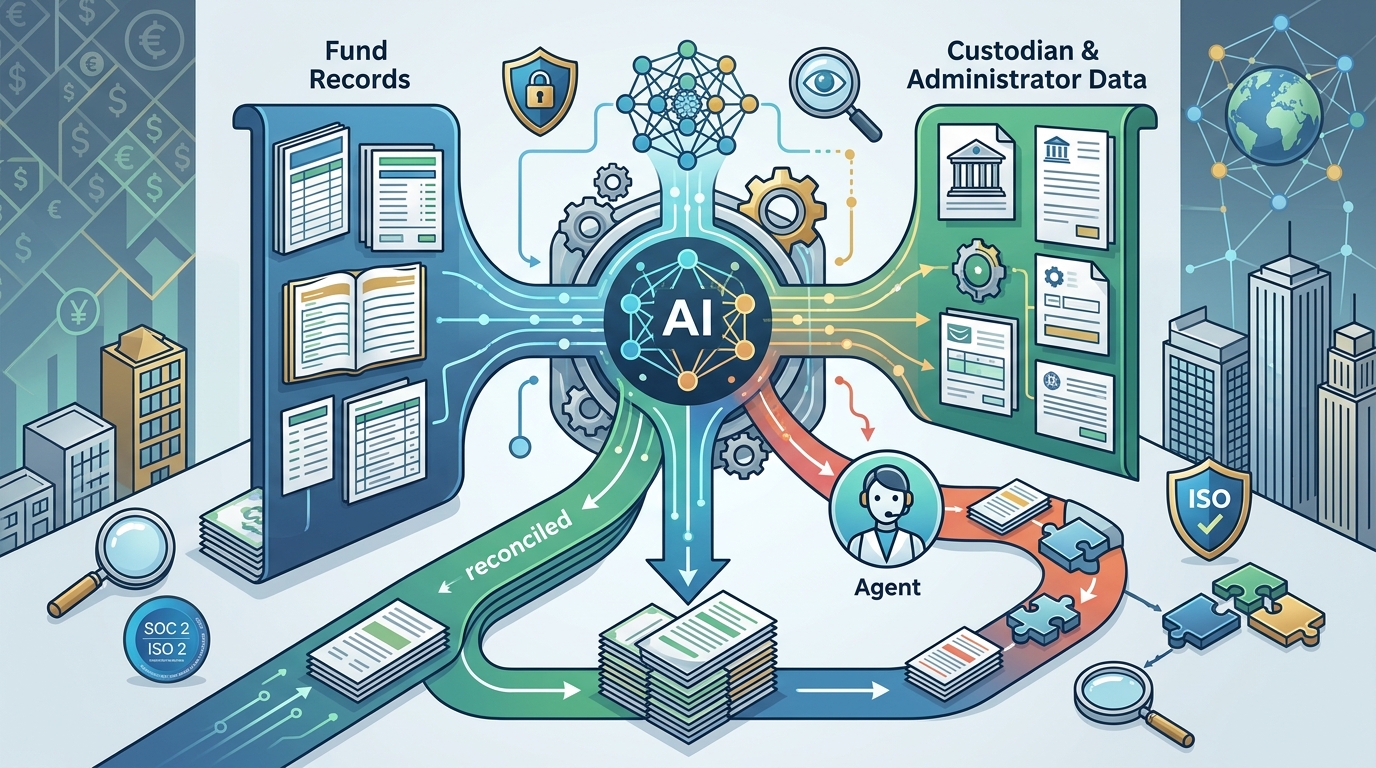
NAV reconciliation software with AI matching uses machine learning to compare fund records against custodian and administrator data, automatically investigating discrepancies rather than just flagging them. This guide covers how AI matching algorithms work, the role of fund administration platforms, and how agentic systems handle the exception queue that traditional tools leave behind.
NAV Reconciliation Software
NAV reconciliation is the process of verifying that a fund's Net Asset Value calculations align with the underlying positions, cash, and income records held by custodians and administrators. Traditional software focuses on arithmetic matching, comparing line items between two data sources. When a match fails, the software flags the item as an exception. The human analyst then must investigate the break, a process that consumes significant time and scales poorly with volume.
The Limitation of Rules-Based Matching
Most legacy reconciliation tools rely on deterministic rules. They match items based on exact identifiers, such as ISINs or trade dates. If the data does not match perfectly, the item moves to an exception queue. This approach handles the majority of transactions but fails to resolve the complex breaks that require context. For example, a trade that settled on a different date than expected, or a corporate action that was processed differently by two parties, requires investigation, not just flagging.
Agentic Reconciliation
Modern AI-driven reconciliation moves beyond flagging to investigation. Aetherix Systems deploys AI agents that ingest data from multiple sources, normalize formats, and apply matching logic. When a break occurs, the agent investigates the root cause. It checks settlement calendars, verifies corporate action schedules, and traces the transaction through the system. The agent then proposes a resolution with full reasoning attached. This shifts the human role from data wrangling to review and approval.
AI Matching Algorithms
AI matching algorithms in NAV reconciliation use machine learning to identify relationships between records that do not share identical identifiers. These algorithms handle fuzzy matching, where slight variations in data, such as different naming conventions or minor price discrepancies, are resolved automatically. The goal is to reduce the volume of exceptions that require human attention.
Fuzzy Matching and Normalization
Fuzzy matching allows the system to recognize that two records represent the same transaction, even if they differ in format. For instance, a custodian might report a stock as "AAPL" while the internal ledger uses "Apple Inc. Class A." The algorithm normalizes these identifiers and matches the records based on quantity, price, and date. This reduces false positives and ensures that only genuine discrepancies are flagged.
Investigation and Reasoning
Advanced AI systems go beyond matching to investigate breaks. When a discrepancy is detected, the agent pulls supporting documentation from both sides. It analyzes the context, such as whether a trade was pending settlement or if a dividend was accrued in one system but not the other. The agent documents its reasoning, creating an audit trail that explains why a resolution was proposed. This transparency is critical for compliance and audit readiness.
Learning from Historical Data
Machine learning models improve over time by learning from historical resolutions. If a specific type of break, such as a timing difference in a particular custodian's reporting, is consistently resolved in a certain way, the model adapts its logic to handle similar cases automatically. This continuous improvement reduces the exception rate over time, freeing up analyst capacity for higher-value tasks.
Fund Administration Platforms
Fund administration platforms serve as the central hub for NAV calculation and reporting. They integrate data from custodians, prime brokers, and internal systems to produce the final NAV. While these platforms handle the arithmetic, they often lack the intelligence to investigate complex breaks. This is where specialized AI reconciliation tools complement the administration platform.
Integration with Administration Systems
Effective NAV reconciliation software integrates seamlessly with fund administration platforms. It pulls data via APIs or file transfers, runs the reconciliation, and pushes results back to the platform. This integration ensures that the NAV calculation is supported by clean, reconciled data. Aetherix Systems provides guides on how to structure these integrations to maintain data integrity and audit trails.
Multi-Source Data Complexity
Fund administrators often deal with data from multiple sources, each with its own format and schedule. A hedge fund might receive data from three prime brokers, two custodians, and several fund administrators. Reconciling this multi-source data is complex and error-prone when done manually. AI agents handle this complexity by normalizing all data into a common format before running the matching logic. This ensures that every source is compared accurately, regardless of its original format.
Compliance and Audit Trails
Regulators and auditors require documented evidence of reconciliation processes. AI-driven systems provide this by logging every action, including data ingestion, matching attempts, and resolution proposals. The audit trail is timestamped and attributed, making it easy to demonstrate compliance. This level of documentation is difficult to achieve with manual processes, where evidence is often scattered across emails and spreadsheets.
Comparison of Reconciliation Approaches
| Feature | Rules-Based Software | AI-Driven Agentic Systems |
|---|---|---|
| Matching Logic | Exact identifier matching | Fuzzy matching and normalization |
| Exception Handling | Flags items for human review | Investigates root cause and proposes resolution |
| Audit Trail | Basic logging of matches | Full reasoning trace for every action |
| Scalability | Linear with volume | Parallel processing of exceptions |
| Human Role | Investigate and resolve | Review and approve |
Key Takeaways
- NAV reconciliation software with AI matching automates both the matching and investigation phases of the process.
- Traditional rules-based tools flag exceptions but do not resolve them, leaving the heavy lifting to human analysts.
- AI agents use fuzzy matching to handle data variations and normalize multi-source data into a common format.
- Agentic systems provide a full audit trail, documenting the reasoning behind every resolution proposal.
- Integration with fund administration platforms ensures that NAV calculations are supported by clean, reconciled data.
- Machine learning models improve over time by learning from historical resolutions, reducing exception rates.
- Human oversight remains critical; AI agents propose resolutions, but named employees approve and post entries.
- Compliance requirements are met through detailed, timestamped logs of all reconciliation activities.
Frequently Asked Questions
What is NAV reconciliation?
NAV reconciliation is the process of verifying that a fund's Net Asset Value calculations align with the underlying positions, cash, and income records held by custodians and administrators.
How does AI matching differ from rules-based matching?
AI matching uses machine learning to handle fuzzy data and investigate discrepancies, while rules-based matching relies on exact identifiers and only flags exceptions for human review.
Can AI agents post journal entries?
No, AI agents propose journal entries with full reasoning attached. A named client employee reviews and approves the entries before they are posted to the ledger.
What data sources do AI reconciliation systems integrate with?
These systems integrate with custodians, prime brokers, fund administrators, and internal accounting systems via APIs or file transfers.
How does AI improve audit readiness?
AI systems log every action, including data ingestion, matching attempts, and resolution proposals, creating a comprehensive audit trail that is easy to review.
Is AI reconciliation suitable for all fund types?
AI reconciliation is beneficial for funds with complex structures, multiple custodians, or high transaction volumes, where manual investigation becomes a bottleneck.
How long does it take to implement AI reconciliation?
Implementation timelines vary based on scope and data complexity, but many engagements move from scoping to production within a few weeks.
Does AI eliminate the need for human analysts?
No, AI shifts the human role from data wrangling to review and approval. Analysts focus on higher-value tasks, such as analyzing exceptions and improving processes.
Conclusion
NAV reconciliation software with AI matching transforms the close process by automating both the matching and investigation phases. By leveraging machine learning and agentic workflows, these systems handle the complexity of multi-source data and provide a full audit trail for every action. For fund administrators and investment managers, this means a faster, more reliable close with reduced manual effort. Aetherix Systems offers reconciliation services for family offices and investment funds, ensuring that your books are clean and your audit trail is complete. To explore how AI agents can streamline your NAV reconciliation process, for a scoping call.