

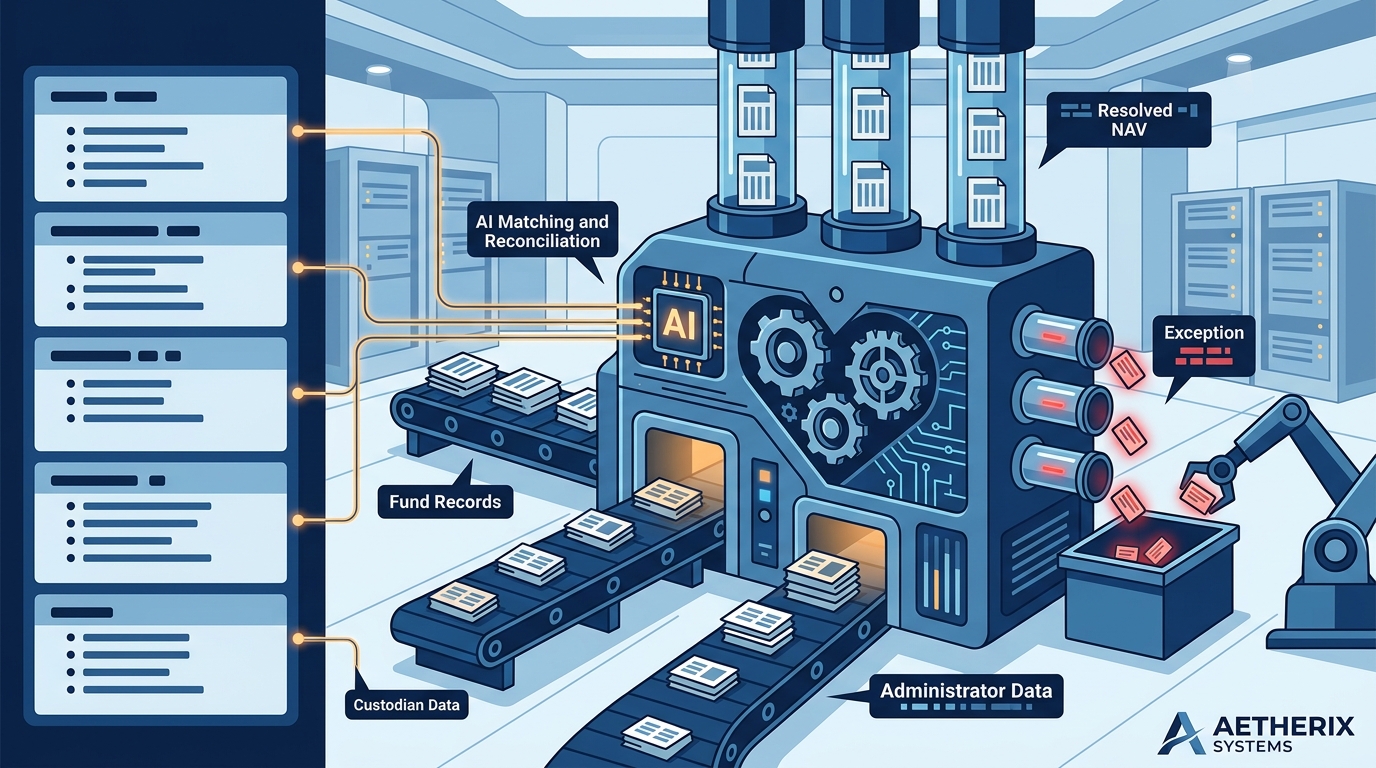
NAV reconciliation software with AI matching uses machine learning to compare fund records against custodian and administrator data, resolving discrepancies automatically. This guide covers how AI matching works, fund administration automation, and how Aetherix Systems integrates these capabilities into enterprise workflows.
NAV Reconciliation Software
NAV reconciliation is the process of verifying that a fund's Net Asset Value calculations match the records held by custodians, prime brokers, and fund administrators. Traditional software relies on rules-based matching, which handles clean data but struggles with complex exceptions. Modern platforms now incorporate AI to investigate breaks that rules-based systems cannot resolve.
The Limitations of Rules-Based Matching
Rules-based engines match transactions based on exact or fuzzy criteria, such as amount, date, and reference number. While effective for straightforward items, they create exception queues for anything that does not match perfectly. These exceptions require manual investigation, which is time-consuming and error-prone. AI-driven software addresses this gap by analyzing context and proposing resolutions.
Why AI is Necessary for NAV
NAV calculations involve multiple data sources, including positions, trades, cash, income, and fees. Discrepancies often arise from timing differences, corporate actions, or valuation mismatches. AI agents can trace these issues back to their root cause, reducing the time spent on manual reconciliation. This is particularly important for funds with complex structures or multiple custodians.
AI Matching Algorithms
AI matching algorithms use machine learning models to identify patterns in transaction data and predict resolutions for discrepancies. These algorithms go beyond simple matching by analyzing historical data, context, and relationships between records. They can handle fuzzy matching, where exact matches are not available, and propose corrections based on learned patterns.
How AI Agents Investigate Breaks
When a discrepancy is detected, an AI agent investigates by pulling supporting documentation, checking settlement dates, and verifying corporate actions. The agent then proposes a resolution with full reasoning attached. This audit trail is crucial for compliance and audit purposes. The agent does not post entries automatically; instead, it presents the proposed resolution for human review and approval.
Types of AI Matching
There are several types of AI matching used in reconciliation. Fuzzy matching handles minor variations in data, such as different date formats or slight amount differences. Predictive matching uses historical data to predict how a discrepancy should be resolved. Contextual matching analyzes the broader context of a transaction, such as the type of instrument or the custodian involved. Each type serves a different purpose and can be combined for more accurate results.
Fund Administration Automation
Fund administration automation involves using software to streamline the processes involved in managing fund operations, including NAV calculation, reporting, and compliance. AI enhances this automation by handling complex tasks that require judgment, such as investigating exceptions and preparing journal entries. This reduces the manual workload on fund administrators and improves accuracy.
Key Areas of Automation
Several areas of fund administration benefit from AI-driven automation. NAV calculation is one of the most critical, as it directly impacts investor reporting. AI can automate the reconciliation of NAV components, ensuring that all data sources agree. Other areas include trade settlement, corporate action processing, and fee calculation. Automating these processes reduces the risk of errors and speeds up the close cycle.
Integration with Existing Systems
Effective fund administration automation requires integration with existing systems, such as ERPs, custodian platforms, and accounting software. AI agents can connect to these systems via APIs, pulling data and pushing results back. This integration ensures that the automation is seamless and does not require significant changes to existing workflows. Aetherix Systems, for example, integrates with platforms like NetSuite and SAP to run reconciliation operations.
AI Matching Capabilities
AI matching capabilities refer to the specific features and functions that AI software provides for reconciliation. These capabilities include exception investigation, resolution proposal, and audit trail generation. The effectiveness of these capabilities depends on the quality of the data and the sophistication of the AI models used.
Exception Investigation
Exception investigation is the core capability of AI-driven reconciliation. When a break is identified, the AI agent investigates by analyzing the data, checking for common causes, and proposing a resolution. This process is automated, but it requires human oversight to ensure that the resolution is appropriate. The agent provides a reasoning trace that explains why it proposed a particular resolution, which is essential for audit and compliance.
Resolution Proposal and Approval
After investigating an exception, the AI agent proposes a resolution, such as a journal entry or a data correction. This proposal is then routed for human approval. The human reviewer can accept, reject, or modify the proposal based on their judgment. This human-in-the-loop approach ensures that the AI does not make unauthorized changes to the records. The approval process is logged, providing a complete audit trail.
Fund Administration Platforms
Fund administration platforms are software systems that provide the tools and infrastructure for managing fund operations. These platforms include features for NAV calculation, reporting, compliance, and reconciliation. When selecting a platform, it is important to consider its AI capabilities, integration options, and scalability. Aetherix Systems offers reconciliation services that can be integrated with various fund administration platforms.
Choosing the Right Platform
When choosing a fund administration platform, consider the following factors. First, evaluate the platform's AI capabilities, including its matching algorithms and exception investigation features. Second, assess its integration options, ensuring that it can connect to your existing systems. Third, consider its scalability, ensuring that it can handle your fund's growth. Finally, review its compliance features, ensuring that it meets your regulatory requirements.
Comparison of AI Capabilities
| Capability | Rules-Based | AI-Driven |
|---|---|---|
| Matching Accuracy | High for clean data | High for complex data |
| Exception Investigation | Manual | Automated with reasoning |
| Audit Trail | Basic | Comprehensive with reasoning |
| Scalability | Limited | High |
Key Takeaways
- NAV reconciliation software with AI matching uses machine learning to resolve discrepancies automatically.
- AI agents investigate exceptions by analyzing context and proposing resolutions with full reasoning.
- Fund administration automation reduces manual workload and improves accuracy in NAV calculation.
- AI matching capabilities include exception investigation, resolution proposal, and audit trail generation.
- When choosing a fund administration platform, consider its AI capabilities, integration options, and scalability.
- Human oversight is essential in AI-driven reconciliation to ensure that resolutions are appropriate.
- Aetherix Systems integrates AI agents with platforms like NetSuite and SAP to run reconciliation operations.
Frequently Asked Questions
What is NAV reconciliation?
NAV reconciliation is the process of verifying that a fund's Net Asset Value calculations match the records held by custodians, prime brokers, and fund administrators.
How does AI matching work in reconciliation?
AI matching uses machine learning algorithms to identify patterns in transaction data and propose resolutions for discrepancies. It analyzes context and historical data to handle complex exceptions that rules-based systems cannot resolve.
Can AI agents post journal entries automatically?
No, AI agents do not post journal entries automatically. They propose resolutions, which are then reviewed and approved by a named human employee. This human-in-the-loop approach ensures that all changes are authorized and auditable.
What are the benefits of AI-driven fund administration automation?
AI-driven automation reduces manual workload, improves accuracy, and speeds up the close cycle. It handles complex tasks, such as exception investigation and NAV calculation, more efficiently than manual processes.
How do I choose a fund administration platform with AI capabilities?
When choosing a platform, evaluate its AI matching algorithms, integration options, scalability, and compliance features. Ensure that it can connect to your existing systems and handle your fund's complexity.
What is the role of human oversight in AI reconciliation?
Human oversight is essential in AI reconciliation. Humans review and approve the resolutions proposed by AI agents, ensuring that they are appropriate and compliant. This oversight provides a layer of control and accountability.
Conclusion
NAV reconciliation software with AI matching is transforming fund administration by automating complex tasks and improving accuracy. Aetherix Systems provides AI-driven reconciliation services that integrate with platforms like NetSuite and SAP, offering a full audit trail on every action. To explore how AI can enhance your fund administration processes, contact Aetherix Systems for a scoping call.