

NAV reconciliation software with AI matching uses machine learning to compare fund records against custodian and administrator data, automatically investigating discrepancies rather than just flagging them. This guide covers how AI matching engines work, the core components of financial reconciliation platforms, and how to evaluate tools for your specific fund structure. We examine the shift from rules-based matching to agentic investigation, providing a framework for selecting the right technology for your operations team.
NAV Reconciliation Software
NAV reconciliation is the process of verifying that a fund's internal valuation records match the data provided by custodians, prime brokers, and fund administrators. Traditional software relies on deterministic rules to match transactions, but this approach often fails when data formats vary or when exceptions require context. Modern platforms must handle the full lifecycle of reconciliation, from data ingestion to final sign-off.
The Limitations of Rules-Based Matching
Rules-based engines are effective for high-volume, low-complexity matching. They compare fields like trade date, symbol, and quantity. However, they cannot interpret why a mismatch occurred. If a custodian reports a different settlement date due to a holiday, a rules-based system flags it as an error. It does not know that the trade is valid. This creates a backlog of exceptions that human analysts must resolve manually.
What to Look for in NAV Software
When evaluating NAV reconciliation software, focus on the exception handling workflow. The tool should not just list breaks; it should provide context. Look for features that allow you to trace a discrepancy back to its source document. The software must integrate with your existing ERP and portfolio management systems. It should support multi-currency and multi-entity structures without requiring manual data mapping for every new fund.
AI Matching Engines
An AI matching engine is a system that uses machine learning models to identify patterns in transaction data and predict the correct match. Unlike static rules, these engines learn from historical resolutions. They can handle fuzzy matching, where data is similar but not identical. This capability is critical for NAV reconciliation, where custodian data often contains minor formatting differences or timing lags.
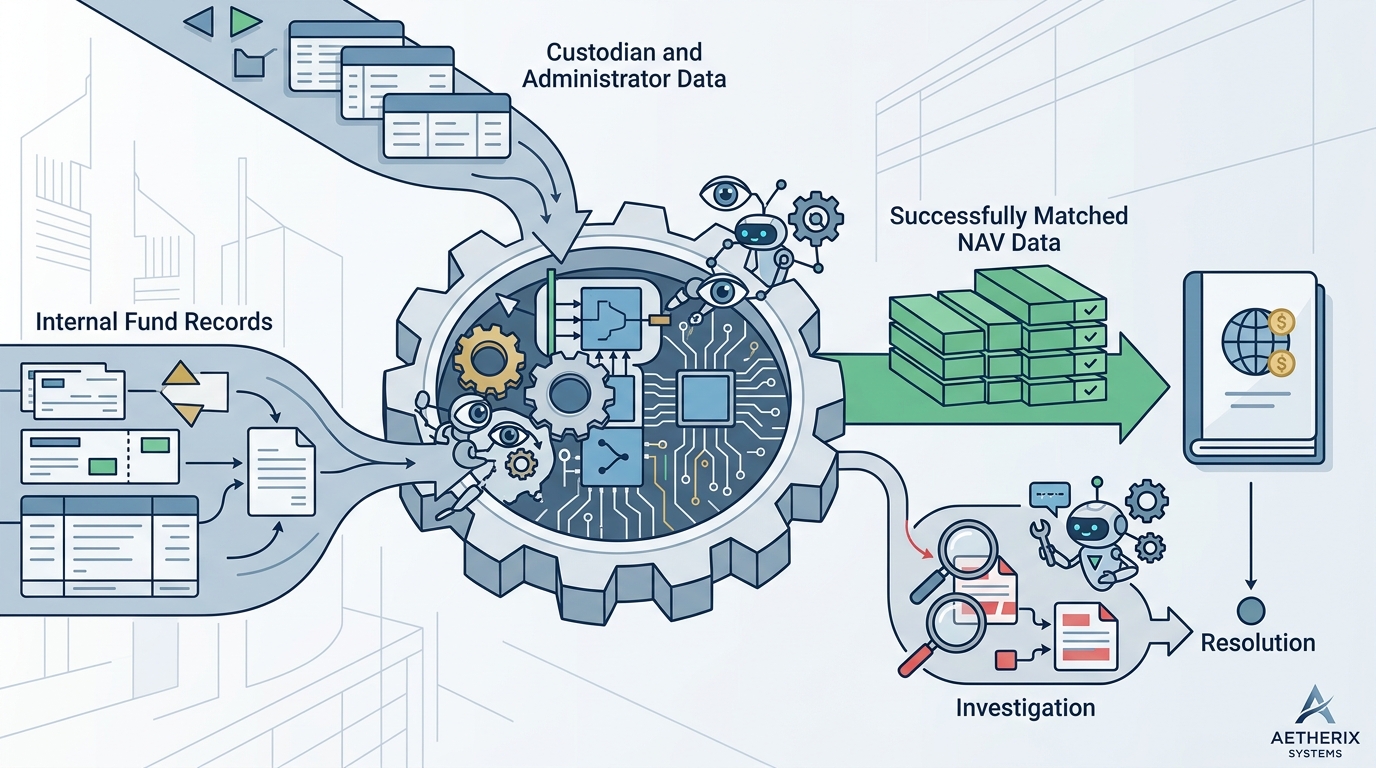
From Flagging to Investigating
The primary value of AI in reconciliation is the shift from flagging to investigating. A traditional engine flags a break. An AI agent investigates the break. It pulls the trade confirmation, checks the settlement calendar, and reviews the custodian statement. It then proposes a resolution with a reasoning trace. This reduces the cognitive load on your operations team. They review the proposed fix rather than performing the initial investigation.
Reasoning and Audit Trails
Every AI decision must be auditable. The engine should record why it made a specific match or why it escalated an exception. This reasoning trace is essential for compliance and audit purposes. It provides a clear chain of evidence. Without this, the AI becomes a black box, which is unacceptable in regulated financial environments. The system must explain its logic in terms that finance professionals can understand.
Financial Reconciliation Platforms
A financial reconciliation platform is a comprehensive suite of tools that manages the end-to-end reconciliation process. It includes data connectors, matching engines, exception management, and reporting modules. These platforms are designed to scale with your organization. They can handle thousands of transactions across multiple entities and currencies. The goal is to provide a single source of truth for all reconciliation activities.
Integration and Data Connectivity
Integration is the backbone of any reconciliation platform. The software must connect to your ERP, custodians, banks, and trading systems. It should support standard APIs and file formats. Data normalization is critical. The platform must convert different data formats into a common structure before matching. This ensures that the matching engine is comparing apples to apples. Poor integration leads to data quality issues that no amount of AI can fix.
Workflow and Human Oversight
Automation does not mean removing humans from the loop. A robust platform includes workflow tools for human review. It routes exceptions to the appropriate team members based on their expertise. It tracks the status of each exception from creation to resolution. It provides dashboards for real-time visibility into the reconciliation process. This human-in-the-loop approach ensures that critical decisions are made by qualified professionals.
| Feature | Rules-Based Engine | AI-Powered Platform |
|---|---|---|
| Matching Logic | Static, pre-defined rules | Dynamic, learns from history |
| Exception Handling | Flags for manual review | Investigates and proposes resolution |
| Audit Trail | Logs rule application | Provides reasoning trace |
| Scalability | Requires new rules for new patterns | Adapts to new data patterns |
| Human Effort | High for exceptions | Low for review and approval |
Key Takeaways
- NAV reconciliation software must handle the full lifecycle, from data ingestion to final sign-off.
- Rules-based engines are limited to flagging exceptions; they cannot investigate root causes.
- AI matching engines use machine learning to learn from historical resolutions and handle fuzzy data.
- The shift from flagging to investigating reduces the cognitive load on operations teams.
- Every AI decision must be auditable with a clear reasoning trace for compliance.
- Integration and data connectivity are critical for the success of any reconciliation platform.
- Human oversight remains essential; AI should propose, humans should approve.
- Look for platforms that provide a single source of truth for all reconciliation activities.
Frequently Asked Questions
What is the difference between AI matching and rules-based matching?
Rules-based matching uses static, pre-defined rules to compare data fields. AI matching uses machine learning models to identify patterns and predict matches. AI can handle fuzzy data and learn from historical resolutions, whereas rules-based systems require manual updates for every new pattern.
Can AI replace human analysts in reconciliation?
No. AI should augment human analysts, not replace them. AI handles the initial investigation and proposes resolutions. Human analysts review these proposals, make final decisions, and handle complex exceptions that require judgment. This human-in-the-loop approach ensures accuracy and compliance.
How does AI handle multi-currency reconciliation?
AI engines can handle multi-currency reconciliation by applying the correct exchange rates and accounting for FX gains and losses. They can trace variances back to the rate source and posting date. This helps distinguish between genuine errors and timing differences.
What is a reasoning trace in AI reconciliation?
A reasoning trace is a log of the steps an AI agent took to reach a decision. It includes the data it read, the logic it applied, and the conclusion it reached. This trace is essential for audit and compliance purposes. It provides a clear chain of evidence for every action taken by the AI.
How long does it take to implement an AI reconciliation platform?
Implementation time varies depending on the complexity of your environment and the number of integrations required. A typical implementation involves scoping, configuration, a shadow period, and production deployment. This process can take several weeks to a few months.
Is AI reconciliation secure?
Yes, provided the platform is built with enterprise-grade security. Look for platforms that offer role-based access, data encryption, and full audit trails. Security is a critical consideration for any financial software. Ensure the vendor complies with relevant data protection regulations.
What are the benefits of using AI for NAV reconciliation?
The primary benefits are speed, accuracy, and scalability. AI can process large volumes of data quickly and accurately. It can handle complex exceptions that would take humans significant time to resolve. This allows operations teams to focus on higher-value tasks.
Conclusion
Selecting the right NAV reconciliation software requires a clear understanding of your operational needs. Look for platforms that offer AI-powered matching and investigation capabilities. Ensure the solution provides a full audit trail and integrates seamlessly with your existing systems. Aetherix Systems offers reconciliation services for family offices and investment reconciliation guides that can help you navigate this transition. To discuss your specific requirements, .