

AI tools that reconcile accounts across multiple custodians are specialized agentic systems that ingest, normalize, and match financial data from disparate external sources against internal books of record. Aetherix Systems builds these autonomous agents to handle the complex exception queues that traditional rules-based matching engines leave behind. This guide covers how AI matching engines operate, the specific challenges of multi-custodian environments, and how to evaluate agentic reconciliation platforms for enterprise finance operations.
AI Matching Engines
Traditional reconciliation software relies on deterministic rules to match transactions. These rules-based engines are effective for high-volume, low-complexity data where formats are standardized. However, they operate on a binary logic: if the data matches the rule, it is cleared; if it does not, it is flagged as an exception. The limitation of this approach is that it creates a massive exception queue without providing any intelligence on how to resolve the discrepancies.
Modern AI matching engines introduce machine learning to improve the initial matching rate. By analyzing historical data, these systems can identify fuzzy matches that strict rules would miss, such as slight variations in vendor names or minor timing differences. While this reduces the volume of exceptions, it does not solve the core problem of investigation. The AI still stops at the point of mismatch, leaving the human analyst to perform the manual work of tracing the break to its root cause.
Limitations of Rules-Based Logic
Rules-based systems struggle with the inherent variability of financial data. A single transaction might be recorded in three different formats across three different systems. When a rule fails, the system cannot adapt. It simply flags the item. In a multi-custodian environment, this results in thousands of flagged items that require human intervention. The cost of this manual investigation scales linearly with the number of breaks, creating a bottleneck that grows as the portfolio expands.
The Multi-Custodian Complexity
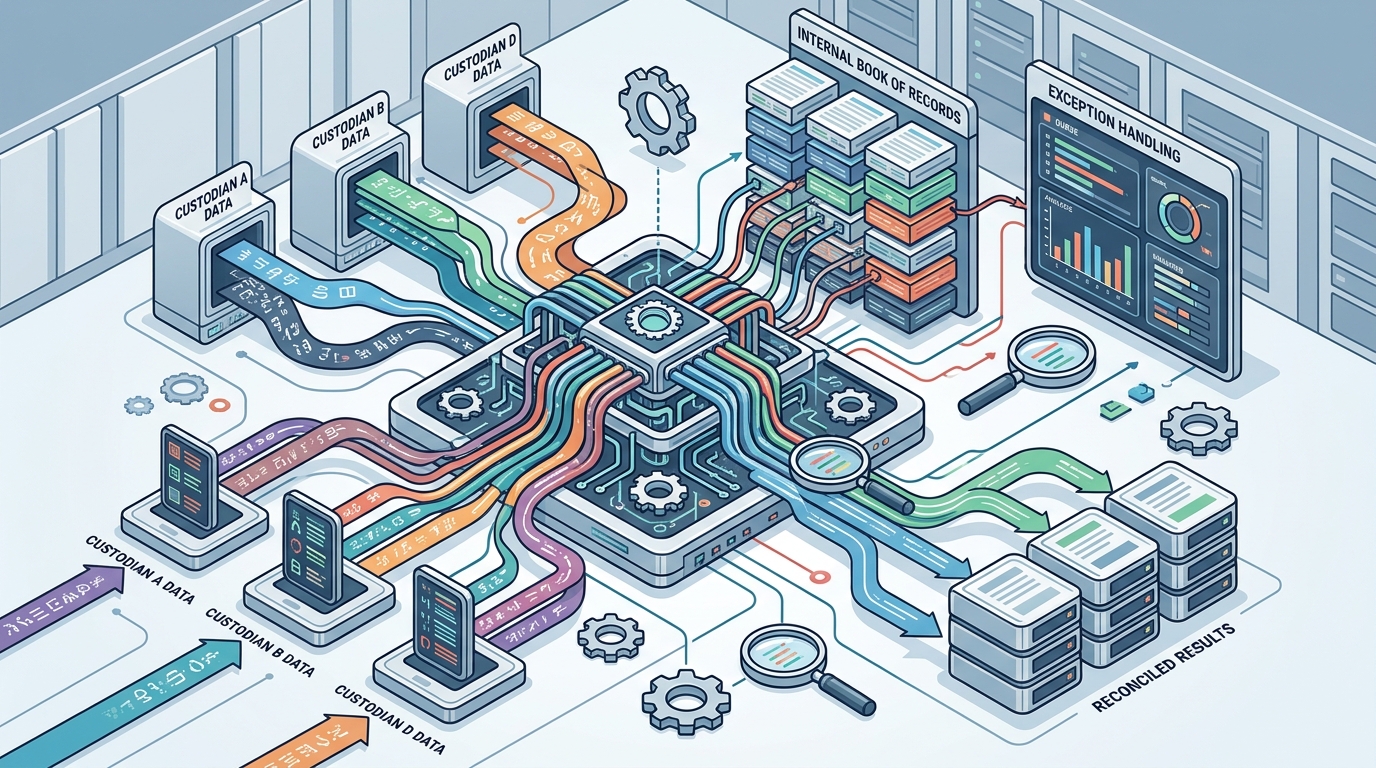
Reconciling accounts across multiple custodians is fundamentally different from reconciling a single bank account. Each custodian, prime broker, or fund administrator delivers data in its own proprietary format, on its own schedule, and with its own naming conventions. A family office or investment fund might hold assets across five different custodians, three prime brokers, and multiple bank accounts in different currencies. This creates a reconciliation matrix that scales multiplicatively rather than linearly.
The complexity is compounded by the diversity of asset classes. Equities, fixed income, derivatives, and private equity all have different settlement cycles, corporate action types, and valuation methodologies. A break in an equity position might be a simple timing difference, while a break in a derivative position might involve complex margin calculations and collateral movements. The data sources are not just different in format; they are different in structure and semantics. This is where generic AI tools often fail, as they are not trained on the specific nuances of multi-custodian financial data.
Data Normalization Challenges
Before any matching can occur, the data must be normalized. This involves mapping custodian-specific identifiers to internal account codes, converting currencies to a base currency, and standardizing date formats. This step is critical but often overlooked in generic AI tools. If the normalization is incorrect, the matching engine will produce false positives and false negatives. Aetherix Systems addresses this by building custom normalization layers for each custodian feed, ensuring that the data is clean and consistent before the matching process begins.
Agentic Exception Resolution
The defining feature of modern AI reconciliation tools is their ability to investigate and resolve exceptions autonomously. Unlike traditional matching engines that stop at the point of mismatch, agentic systems continue the workflow by pulling supporting documentation, tracing the transaction through the system, and proposing a resolution. This is the difference between flagging a problem and solving it.
At Aetherix Systems, our agents are designed to handle the full investigation workflow. When a break is identified, the agent pulls the relevant data from the custodian, the internal ledger, and any intermediate systems. It then applies a reasoning chain to determine the root cause. Is it a timing difference? A missing corporate action? A data entry error? The agent documents its reasoning and either auto-resolves the item if it falls within configured tolerance rules or escalates it to a human reviewer with a complete audit trail attached.
Reasoning and Audit Trails
Every action taken by an AI agent must be auditable. This is a critical requirement for financial institutions and family offices that are subject to regulatory scrutiny. Aetherix Systems ensures that every agent action is logged with a full reasoning trace. This includes the data that was read, the logic that was applied, and the decision that was made. This audit trail is not just a log file; it is a structured record that can be exported for regulatory reporting or external audit. This level of transparency is essential for building trust in AI-driven financial operations.
Evaluation Framework for Reconciliation AI
When evaluating AI tools for multi-custodian reconciliation, it is important to look beyond the initial matching rate. The true value of an AI tool lies in its ability to reduce the time and cost of exception resolution. A tool that matches 95% of transactions but leaves the remaining 5% in a manual queue is not a complete solution. You need a tool that can investigate and resolve those exceptions autonomously.
Consider the following factors when evaluating AI reconciliation platforms:
| Factor | Traditional Matching Engine | Agentic AI System |
|---|---|---|
| Matching Logic | Rules-based, deterministic | Machine learning, adaptive |
| Exception Handling | Flags for manual review | Investigates and proposes resolution |
| Audit Trail | Basic log of matches | Full reasoning trace on every action |
| Scalability | Linear with volume | Parallel processing, non-linear |
| Human Involvement | High, for every exception | Low, for review and approval only |
It is also important to consider the integration capabilities of the tool. Can it connect to your existing ERP, custodian portals, and bank feeds? Does it offer APIs for custom integrations? Aetherix Systems provides API-first integration, allowing you to trigger reconciliation runs, query status, and retrieve results via REST API. This flexibility is essential for building a custom reconciliation workflow that fits your specific operational needs.
Key Takeaways
- Traditional rules-based matching engines are effective for high-volume, low-complexity data but create large exception queues that require manual investigation.
- Multi-custodian reconciliation is complex due to varying data formats, schedules, and naming conventions across different custodians and prime brokers.
- Agentic AI systems go beyond matching by investigating exceptions, determining root causes, and proposing resolutions autonomously.
- A full audit trail with reasoning traces is essential for regulatory compliance and building trust in AI-driven financial operations.
- When evaluating AI reconciliation tools, focus on exception resolution capabilities, not just initial matching rates.
- API-first integration is critical for building custom reconciliation workflows that fit your specific operational needs.
- Aetherix Systems provides agentic reconciliation services for family offices, investment funds, and financial institutions, with a full audit trail on every action.
Frequently Asked Questions
What is the difference between a matching engine and an agentic AI system?
A matching engine uses rules to identify discrepancies, while an agentic AI system investigates those discrepancies, determines the root cause, and proposes a resolution. The former flags problems; the latter solves them.
Can AI tools handle multi-custodian reconciliation?
Yes, but only if they are designed for it. Generic AI tools often struggle with the complexity of multi-custodian data. Aetherix Systems builds custom normalization layers and matching rules for each custodian feed to ensure accurate reconciliation.
How does Aetherix Systems ensure auditability?
Every action taken by an Aetherix agent is logged with a full reasoning trace. This includes the data that was read, the logic that was applied, and the decision that was made. This audit trail can be exported for regulatory reporting or external audit.
What types of exceptions can agentic AI resolve?
Agentic AI can resolve a wide range of exceptions, including timing differences, missing corporate actions, data entry errors, and pricing discrepancies. The specific types of exceptions that can be resolved depend on the configuration of the agent and the complexity of the data.
How long does it take to implement an AI reconciliation system?
Implementation time varies depending on the complexity of the data and the number of custodians involved. Aetherix Systems typically delivers a production-ready system in 3-6 weeks, including a shadow period where the agents run in parallel with the existing process.
Do AI tools replace human analysts?
No, AI tools augment human analysts. The agents handle the repetitive, rule-based tasks of investigation and resolution, freeing up human analysts to focus on higher-value work such as strategy, creativity, and growth.
What is the role of tolerance rules in AI reconciliation?
Tolerance rules define what auto-resolves and what requires human review. For example, a small pricing discrepancy might be auto-resolved if it falls within a configured tolerance, while a large discrepancy would be escalated to a human reviewer. These rules are configurable per account type, entity, and period.
Conclusion
Choosing the right AI tool for multi-custodian reconciliation is a critical decision for any financial institution or family office. The key is to look beyond the initial matching rate and focus on the tool's ability to investigate and resolve exceptions autonomously. Aetherix Systems provides agentic reconciliation services that handle the full workflow, from data ingestion to exception resolution, with a full audit trail on every action. By leveraging AI agents, you can compress your close cycle, reduce manual effort, and improve your compliance posture. To learn more about how Aetherix Systems can help you automate your reconciliation operations, .