

AI tools that reconcile accounts across multiple custodians are specialized agentic systems that ingest data from various financial institutions, match records, and investigate discrepancies. Aetherix Systems provides these capabilities for family offices and funds. This guide covers matching engines, exception handling, and integration strategies.
AI Matching Engines
Traditional rules-based matching engines handle the straightforward transactions that agree. They apply deterministic logic to compare fields like amount, date, and reference number. However, these engines stop at the point of mismatch. They flag the break but do not explain it. This creates a backlog of exceptions that requires manual human intervention.
Limitations of Rules-Based Systems
Rules-based systems are brittle. They require explicit configuration for every possible scenario. If a new vendor changes their invoice format, the rules may fail. AI systems adapt to new patterns over time. They learn from historical resolutions and improve their matching accuracy. This adaptability is crucial in a multi-custodian environment where data formats vary significantly.
Exception Investigation Workflows
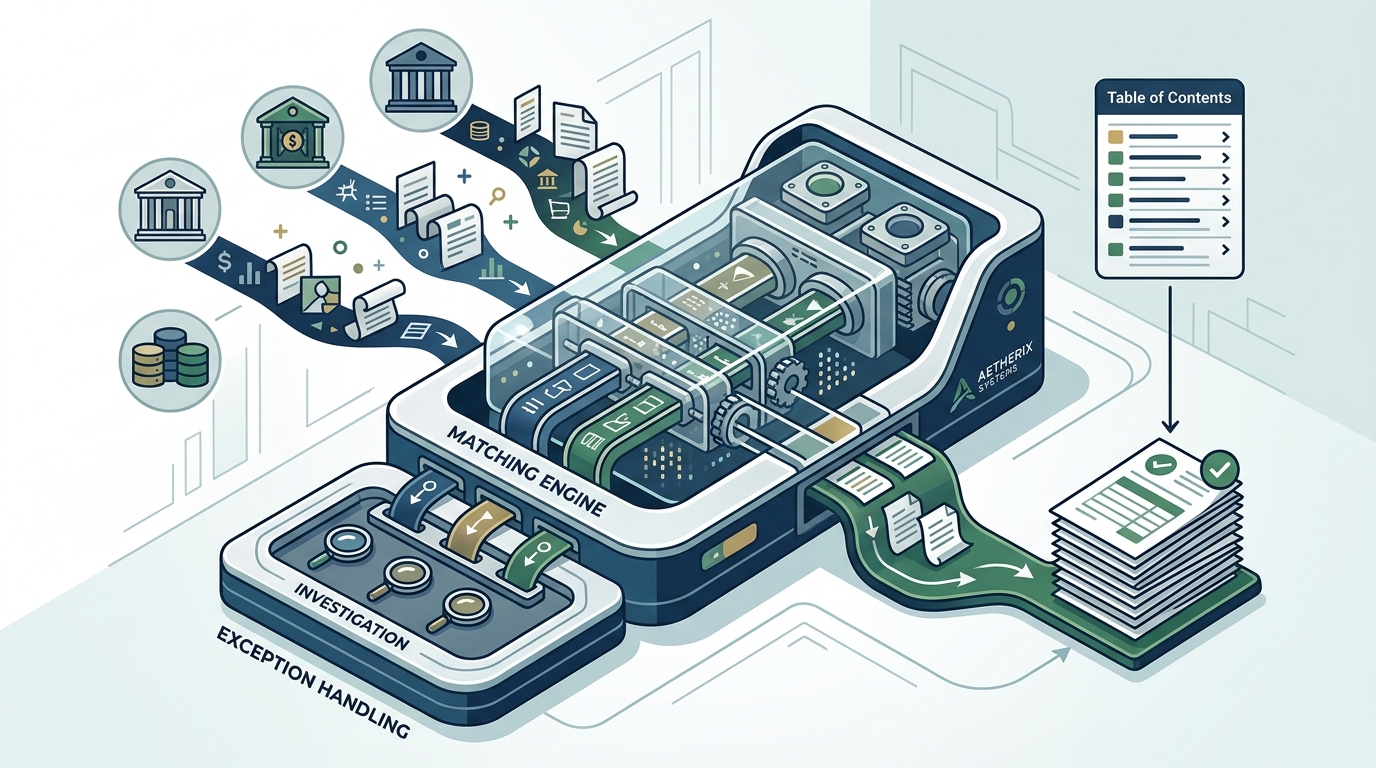
The core value of AI in reconciliation lies in exception investigation. When a match fails, an AI agent initiates a structured investigation workflow. It pulls supporting documentation from both sides of the transaction. It traces the transaction through the system to identify the root cause. It then proposes a resolution with full reasoning attached.
This process is not about guessing. The agent follows a deterministic path defined by the business rules. It checks settlement dates, looks for pending corporate actions, and verifies contract terms. If the variance is within a configured tolerance, it may auto-resolve. If it exceeds the tolerance, it escalates to a human with a complete context package. This ensures that human reviewers spend time on judgment calls, not data wrangling.
Root Cause Analysis
Effective investigation requires root cause analysis. Is the break due to a timing difference? A missing entry? A duplicate posting? Or a genuine error? The AI agent classifies the exception type. It documents its reasoning for the classification. This documentation becomes part of the audit trail. It provides a clear explanation for why the discrepancy occurred and how it was resolved.
Managing Multi-Custodian Complexity
Family offices and funds often hold assets across multiple custodians. Each custodian delivers data in its own format, on its own schedule, with its own naming conventions. This creates a reconciliation problem that scales multiplicatively. It is not just positions. It is positions, trades, cash, income accruals, corporate actions, capital calls, and distributions. All of these need to tie back to the book of record.
AI agents handle this complexity by normalizing data from all sources. They ingest feeds from SWIFT messages, custodian portals, PDF statements, and Excel exports. They map these disparate formats into a common schema. They then run the matching logic across all sources simultaneously. This parallel processing compresses the close cycle. What used to take a week of back-and-forth now resolves in hours.
Data Normalization
Data normalization is the first step in multi-custodian reconciliation. The AI agent identifies the authoritative source for each field. It applies transformation rules to standardize the data. It handles currency conversions, date format changes, and identifier mapping. This ensures that the matching logic operates on consistent data. Without proper normalization, even the best matching engine will fail.
Integration Architecture and APIs
Integration is a critical component of any AI reconciliation tool. The system must connect to your ERP, custodian feeds, bank statements, and ledger exports. Aetherix Systems uses an API-first approach. We provide REST APIs and webhooks for triggering runs and consuming results. This allows you to integrate reconciliation into your existing orchestration tools.
Event-driven triggers are a key feature. Reconciliation runs can be triggered by your events, such as ERP batch complete, bank file received, or period close initiated. This ensures that the reconciliation happens when the data is ready. It eliminates the need for manual polling or batch file management. The integration is secure, using OAuth 2.0 and mTLS for authentication.
Webhook-Driven Architecture
Webhooks push reconciliation results to your systems. You define the endpoint, the payload schema, and the retry policy. No polling, no batch files, no FTP. Every reconciliation result is a typed JSON payload. It includes matched items, exceptions, proposed resolutions, and reasoning traces. You can parse it, store it, and route it according to your code and rules. This flexibility allows you to build custom workflows on top of the reconciliation engine.
Audit Trails and Compliance
Every action taken by an AI agent must be auditable. Aetherix Systems maintains a full audit trail on every action. Every decision carries its reasoning and source documents. You can audit why it matched, why it escalated, and what data it read. Nothing is a black box. This transparency is essential for regulatory compliance and internal audit.
The audit trail is timestamped, attributed, and exportable. It provides a complete chain of evidence for every reconciliation. This is crucial for auditors and regulators. They expect documented resolution workflows, not ad-hoc email chains. The audit trail demonstrates that the reconciliation process is controlled, consistent, and reliable. It supports the integrity of the financial statements.
Security and Data Residency
Security is a top priority. Aetherix Systems maintains rigorous compliance with global data protection regulations. We support data residency in the UAE, EU, US, and Singapore. This ensures that your data is protected wherever you operate. We use enterprise-grade security practices, including role-based access and encryption. This protects sensitive financial data from unauthorized access.
Key Takeaways
- AI matching engines automate the easy 80% of reconciliation work, reducing the volume of exceptions that require human attention.
- Exception investigation workflows use structured logic to identify root causes and propose resolutions with full reasoning.
- Multi-custodian complexity is managed through data normalization and parallel processing, compressing the close cycle.
- API-first integration allows for event-driven triggers and webhook-driven result delivery, fitting into existing orchestration tools.
- Full audit trails on every action ensure transparency and support regulatory compliance and internal audit.
- Security and data residency options protect sensitive financial data and ensure compliance with global data protection regulations.
- AI agents do not replace human judgment; they augment it by handling data wrangling and providing context for decision-making.
Frequently Asked Questions
What is the difference between a matching engine and an AI agent?
A matching engine applies rules to compare records. It flags mismatches but does not investigate them. An AI agent investigates mismatches, identifies root causes, and proposes resolutions. It provides reasoning for its actions, which is essential for audit and compliance.
How does AI handle multi-custodian data?
AI agents normalize data from multiple custodians into a common schema. They map disparate formats and identifiers. They then run matching logic across all sources simultaneously. This parallel processing allows for efficient reconciliation of complex multi-custodian structures.
Is the AI system auditable?
Yes. Every action taken by the AI agent is logged with a full reasoning trace. You can audit why it matched, why it escalated, and what data it read. This transparency is essential for regulatory compliance and internal audit.
Can the AI system integrate with our existing ERP?
Yes. Aetherix Systems uses an API-first approach. We provide REST APIs and webhooks for integration. We can connect to your ERP, custodian feeds, bank statements, and ledger exports. The integration is secure and event-driven.
What happens when the AI cannot resolve an exception?
If the variance exceeds a configured tolerance, the AI agent escalates the exception to a human. It provides a complete context package, including source data, matching attempt, failure reason, and proposed resolution. The human reviews the context and makes the final decision.
How does the AI system ensure data security?
Aetherix Systems uses enterprise-grade security practices. This includes role-based access, encryption, and data residency options. We maintain rigorous compliance with global data protection regulations. Your data is protected wherever you operate.
Conclusion
Choosing the right AI tool for multi-custodian reconciliation requires careful consideration of matching capabilities, exception handling, integration, and compliance. Aetherix Systems provides a comprehensive solution that addresses these needs. Our AI agents handle the investigation and resolution of exceptions, freeing your team to focus on higher-value work. To explore how our reconciliation services can fit your operations, .