

Good AI tools for nostro and vostro account reconciliation are agentic systems that investigate discrepancies, trace root causes, and propose resolutions with full audit trails. This guide covers the core capabilities of modern reconciliation tools, the specific challenges of correspondent banking, and how to evaluate exception handling workflows for your institution.
Nostro and Vostro Reconciliation Tools
Nostro and vostro account reconciliation is the process of matching internal ledger balances against external bank statements to verify that all cash movements are accurately recorded across correspondent banking relationships. Traditional rules-based matching engines handle the straightforward transactions that agree, but they create an exception queue that requires manual investigation. Modern AI tools shift the focus from simple matching to intelligent exception resolution.
From Matching to Investigation
Financial institutions operate at a scale where even a 0.1% exception rate generates thousands of breaks per day. A mid-sized bank running nostro reconciliation across 30 correspondent banks might process 50,000 transactions daily, and a portion of those will not match on the first pass. Each one requires investigation to determine if it is a timing difference, a missing entry, a duplicate, or a genuine error. Legacy platforms built in the 2000s handle matching reasonably well but offer no intelligence on the investigation side. The matching engine flags a break, and a human investigates it. At scale, that human layer becomes the constraint.
Agentic AI Capabilities
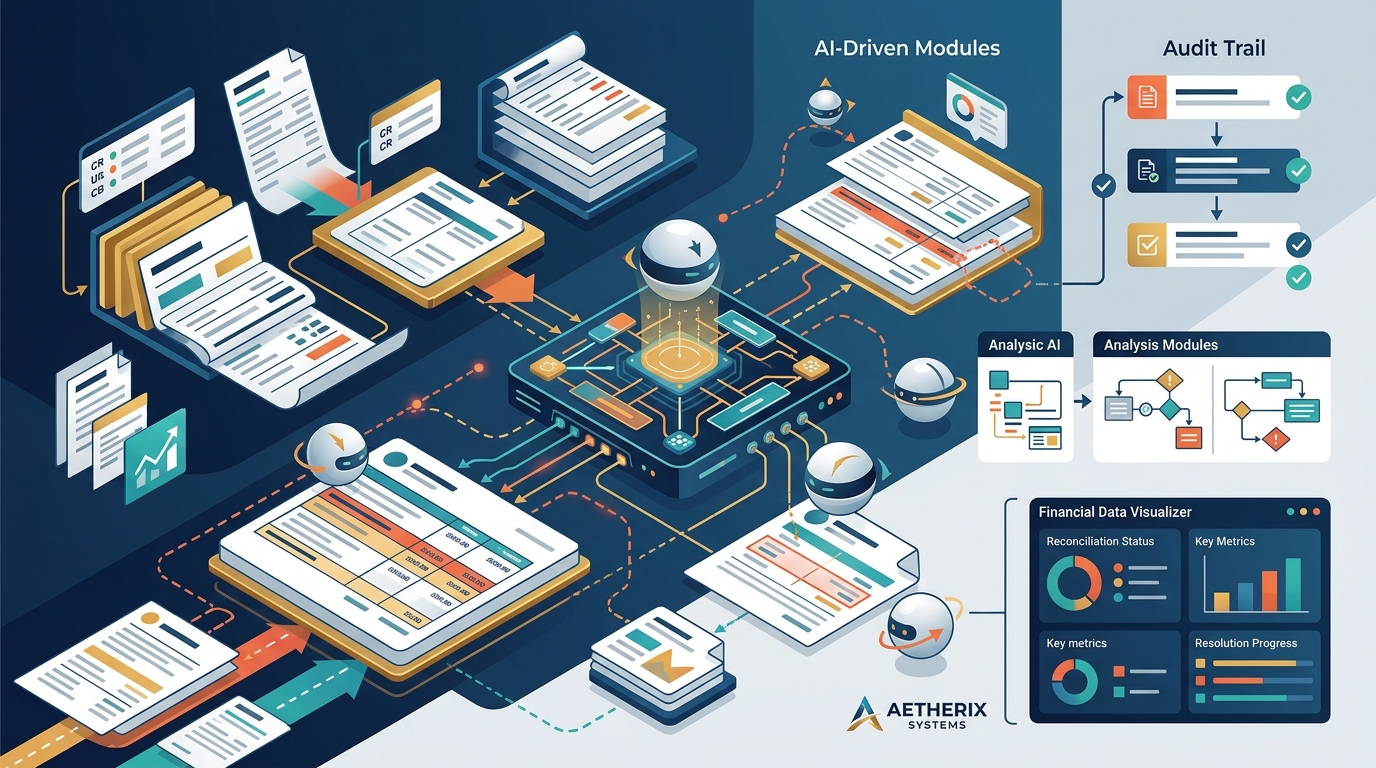
Agentic AI systems represent the next paradigm in enterprise software. These are not chatbots or copilots. They are fully autonomous agents that handle complex workflows end-to-end. In the context of nostro and vostro reconciliation, these agents ingest data from custodians, banks, and ledgers, auto-match positions and cash, and then investigate breaks by researching source documents and proposing resolutions. Every action is auditable, with a full reasoning trace attached to each decision. This approach transforms the close from a fire drill into a predictable, accelerated process.
Evaluating Tool Capabilities
When evaluating AI tools for nostro and vostro reconciliation, look for systems that can handle the diversity of reconciliation types running simultaneously. Nostro and vostro accounts need daily balancing, while intercompany positions between legal entities need elimination at month-end. The tool must be able to trace a nostro discrepancy back to its root cause, such as a pending SWIFT confirmation, a duplicate posting, or a value-date mismatch. It should document its reasoning and either auto-resolve with evidence or escalate with a recommended action. Your team should review resolutions rather than performing investigations.
Exception Handling Workflows
Exception handling is the critical differentiator in reconciliation automation. Matching creates an exception queue, but an operating model must still investigate, document, escalate, and close each break. The quality of the exception handling workflow determines whether the tool reduces workload or simply moves the work to a different queue.
Root Cause Analysis
Effective exception handling begins with root cause analysis. The agent must be able to distinguish between timing differences that will self-clear and genuine errors that require correction. For example, a trade date versus settlement date mismatch is a timing break. The agent checks the settlement calendar, confirms pending status, and auto-resolves on T+1 or T+2. A quantity break, such as a lot-level mismatch or partial fill, requires the agent to trace to the source trade and verify the corporate action schedule. If unresolved after a set number of business days, it flags the item for human review.
Escalation and Audit Trails
Not every mismatch is a problem. Tolerances define what auto-resolves and what requires human review. Rules are configurable per account type, entity, and period. When an exception exceeds tolerance, the system must escalate with full context. This includes the source data, the matching attempt, the failure reason, and the proposed resolution. Every agent action is logged as a work note, creating an audit trail that lives in your GRC module. Compliance teams can review reconciliation evidence without leaving their existing workflows. This is crucial for regulatory reporting and external audit, where auditors expect documented resolution workflows, not ad-hoc email chains.
Integration with Existing Systems
The exception handling workflow must integrate seamlessly with your existing tech stack. Our agents integrate with ERP systems, CRM platforms, data warehouses, and custom internal tools via APIs and event-driven architectures. For example, every reconciliation break can become a ServiceNow incident with full context. Your ops team works exceptions in the tool they already live in. Journal entry proposals route through your existing approval chains, with role-based routing, SLA tracking, and escalation paths configured in your instance. This bidirectional integration ensures that the AI tool enhances your existing workflows rather than replacing them.
| Capability | Rules-Based Engine | Agentic AI System |
|---|---|---|
| Matching | High accuracy on clean items | High accuracy on clean items |
| Exception Investigation | Flags breaks for human review | Investigates root cause, proposes resolution |
| Audit Trail | Basic logging | Full reasoning trace on every action |
| Escalation | Manual routing | Context-rich escalation with evidence |
| Integration | Batch files, FTP | APIs, webhooks, event-driven triggers |
Key Takeaways
- Good AI tools for nostro and vostro reconciliation go beyond matching to investigate exceptions and propose resolutions.
- Agentic AI systems provide full audit trails with reasoning traces on every action, which is critical for regulatory compliance.
- Exception handling workflows must distinguish between timing differences and genuine errors to avoid unnecessary escalations.
- Integration with existing systems like ServiceNow and Salesforce ensures that the AI tool enhances rather than replaces your workflows.
- Tolerance rules are configurable per account type, entity, and period, allowing for precise control over what auto-resolves and what requires human review.
- The goal is to transform the close from a fire drill into a predictable, accelerated process by removing manual work from the reconciliation cycle.
Frequently Asked Questions
What is the difference between nostro and vostro accounts?
Nostro accounts are accounts held by a bank in another bank's name, while vostro accounts are accounts held by a bank for another bank. Both require reconciliation to ensure that balances match across the two institutions.
How do AI agents handle nostro reconciliation exceptions?
AI agents investigate breaks by researching source documents, tracing root causes, and proposing resolutions. They document their reasoning and either auto-resolve with evidence or escalate with a recommended action.
What is the role of tolerance rules in reconciliation?
Tolerance rules define what auto-resolves and what requires human review. They are configurable per account type, entity, and period, allowing for precise control over exception handling.
Can AI tools integrate with existing ERP systems?
Yes, AI tools can integrate with ERP systems, CRM platforms, data warehouses, and custom internal tools via APIs and event-driven architectures. This ensures seamless integration with your existing tech stack.
What is an audit trail in the context of reconciliation?
An audit trail is a complete record of every action taken during the reconciliation process, including the source data, matching attempt, failure reason, and proposed resolution. It is crucial for regulatory compliance and external audit.
How does agentic AI differ from rules-based automation?
Agentic AI systems are fully autonomous agents that handle complex workflows end-to-end, including investigation and resolution. Rules-based automation handles matching but requires human intervention for exception investigation.
What are the benefits of using AI for nostro and vostro reconciliation?
The benefits include reduced manual workload, faster close cycles, improved audit trails, and better regulatory compliance. AI tools transform the close from a fire drill into a predictable, accelerated process.How do I evaluate AI tools for reconciliation?
Look for systems that can handle the diversity of reconciliation types running simultaneously, provide full audit trails, and integrate seamlessly with your existing tech stack. Evaluate the quality of the exception handling workflow and the ability to trace root causes.
Conclusion
Choosing the right AI tool for nostro and vostro account reconciliation is about more than matching accuracy. It is about building an operating model that investigates exceptions, documents resolutions, and integrates with your existing workflows. Aetherix Systems runs reconciliation operations for family offices, investment funds, and financial institutions using AI agents, with a full audit trail on every action. Our agents handle the exception queue, investigate breaks, and propose resolutions, freeing your team to focus on higher-value work. To plan your visit, to discuss how we can help you transform your reconciliation process.