

Good AI tools for financial reconciliation are systems that move beyond simple matching to actively investigate, resolve, and document exceptions. This guide covers enterprise reconciliation platforms, transaction matching automation, and exception handling workflows. It explains how modern agentic AI transforms month-end close processes for finance teams.
Enterprise Reconciliation Platforms
Enterprise reconciliation platforms are software systems designed to manage the end-to-end process of verifying financial records across multiple sources. Traditional platforms focus heavily on the matching engine, which compares data points from different systems. While these tools are effective for high-volume, low-complexity matching, they often leave the most difficult work to human analysts. The modern enterprise platform must integrate deeply with ERP systems, data warehouses, and workflow management tools to provide a complete operational picture.
Integration and Data Connectivity
The value of a reconciliation platform is determined by its ability to ingest data from diverse sources. This includes ERP systems like SAP and NetSuite, bank feeds, custodian statements, and third-party APIs. A robust platform uses secure, API-first architectures to pull data in real-time or on a scheduled basis. It must handle various data formats, including structured JSON, CSV, and unstructured PDFs, normalizing them into a consistent schema for processing. Without strong connectivity, the platform becomes a silo that requires manual data entry, negating the benefits of automation.
Scalability and Multi-Entity Support
For organizations with multiple subsidiaries, currencies, or legal entities, the platform must scale without linear increases in cost or complexity. It should support multi-tenant architectures where each entity's data is isolated but can be consolidated for group reporting. The platform must also handle the specific challenges of multi-currency reconciliation, including FX revaluation and rate source verification. Aetherix Systems, for example, builds agents that connect to these enterprise landscapes to run reconciliation as a managed service, ensuring that the infrastructure scales with the client's operational footprint.
Transaction Matching Automation
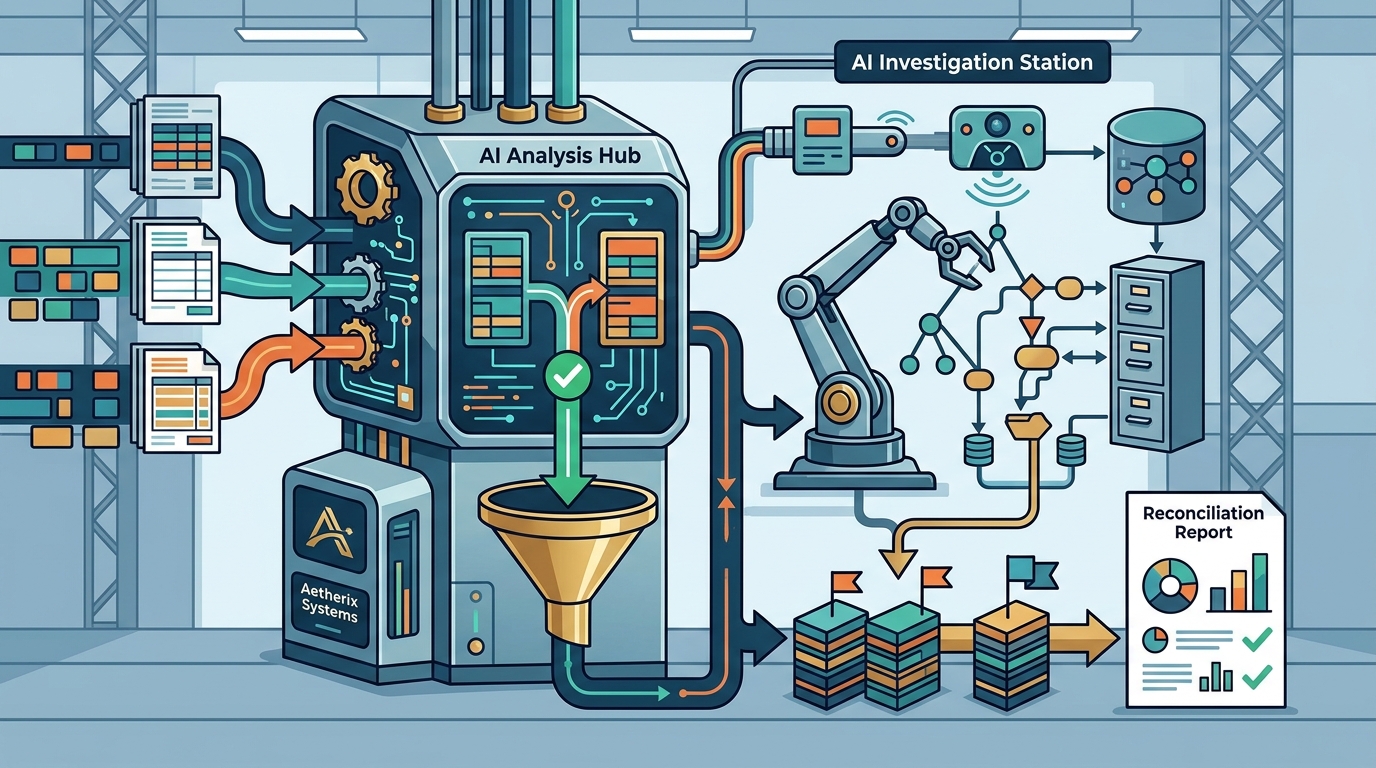
Transaction matching automation is the process of using algorithms to compare records from two or more systems to identify agreements and discrepancies. This is the foundational layer of reconciliation. Modern automation uses a combination of rule-based logic and machine learning to improve match rates over time. The goal is to reduce the volume of items that require human attention by automatically clearing the straightforward transactions.
Rule-Based vs. AI-Driven Matching
Rule-based matching relies on predefined criteria, such as matching invoice numbers, amounts, and dates. It is deterministic and predictable, making it ideal for high-volume, standardized transactions. However, it struggles with variations in data formatting or minor discrepancies. AI-driven matching uses machine learning models to identify patterns and predict matches even when exact fields do not align. These models can learn from historical resolutions, improving their accuracy as they process more data. The most effective systems combine both approaches, using rules for the bulk of transactions and AI for the complex tail.
Three-Way Matching and Beyond
In accounts payable, three-way matching compares the purchase order, goods receipt, and vendor invoice. Automation must handle the logic of tolerances, where small variances are accepted, and larger ones are flagged. For more complex scenarios, such as intercompany transactions or investment positions, the matching logic must account for timing differences, currency conversions, and corporate actions. The automation layer must not only flag mismatches but also provide context for why a match failed, helping analysts understand the root cause quickly.
Exception Handling Workflows
Exception handling workflows are the processes and tools used to investigate, resolve, and document discrepancies that automated matching cannot clear. This is where the true value of AI in reconciliation emerges. Traditional tools create a queue of exceptions that analysts must work through manually. Agentic AI systems, on the other hand, can investigate these exceptions by pulling supporting documentation, tracing transaction paths, and proposing resolutions.
From Flagging to Investigating
The shift from flagging to investigating represents a paradigm change in reconciliation. When an agent encounters a break, it does not just stop; it reasons through the problem. It might check if a trade is pending settlement, verify if a credit memo was issued, or trace a journal entry that bypassed the subledger. This investigative capability requires access to the full context of the transaction, including related documents and system logs. The agent then proposes a resolution, such as a journal entry or a status update, which is presented to a human for approval.
Audit Trails and Compliance
Every action taken by an AI agent must be logged with a complete audit trail. This includes the data compared, the logic applied, and the reasoning behind the proposed resolution. This transparency is critical for compliance and audit purposes. Regulators and auditors expect documented resolution workflows, not ad-hoc email chains or undocumented spreadsheet adjustments. Aetherix Systems emphasizes this by ensuring that every agent action is auditable, providing a clean chain of evidence that supports the integrity of the financial close.
Key Takeaways
- Enterprise reconciliation platforms must integrate deeply with ERPs and data warehouses to provide a complete operational view.
- Transaction matching automation combines rule-based logic with AI to improve match rates and reduce manual effort.
- Exception handling is the most valuable application of AI in reconciliation, moving from flagging breaks to investigating and resolving them.
- Agentic AI systems can propose resolutions with full reasoning, but human oversight remains essential for final approval.
- A complete audit trail is non-negotiable for compliance, ensuring that every automated action is documented and verifiable.
- Scalability is critical for multi-entity organizations, requiring platforms that can handle complex consolidation and multi-currency scenarios.
- The goal of AI in reconciliation is to free finance teams from data wrangling, allowing them to focus on higher-value analysis and strategy.
Frequently Asked Questions
What is the difference between RPA and AI in reconciliation?
RPA (Robotic Process Automation) automates repetitive, rule-based tasks, such as data entry or simple matching. AI, particularly agentic AI, can handle complex, judgment-intensive tasks like investigating exceptions and proposing resolutions. RPA is effective for the high-volume, low-complexity portion of reconciliation, while AI addresses the difficult tail of exceptions.
Can AI fully automate the financial close?
AI can automate the majority of the reconciliation and journal entry preparation steps in the financial close. However, it cannot fully automate the close because human judgment is required for final approvals, strategic decisions, and complex accounting estimates. The goal is to accelerate the close by removing manual work, not to eliminate human oversight.
How do AI agents handle multi-currency reconciliation?
AI agents handle multi-currency reconciliation by tracing variances back to the exchange rate used and the posting date. They can classify differences as realized or unrealized FX gains and losses, ensuring that the reconciliation aligns with accounting standards. This requires access to the rate source and the specific transaction details.
What is an agentic AI system?
An agentic AI system is a type of AI that can perceive its environment, reason about problems, make decisions, and take actions to achieve a goal. In reconciliation, an agentic AI system can investigate a break, pull supporting documents, and propose a resolution, acting with a degree of autonomy while remaining within defined safety boundaries.
How does Aetherix Systems differ from traditional reconciliation software?
Traditional reconciliation software focuses on matching and flagging exceptions. Aetherix Systems runs reconciliation as a managed service using AI agents that investigate and resolve exceptions. This means the client receives a clean reconciliation with full audit trails, rather than a dashboard of exceptions to work through manually.
Is AI reconciliation secure?
Yes, when implemented with enterprise-grade security practices. This includes role-based access control, data encryption, and full audit trails. Aetherix Systems, for example, operates with SOC 2 Type II and ISO 27001 aligned security practices, ensuring that client data is protected and that every action is logged.
Conclusion
Choosing the right AI tools for financial reconciliation requires looking beyond simple matching capabilities. The most effective systems are those that can investigate exceptions, propose resolutions, and provide a complete audit trail. Aetherix Systems offers a managed service approach that leverages agentic AI to handle the complex tail of reconciliation, freeing finance teams to focus on higher-value work. By integrating deeply with enterprise systems and maintaining rigorous security and compliance standards, Aetherix Systems helps organizations achieve a faster, cleaner, and more auditable financial close.