

AI exception handlers resolve reconciliation breaks by autonomously investigating discrepancies, validating data integrity, and proposing corrective journal entries. Aetherix Systems builds these agentic workflows to manage complex financial operations across multiple prime brokers. These systems reduce manual review time while maintaining a strict audit trail for every automated action. For additional details, review the aetherixsystems com.
The Mechanics of Autonomous Investigation
Traditional rules-based matching engines flag exceptions but stop there. They identify a mismatch between a trade record and a settlement report, then wait for a human to intervene. AI exception handlers go further. They act as digital investigators that dig into the root cause of the break. For additional details, review the .
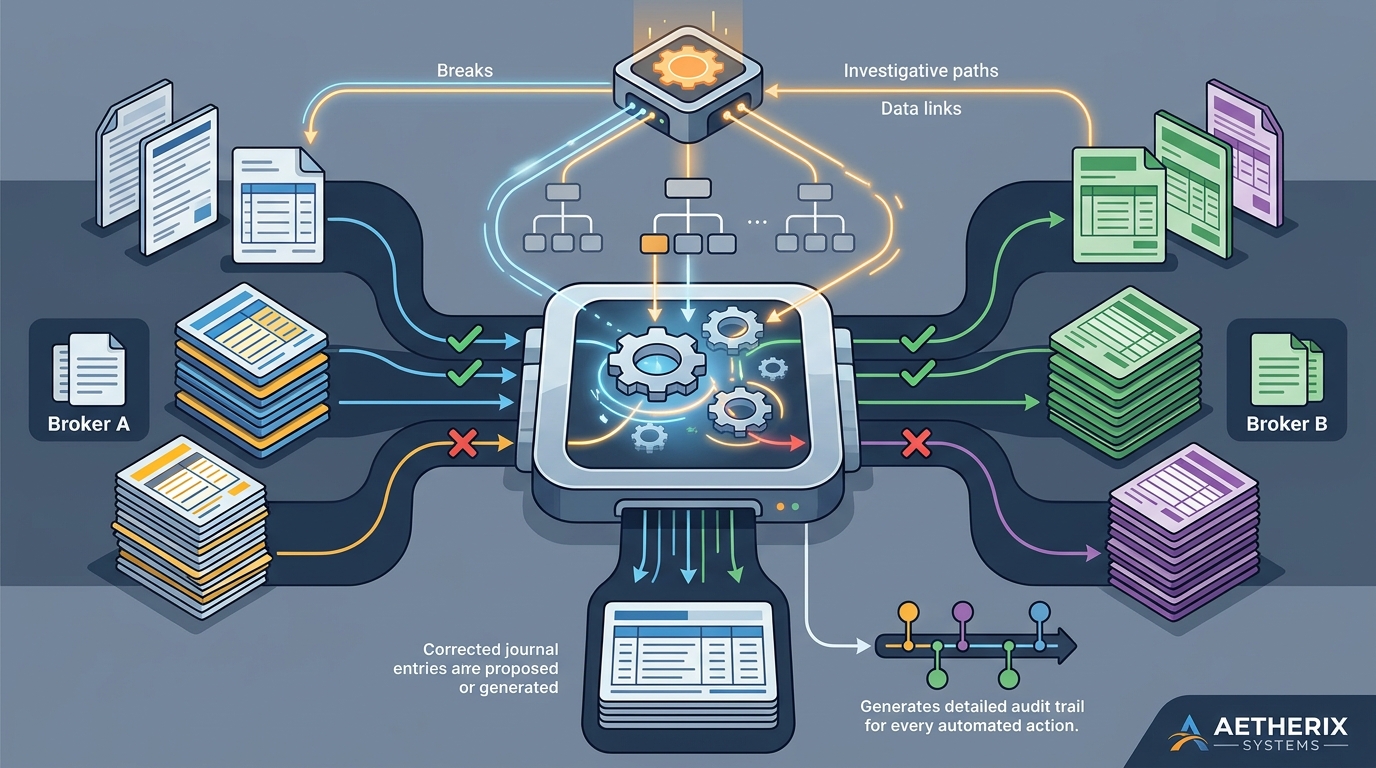
An AI agent is an autonomous software system capable of perceiving its environment, reasoning about discrepancies, and taking actions to achieve a goal. When a reconciliation break occurs, the agent first classifies the error type. It distinguishes between timing differences, data entry errors, and genuine settlement failures. This classification determines the next step in the workflow. For additional details, review the Customer Experience.
The agent then queries multiple data sources simultaneously. It cross-references the prime broker report with the internal ledger, the custodian statement, and the trade blotter. If the agent finds a missing trade, it searches for the corresponding confirmation. If it finds a price discrepancy, it validates the execution price against market data. This multi-source validation is the core of the automated resolution process. For additional details, review the Frequently Asked Questions.
Handling Complex Multi-Broker Scenarios
Reconciliation across multiple prime brokers introduces significant complexity. Each broker may use different data formats, reporting cycles, and settlement conventions. A single position might be split across three different broker accounts. Manual reconciliation in this environment is slow and prone to human error. For additional details, review the About.
AI systems handle this complexity through normalization and mapping. The agent translates disparate data formats into a common schema. It aligns different naming conventions for the same underlying asset. For example, it recognizes that a specific ticker symbol in one broker system refers to the same instrument as a different identifier in another system. This semantic alignment allows the agent to aggregate positions accurately.
Consider a scenario where a fund holds a large equity position split across two prime brokers. A settlement failure occurs at one broker, but the position is fully settled at the other. A rules-based system might flag the entire position as an exception. An AI handler recognizes the split. It isolates the failed leg, investigates the specific failure reason, and proposes a journal entry to adjust only the affected portion. The rest of the position remains reconciled without manual intervention.
Proposing and Validating Corrective Actions
Identifying the root cause is only half the job. The system must also propose a fix. AI exception handlers generate proposed journal entries to correct the ledger. These proposals are not final. They are recommendations that require human approval before posting.
This human-in-the-loop design is critical for compliance. Aetherix Systems ensures that our agents propose journal entries, but a named client employee posts them. This separation of duties preserves the integrity of the financial records. It also satisfies internal control requirements that mandate human oversight for financial adjustments. The system maintains a full audit trail, logging every step of the investigation and the rationale for the proposed fix.
Operational Efficiency and Audit Trails
The primary benefit of AI exception handling is operational efficiency. Manual reconciliation teams spend significant time on repetitive investigation tasks. AI agents handle these tasks in seconds. This frees up human analysts to focus on complex, high-value exceptions that require judgment and context.
Efficiency is not the only advantage. AI systems provide a consistent and complete audit trail. Every action taken by the agent is logged. The system records the data sources queried, the logic applied, and the outcome of each investigation. This level of detail is difficult to achieve with manual processes. It provides a clear history of how each exception was resolved.
Key Takeaways
- AI exception handlers investigate reconciliation breaks by querying multiple data sources and validating data integrity.
- These systems normalize disparate data formats from multiple prime brokers into a common schema for accurate aggregation.
- Agents propose corrective journal entries with confidence scores, but human employees must approve and post them.
- A full audit trail is maintained for every automated action, supporting regulatory compliance and internal controls.
- AI systems reduce manual review time by handling repetitive investigation tasks, allowing analysts to focus on complex exceptions.
- The human-in-the-loop design ensures that financial adjustments remain under human oversight, preserving control integrity.
Frequently Asked Questions
Do AI exception handlers post journal entries automatically?
No. AI agents propose journal entries based on their investigation findings. A named client employee reviews and approves these proposals before they are posted to the ledger. This ensures human oversight and compliance with internal controls.
How do AI systems handle data from different prime brokers?
AI systems use normalization and mapping techniques to translate disparate data formats into a common schema. They align different naming conventions and identifiers to ensure that positions are aggregated accurately across multiple brokers.
What is the role of confidence scores in AI exception handling?
Confidence scores reflect the agent's certainty in its diagnosis. High-confidence proposals may be batched for quick review, while low-confidence proposals are routed to senior analysts for detailed examination. This prioritization helps manage the review workload efficiently.
Can AI systems distinguish between different types of reconciliation breaks?
Yes. AI agents classify errors by type, such as timing differences, data entry errors, or settlement failures. This classification determines the investigation path and the type of corrective action proposed.
How does AI exception handling support regulatory compliance?
Conclusion
AI exception handlers transform reconciliation from a manual, reactive process into an automated, proactive workflow. By investigating breaks, validating data, and proposing fixes, these systems significantly reduce the time and effort required to maintain accurate financial records. Aetherix Systems designs these agentic workflows to integrate seamlessly with existing finance operations, ensuring that every action is documented and every exception is resolved with precision. To explore how AI-driven exception handling can streamline your reconciliation processes, contact Aetherix Systems. Learn more: aetherixsystems com.