

Good AI tools for financial reconciliation are agentic systems that investigate and resolve exceptions, not just match transactions. This guide covers enterprise reconciliation platforms, AI agent architectures, and integration strategies for modern finance teams.
Enterprise Reconciliation Platforms
Enterprise reconciliation platforms are software systems designed to automate the matching of financial records across multiple sources. Traditional platforms focus on rules-based matching, where predefined logic compares data points between systems. While effective for clean data, these tools often struggle with the complex exceptions that arise in real-world financial operations.
The modern landscape includes several categories of tools. First, there are legacy reconciliation engines that have been updated with basic automation features. Second, there are cloud-native platforms that offer flexible matching rules and dashboards. Third, and increasingly common, are agentic AI systems that go beyond matching to investigate and resolve discrepancies.
Rules-Based vs. Agentic Approaches
Rules-based tools are deterministic. They apply a set of if-then logic to identify matches and flag exceptions. This approach is transparent and easy to audit, but it lacks the ability to handle novel or complex breaks. When a rule fails, the exception sits in a queue for a human to investigate.
Agentic AI tools, by contrast, use large language models and reasoning chains to understand context. They can interpret unstructured data, such as email threads or PDF statements, and propose resolutions. This shift from matching to investigation is the defining characteristic of modern AI reconciliation tools.
AI Agent Architecture for Finance
AI agent architecture is the underlying design pattern that enables autonomous decision-making in financial workflows. In reconciliation, agents are not general-purpose chatbots. They are purpose-built systems with defined roles, decision boundaries, and safety guardrails.
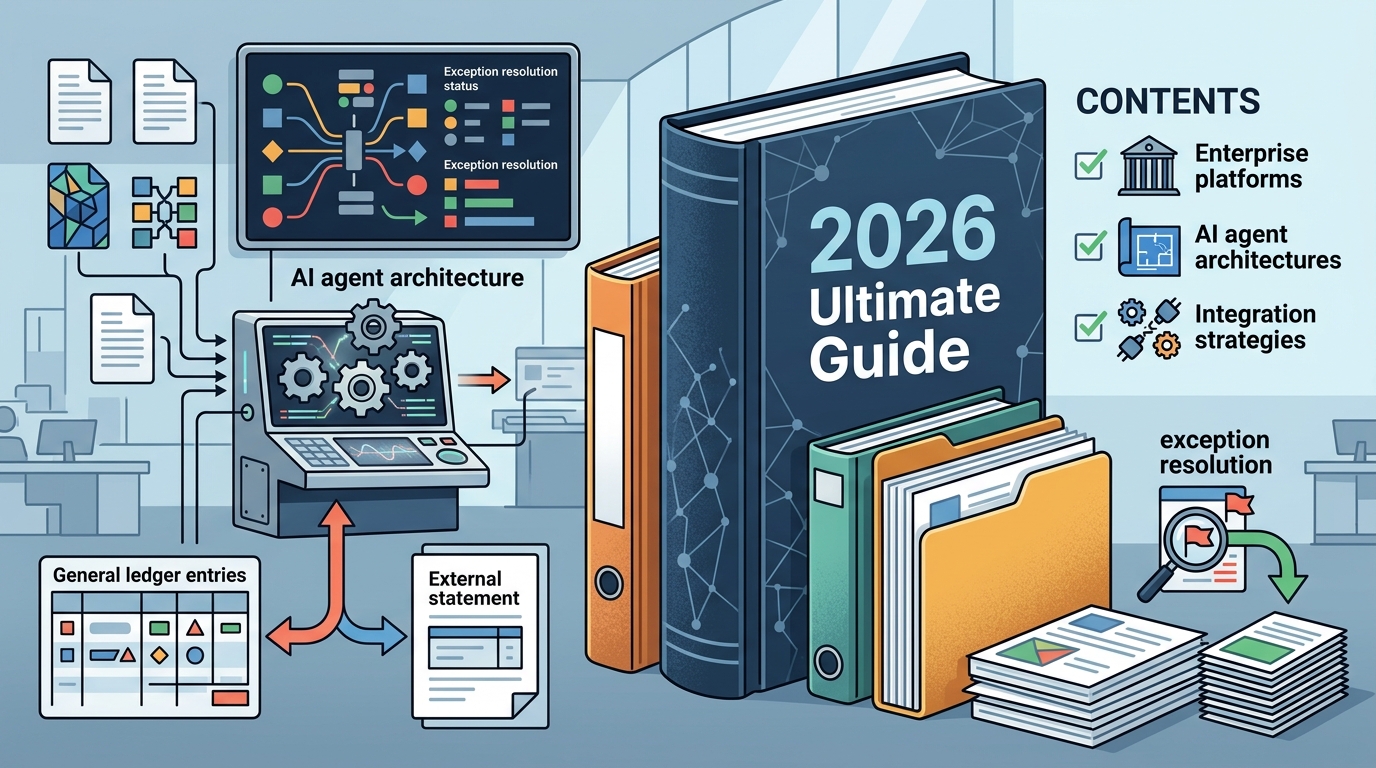
A typical reconciliation agent operates in a multi-step workflow. It ingests data from various sources, performs initial matching, and then investigates any breaks. The investigation phase is where the value lies. The agent pulls supporting documentation, traces the transaction through the system, and classifies the exception. It then proposes a resolution, which a human reviewer can approve or reject.
Multi-Agent Orchestration
Complex financial processes often require multiple agents working together. For example, one agent might handle bank reconciliation, while another manages intercompany eliminations. An orchestration layer coordinates these agents, routing tasks and managing handoffs. This ensures that the entire reconciliation process is completed end-to-end without manual intervention between steps.
At Aetherix Systems, we build these multi-agent architectures for family offices, investment funds, and financial institutions. Our agents are designed to operate within enterprise environments, integrating with existing ERP systems and data warehouses. They provide a full audit trail on every action, ensuring that every decision is explainable and auditable.
Integration Strategies and Data Flow
Integration strategy is the method by which AI tools connect to your existing technology stack. The best tools do not require you to migrate your data or change your workflows. Instead, they integrate with your current systems via APIs, webhooks, and event-driven triggers.
There are three primary integration patterns. The first is API-first integration, where the tool exposes a REST API that allows you to trigger runs, query status, and retrieve results. The second is webhook-driven architecture, where the tool pushes results to your systems via webhooks. The third is event-driven triggers, where reconciliation runs are initiated by events in your existing orchestration tools, such as Airflow or Step Functions.
Structured Output and Data Normalization
Every reconciliation result should be a typed JSON payload. This includes matched items, exceptions, proposed resolutions, and reasoning traces. This structured output allows you to parse, store, and route the data into your own systems. It also ensures that the data is normalized, regardless of the source format.
For engineering teams, this means you can build your own workflows on top of the reconciliation capability. You handle the integration, while the AI tool handles the logic. This separation of concerns is critical for scalability and maintainability.
Compliance, Audit, and Security
Compliance and audit readiness are non-negotiable for financial AI tools. Every action taken by an AI agent must be logged with a complete audit trail. This includes the data that was compared, the logic that was applied, and the reasoning behind the conclusion. This trail must be exportable for regulatory reporting or external audit.
Security is equally important. Enterprise-grade tools must support role-based access, data residency compliance, and SOC 2 aligned security practices. They should also implement human-in-the-loop controls, ensuring that critical decisions are reviewed by a human before they are finalized.
Data Residency and Privacy
Data residency is a key consideration for global organizations. Your AI tool should allow you to specify where your data is stored and processed. This is particularly important for organizations operating in multiple jurisdictions with different data protection regulations, such as GDPR, UAE PDPL, and CCPA.
Aetherix Systems maintains rigorous compliance with global data protection regulations and AI governance frameworks. Our multi-jurisdictional approach ensures your data is protected wherever you operate. We support data residency in the UAE, EU, US, and Singapore, allowing you to align with local regulatory requirements.
Key Takeaways
- Agentic AI tools investigate and resolve exceptions, whereas rules-based tools only match and flag.
- Multi-agent orchestration is essential for complex, end-to-end financial processes.
- API-first and webhook-driven integrations allow you to keep control over your data and workflows.
- Structured JSON output ensures that reconciliation results are easy to parse and route.
- A full audit trail on every agent action is critical for compliance and audit readiness.
- Data residency options are necessary for organizations operating in multiple jurisdictions.
- Human-in-the-loop controls ensure that critical decisions are reviewed and approved by humans.
Frequently Asked Questions
What is the difference between rules-based and agentic AI reconciliation?
Rules-based tools use predefined logic to match transactions and flag exceptions. Agentic AI tools use reasoning to investigate exceptions and propose resolutions. The latter can handle complex, novel breaks that rules-based tools cannot.
Do AI reconciliation tools replace human analysts?
No. AI tools augment human analysts by handling the repetitive investigation work. Humans review and approve the proposed resolutions, ensuring that critical decisions are made by people.
How do AI tools integrate with existing ERP systems?
They integrate via APIs, webhooks, and event-driven triggers. This allows them to pull data from your ERP, process it, and push results back to your systems without requiring data migration.
What is a multi-agent architecture?
A multi-agent architecture is a design pattern where multiple AI agents work together to complete a complex process. An orchestration layer coordinates the agents, routing tasks and managing handoffs.
How is data security handled in AI reconciliation tools?
Enterprise-grade tools support role-based access, data residency compliance, and SOC 2 aligned security practices. They also implement human-in-the-loop controls and full audit trails.
Can AI tools handle multi-currency and multi-entity reconciliation?
Yes. Agentic AI tools can handle the complexity of multi-currency and multi-entity reconciliation. They can trace variances back to rate differentials and classify realized vs. unrealized gains and losses.
Conclusion
Choosing the right AI tool for financial reconciliation requires looking beyond basic matching capabilities. You need a system that can investigate exceptions, integrate with your existing stack, and provide a full audit trail. Agentic AI systems represent the next paradigm in enterprise software, offering the judgment and adaptability that rules-based automation lacks.
At Aetherix Systems, we build these systems for family offices, investment funds, and financial institutions. Our agents run reconciliation operations with a full audit trail on every action, ensuring that your close comes back clean and every decision is auditable. To plan your visit, .