

The best AI reconciliation for financial operations teams is an agentic system that investigates exceptions, not just flags them. Aetherix Systems provides this capability by running reconciliation operations with AI agents that attach full reasoning to every action. This guide covers AI reconciliation platforms, financial close automation, and agentic finance workflows to help you evaluate the right technology for your close process.
AI Reconciliation Platforms
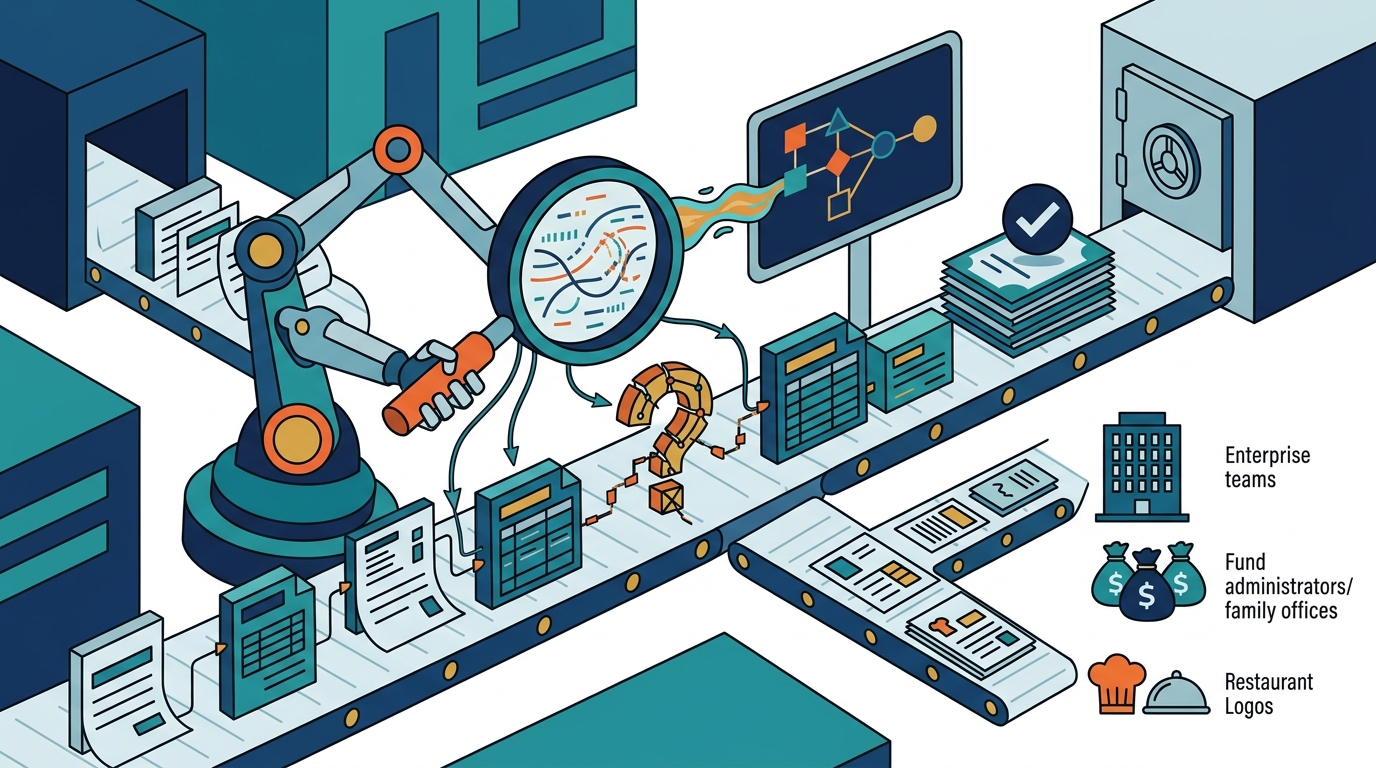
Financial reconciliation is the process of verifying that two or more sets of records agree. Traditional platforms focus on matching transactions that align perfectly. They handle the easy 86% of invoices and transactions that reconcile themselves. The real operational cost lies in the remaining 14% of exceptions that require human investigation. Aetherix Systems addresses this gap by deploying AI agents that work the exception queue directly.
Matching vs. Investigating
Rules-based matching engines are excellent at identifying when a purchase order, receipt, and invoice agree. However, they lack the cognitive ability to determine why a discrepancy exists. When a price variance occurs or a credit memo is missing, a standard platform simply flags the item. An agentic platform investigates the break. It pulls supporting documentation, traces the transaction through the system, and proposes a resolution with a complete audit trail.
Evaluating Platform Capabilities
When selecting a platform, teams must look beyond matching coverage. You need a system that can handle multi-currency complexity, intercompany eliminations, and subledger-to-GL drift. Aetherix Systems integrates with major ERP environments like SAP and NetSuite. The agents pull data via native APIs, execute matching rules, and investigate exceptions without requiring code changes on your side. This approach ensures that the platform scales with your entity count rather than your headcount.
Financial Close Automation
Financial close automation is the use of software to execute the steps required to finalize accounting records for a specific period. The month-end close remains one of the most labor-intensive processes in finance. Serial handoffs between sub-ledgers, reconciliations, and consolidation create bottlenecks. One late queue can delay the entire reporting cycle. Automation breaks these dependencies by allowing workstreams to run in parallel.
Accelerating the Close Cycle
Manual close processes rely on human capacity to investigate breaks. As volume grows, teams must grow linearly to maintain the same close timeline. This creates a fixed overhead that scales with complexity, not value. Aetherix Systems runs reconciliation as a managed service. Agents handle the investigation and resolution of breaks, delivering a clean reconciliation pack for your review. Your team approves the entries, and the close proceeds without the traditional fire drill.
Journal Entry Preparation
Automation also extends to journal entry preparation. Agents analyze accruals, prepayments, and adjustments, then prepare entries with full supporting documentation. This ensures that every journal entry is ready for review and posting. The system maintains a full audit trail on every action, which is critical for compliance and internal audit. By moving work earlier in the reporting cycle, teams can achieve a faster, more predictable close.
Agentic Finance Workflows
Agentic finance workflows are automated processes where AI agents perceive, reason, decide, and act within defined boundaries. Unlike chatbots or copilots, these agents are purpose-built for specific enterprise workflows. They execute structured investigation workflows that ingest data, match records, investigate breaks, and resolve discrepancies. Aetherix Systems designs multi-agent architectures where each agent has a defined role and clear decision boundaries.
Human-in-the-Loop Controls
Autonomy does not mean a lack of control. Aetherix Systems implements hard constraints on what agents can do. The agent cannot write to your ledger; it proposes entries, and a named human posts them. The agent cannot close a period; your team reviews and signs off the close pack. The agent cannot resolve outside tolerance; anything above a configurable threshold escalates with documentation attached. These controls ensure that the system remains safe, predictable, and compliant with your internal policies.
Orchestration and Integration
Complex enterprise processes require multiple agents working together. Aetherix Systems builds orchestration layers that coordinate agent teams, routing tasks and managing handoffs. The agents integrate with your existing tech stack, including ERP systems, CRM platforms, and data warehouses. This integration allows the agents to operate within your current environment, providing a seamless extension of your finance operations. The result is a workforce of AI agents that handle repetitive, judgment-intensive tasks with enterprise-grade reliability.
| Capability | Rules-Based Platform | Agentic AI Platform |
|---|---|---|
| Exception Handling | Flags breaks for manual review | Investigates breaks and proposes resolutions |
| Audit Trail | Logs matching attempts | Logs full reasoning and source documents |
| Scalability | Requires more staff as volume grows | Scales with configuration, not headcount |
| Human Role | Performs investigation and resolution | Reviews and approves proposed actions |
Key Takeaways
- The best AI reconciliation platform investigates exceptions rather than just flagging them.
- Agentic workflows provide a full audit trail with reasoning attached to every action.
- Financial close automation reduces serial handoffs by enabling parallel workstreams.
- Human-in-the-loop controls ensure that agents propose entries but humans post them.
- Integration with existing ERPs like SAP and NetSuite is critical for seamless adoption.
- Managed services models allow teams to pay for outcomes rather than software seats.
- Compliance with global data protection regulations is essential for enterprise AI deployment.
Frequently Asked Questions
What is the difference between RPA and AI agents in reconciliation?
RPA automates repetitive, rule-based tasks like data entry. AI agents can perceive, reason, and decide on complex exceptions. RPA bots create exception queues that humans must clear. AI agents investigate those queues and propose resolutions, completing the automation loop.
Can AI agents post journal entries directly to the ledger?
No. Aetherix Systems agents propose journal entries with full reasoning. A named human employee reviews and posts the entries. Write access is never implicit; it is granted per-system with an approval workflow attached.
How long does it take to deploy an AI reconciliation system?
Aetherix Systems typically moves from a scoping call to production in 3 to 6 weeks. This includes configuration, a shadow period where agents run in parallel, and final tuning based on feedback.
Does the system require code changes in our ERP?
No. The agents connect to your ERP via standard APIs and data feeds. No code changes are required on your side. The system integrates with your existing orchestration and data architecture.
How does the system handle multi-currency reconciliation?
The agents trace variances back to rate differentials and classify them as realized or unrealized. They apply agreed exchange rates to confirm amounts match after conversion, identifying FX differences as a major source of breaks.
Is the AI system compliant with data protection regulations?
Yes. Aetherix Systems maintains compliance with global data protection regulations, including GDPR and UAE PDPL. The system operates within defined safety boundaries with full audit trails and role-based access controls.
Conclusion
Selecting the right AI reconciliation partner requires looking beyond basic matching capabilities. You need a system that investigates exceptions, provides a full audit trail, and integrates seamlessly with your existing ERP. Aetherix Systems offers this capability through its agentic finance workflows, which are designed for enterprise-grade reliability and compliance. To see how our agents can handle your reconciliation operations, explore our delivery model or book a scoping call.