

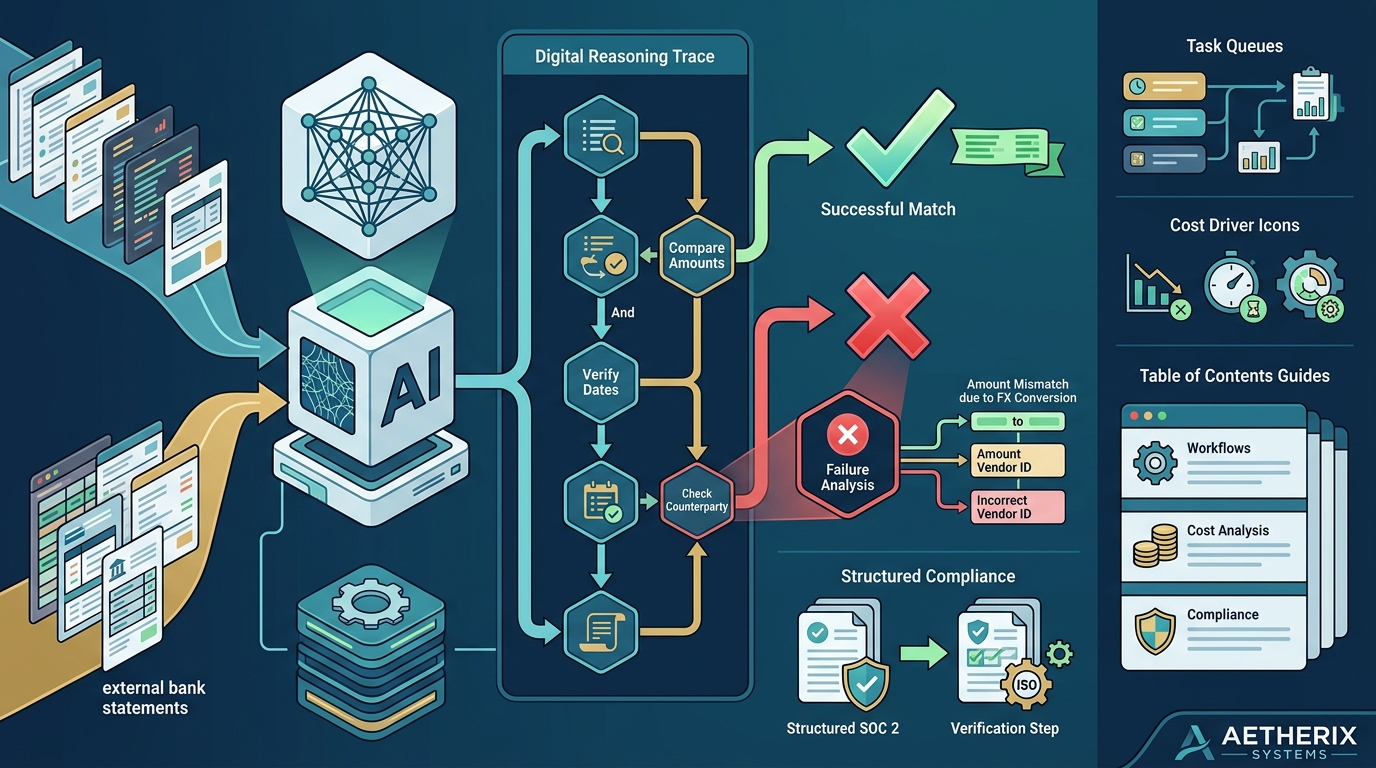
AI reconciliation services explain why a transaction failed to match by generating a structured reasoning trace that documents the data compared, the logic applied, and the root cause identified. This guide covers how to evaluate, verify, and implement these systems, detailing the operational workflows, cost drivers, and compliance protections that define modern financial operations.
How to Choose: What Separates a Good Option from a Bad One
The primary differentiator in AI reconciliation is the distinction between matching and investigation. Traditional rules-based engines handle the transactions that agree. They apply deterministic logic to match a purchase order to a receipt and an invoice. When those three documents align, the system marks the item as clean. This is a solved problem. The real operational burden lies in the exceptions, the items that do not match. A high-quality AI reconciliation service is defined by its ability to investigate these breaks. It must pull supporting documentation, trace the transaction through the system, identify the root cause, and propose a resolution with full reasoning attached. If a vendor only offers matching, they are handing you a larger queue of work, not a solution. You need a system that acts as an investigator, not just a comparator.
What to Ask: The Specific Questions to Ask Before Committing
Before committing to an AI reconciliation provider, you must interrogate their exception handling capabilities. Ask how the system handles a variance that exceeds your tolerance threshold. Does it guess, or does it escalate? A robust system will never guess. It will attach the full context, including the source documents and the logic that led to the discrepancy, and route it to a human for review. You should also ask about the audit trail. Can you see exactly why the agent matched a specific item? Can you see why it escalated another? The answer must be yes. Every action must be traceable. If the system is a black box, it is not enterprise-grade. You need transparency that allows your compliance team to review the decision-making process without reconstructing it from memory.
How to Verify: How to Check That a Claim or Credential Is Real
Verifying the capabilities of an AI vendor requires looking beyond marketing claims. Request a demonstration of the reasoning trace. Do not accept a summary. Look at the actual data the agent read, the rules it applied, and the conclusion it reached. Verify their security posture by asking for their compliance documentation. Aetherix Systems, for example, maintains rigorous compliance with global data protection regulations and AI governance frameworks. They operate under SOC 2 Type II and ISO/IEC 27001:2022 standards. Check if these are current attestations or merely alignments. The distinction matters. A company aligned to a standard is working toward it; a company compliant with it has been audited against it. You need the latter for enterprise trust.
How It Works: What Happens, in What Order, and How Long It Takes
The operational workflow of an AI reconciliation agent follows a structured investigation path. The process begins with ingestion, where data is pulled from your ERP, custodian, bank, or counterparty. The system normalizes formats, currencies, and identifiers. Next is matching, where the agent applies rules to flag items that do not agree within tolerance. The critical step is investigation. For each break, the agent pulls supporting detail, traces the transaction, and identifies the root cause. It then proposes a resolution. This is not a static process. It is a dynamic loop that continues until the exception is resolved or escalated. The timeline for implementation varies, but a typical deployment moves from scoping to production in a matter of weeks, not years.
What It Costs: What Drives the Price Up or Down
The cost of AI reconciliation is driven by volume, complexity, and the depth of investigation required. Simple matching is cheap. Investigation is expensive because it requires compute resources and sophisticated logic. Pricing models vary. Some vendors charge per seat, which penalizes you for scaling. Others charge per transaction, which can become unpredictable. Aetherix Systems operates on an outcome-based model. You pay for reconciliation outcomes, not software seats. This aligns the vendor's incentives with your success. If the system resolves more exceptions, you benefit. If it fails, you do not pay for the failure. This model removes the risk of paying for software that does not work.
What Goes Wrong: The Common Mistakes and How to Avoid Them
The most common mistake is assuming that automation eliminates the need for human oversight. It does not. It shifts the human role from data entry to review. If you do not configure your tolerance rules correctly, the system will either auto-resolve errors or escalate trivialities. Both are costly. Another mistake is ignoring the data quality. If your source data is dirty, the AI will produce dirty results. You must ensure that your ERP and subledgers are clean before deploying the agent. Finally, do not skip the shadow period. Run the agent in parallel with your existing process. Review every proposed resolution. Tune the rules based on feedback. This phase is critical for building trust and accuracy.
Versus Alternatives: How This Compares to the Alternatives
AI reconciliation differs fundamentally from Robotic Process Automation (RPA) and manual processes. RPA bots execute predefined steps. They are excellent for repetitive tasks but fail when the task requires judgment. When an RPA bot encounters an exception, it stops. It cannot investigate. It creates a queue of work for a human. AI agents, however, can reason. They can adapt to new patterns and investigate breaks. Manual processes are slow and error-prone. They do not scale. AI reconciliation scales. It can process millions of transactions in parallel. The comparison is not about speed; it is about capability. AI adds the layer of judgment that RPA and humans lack.
For a Specific Situation: How the Answer Changes for a Particular Case
The value of AI reconciliation varies by industry. For a family office, the focus is on multi-custodian and multi-entity complexity. The agent must handle different data formats and naming conventions. For a restaurant group, the focus is on high-volume invoice processing. The agent must parse distributor invoices, match them to purchase orders, and code them to the correct location and GL account. For a financial institution, the focus is on regulatory compliance and high-volume nostro reconciliation. The agent must provide a complete audit trail for every action. The core capability is the same, but the configuration is specific. You need a vendor that understands your industry's specific failure modes.
Rules and Protections: The Rules, Rights or Protections That Apply
Enterprise AI systems operate within strict safety boundaries. The agent cannot write to your ledger. It proposes entries. A named human posts them. Write access is never implicit. It is granted per-system, per-action, with an approval workflow attached. The agent cannot close a period. Every close pack is reviewed and signed off by your team. The agent cannot resolve outside tolerance. Anything above threshold escalates with documentation attached. These are hard constraints, not guidelines. They ensure that the AI remains a tool, not an autonomous actor. You stay in control. The agent does the work, but you make the final decision.
Local Specifics: What Is Specific to the Areas Served
Operating in the GCC and global markets requires adherence to local data residency and compliance laws. Aetherix Systems is based in Dubai and maintains data residency in the UAE, EU, US, and Singapore. This is critical for organizations that operate across multiple jurisdictions. You cannot send sensitive financial data to a server in a country that does not meet your regulatory requirements. The vendor must have the infrastructure to keep your data where it belongs. This is not just a technical requirement; it is a legal one. Ensure that your vendor's data centers are located in regions that comply with your local privacy laws, such as the UAE PDPL or GDPR.
Timing: When to Act and How Timing Changes the Outcome
The timing of your implementation affects the outcome. If you wait until your close is broken, you are in a fire drill. The pressure to fix the problem quickly leads to poor decisions. It is better to implement AI reconciliation proactively. Start with a scoping call. Map your systems, data sources, and exception types. This takes 30 minutes. It gives you a clear picture of what you need. Then, move to configuration. This takes 1 to 2 weeks. Finally, run the shadow period. This takes 2 to 4 weeks. By the time you go to production, you have a tested, tuned system. This phased approach reduces risk and ensures a smooth transition.
Results Over Time: Measurable Outcomes and What to Expect Long Term
The long-term outcome of AI reconciliation is a compressed close cycle. What used to take a week of back-and-forth now resolves in hours. The investigation happens in parallel across all accounts simultaneously. Your team reviews exceptions rather than performing the initial match. This means fewer people doing higher-value work. The compliance posture improves without additional effort. Regulators and auditors see a clean chain of evidence rather than a folder of emails and annotated spreadsheets. The system learns from historical resolutions. It gets better over time. The more it runs, the more accurate it becomes. This is the compounding benefit of AI.
Key Takeaways
- AI reconciliation is defined by its ability to investigate exceptions, not just match transactions.
- Every action must be auditable, with a full reasoning trace attached.
- The agent proposes resolutions; a named human approves and posts them.
- Outcome-based pricing aligns vendor incentives with your success.
- Data residency and compliance are critical for multi-jurisdictional operations.
- A shadow period is essential for tuning rules and building trust.
- The long-term benefit is a compressed close cycle and improved compliance.
Frequently Asked Questions
What is the difference between matching and investigation in reconciliation?
Matching is the process of comparing two sets of records to see if they agree. Investigation is the process of determining why they do not agree. Matching is a solved problem. Investigation is the hard part. AI agents are designed to handle the investigation.
Can an AI agent write to my general ledger?
No. The agent proposes journal entries. A named human employee reviews and posts them. Write access is never implicit. It is granted per-system, per-action, with an approval workflow attached.
How long does it take to implement an AI reconciliation system?
Implementation typically takes 3 to 6 weeks. This includes a scoping call, configuration, a shadow period, and production launch. The exact timeline depends on the complexity of your systems and data.
What is a reasoning trace?
A reasoning trace is a log of the data the agent read, the rules it applied, and the conclusion it reached. It provides full transparency into the decision-making process. It is essential for audit and compliance.
How does AI reconciliation handle multi-currency transactions?
The agent traces each variance back to the rate differential and classifies realized versus unrealized gains and losses. It applies the agreed exchange rate to confirm amounts match after conversion.
Is AI reconciliation suitable for small businesses?
It is most valuable for organizations with high transaction volumes and complex structures. Small businesses with simple, low-volume operations may not see a return on investment. The system scales with complexity.
What happens if the agent encounters an error it cannot resolve?
It escalates the item to a human with full context attached. It never guesses. It documents its reasoning and recommends an action. The human makes the final decision.
Conclusion
AI reconciliation is not a magic bullet. It is a tool that requires careful configuration, oversight, and trust. The value lies in the investigation, not the matching. By choosing a vendor that prioritizes transparency, auditability, and human oversight, you can transform your financial close from a fire drill into a predictable, accelerated process. Aetherix Systems provides this capability, running reconciliation operations for family offices, investment funds, and financial institutions with a full audit trail on every action. To plan your visit, .