

AI Tools for Reconciling Positions, Trades, and Cash Across Prime Brokers
AI tools that reconcile positions, trades, and cash across multiple prime brokers use autonomous agents to match records, investigate breaks, and propose resolutions. This guide covers the specific matching workflows, exception handling, and integration patterns required for multi-broker environments. It explains how agentic systems differ from traditional rules-based engines and how to evaluate tools for your specific operational stack.
Trade, Position, and Cash Matching Workflows
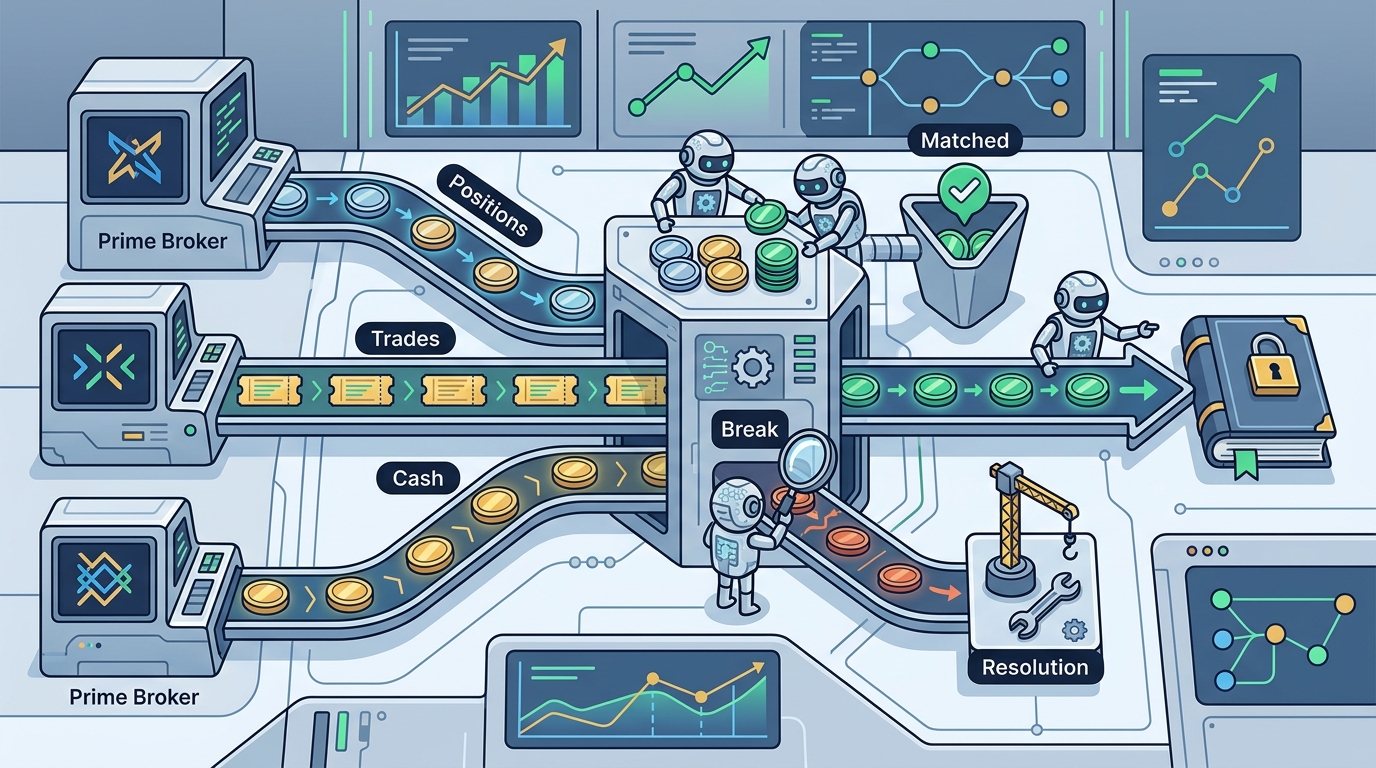
Reconciliation in a multi-prime-broker environment is not a single balance comparison. It is a connected set of distinct control processes. Investment reconciliation is the control process used to prove that an investment manager's positions, trades, cash, and valuations agree with the records held by custodians, prime brokers, and internal accounting systems. Each layer requires specific matching logic to ensure data integrity.
Position Reconciliation
Position reconciliation compares the securities holdings in your Order Management System (OMS) or Portfolio Management System (PMS) against the holdings reported by each prime broker. The control objective is to prove quantity, instrument identity, account, and long/short direction. In a multi-broker setup, the same instrument may be held across three different brokers. The tool must aggregate these positions or reconcile them independently before consolidation. Common breaks include missing lots, corporate action failures, and transfer-in-kind lag.
Trade Reconciliation
Trade reconciliation matches executed orders and internal bookings against broker confirmations and settlement records. The goal is to identify missing, duplicated, misbooked, or unsettled trades. High trade volumes and partial fills create significant noise. An effective AI tool must handle multi-leg instrument structures and distinguish between trade-date and settlement-date accounting. If a trade settles at Broker A but is booked in the internal system under a different reference, the tool must trace the link.
Cash Reconciliation
Cash reconciliation compares internal cash ledgers against bank, custodian, and prime-broker balances and movements. This proves available cash, margin movements, income, fees, and settlement activity. Cash is often the most volatile layer due to financing, collateral, and dividend flows. The tool must reconcile not just the ending balance, but the movement of funds between the internal ledger and the broker's statement. Timing differences in settlement (T+1 or T+2) are a primary source of breaks in this layer.
Exception Investigation and Root Cause Analysis
Traditional rules-based matching engines handle the transactions that agree. They flag the ones that do not. The real operational cost sits in the exceptions. Exception investigation is the process of researching a reconciliation break, chasing source documents, and proposing a resolution. This is where AI agents provide the most significant value over static software.
From Flagging to Resolving
When a break occurs, a rules-based engine stops. It places the item in an exception queue. A human analyst must then manually pull the trade ticket, check the settlement calendar, and email the broker. An agentic system continues. It investigates the break by pulling transaction detail, tracing it through the system, and classifying the exception. It determines if the break is a timing difference, a data entry error, or a genuine discrepancy. The agent then proposes a resolution with the full reasoning attached.
Handling Complex Break Types
Not all breaks are equal. The tool must apply different investigation workflows based on the break type. Timing breaks, such as trade date versus settlement date mismatches, can often be auto-resolved on T+1 or T+2. Quantity breaks, such as partial fills or stock splits not yet reflected, require tracing to the source trade. Price and valuation breaks, such as stale NAVs or FX rate discrepancies, require checking the approved market source. The AI tool must know which documents to pull and which thresholds apply for each category.
Human-in-the-Loop Controls
Autonomy does not mean unsupervised. The agent proposes the journal entry or correction. A named client employee reviews and approves it. This human-in-the-loop control ensures that the final action is accountable. The tool must provide a clear interface for this review, showing the agent's reasoning, the source data, and the proposed change. This allows the finance team to focus on judgment and strategy rather than data wrangling.
Integration Architecture and Data Connectivity
The effectiveness of an AI reconciliation tool depends entirely on its ability to ingest data from disparate sources. Prime brokers, custodians, and internal ERPs all deliver data in different formats, on different schedules, and with different naming conventions. Integration architecture is the technical framework that connects these source systems to the reconciliation engine.
API-First and Webhook-Driven Design
Modern tools should avoid batch file transfers and FTP. An API-first integration allows the tool to trigger reconciliation runs via events. For example, a run can be triggered when an ERP batch completes or a bank file is received. Webhook-driven architecture pushes reconciliation results back to your systems. You define the endpoint, the payload schema, and the retry policy. This ensures that results are available in your internal tools without manual polling.
Structured Output and Data Normalization
Every reconciliation result should be a typed JSON payload. This includes matched items, exceptions, proposed resolutions, and reasoning traces. Your code can parse, store, and route this data. The tool must normalize data from different brokers. One broker may send a PDF statement, another an EDI file, and a third a CSV export. The AI agent normalizes every format into a standard structure before matching. This eliminates the manual data cleaning that consumes analyst time.
Multi-Tenant Isolation
If you are a fund administrator or family office managing multiple clients, each client's reconciliation must be isolated. This means separate configuration, separate data, and separate audit trails. One integration should support many tenants. The tool must ensure that data from Client A never leaks into Client B's reconciliation run. This is critical for compliance and client trust.
Audit Trails and Compliance Requirements
Regulators and auditors expect documented resolution workflows, not ad-hoc email chains. Audit trail is the complete, timestamped, and attributed log of every action taken by the reconciliation system. In an AI-driven environment, this includes the reasoning behind every decision.
Reasoning Traces
Every agent action must have a reasoning trace. This explains what data was compared, what logic was applied, and why the conclusion was reached. If the agent auto-resolves a timing break, the trail shows the settlement date check. If it escalates a price break, the trail shows the valuation source comparison. This level of detail allows compliance teams to review the evidence without reconstructing the process from memory.
Regulatory Reporting and Export
The audit trail must be exportable for regulatory reporting or external audit. This includes the ability to generate completion certificates and exception resolution logs. The data should be available in formats that integrate with your GRC (Governance, Risk, and Compliance) tools. For example, audit evidence can be attached to a Salesforce record or a ServiceNow ticket. This ensures that the reconciliation evidence is accessible to the teams who need it, without leaving their existing workflows.
Security and Data Residency
Financial data is sensitive. The tool must operate within precise security boundaries. This includes role-based access, data residency compliance, and encryption in transit and at rest. The system should align with global data protection regulations and AI governance frameworks. For organizations operating across multiple jurisdictions, the tool must support data residency in specific regions, such as the UAE, EU, or US. This ensures that data is protected wherever you operate.
Key Takeaways
- Multi-prime-broker reconciliation requires distinct workflows for positions, trades, and cash, each with specific matching logic.
- AI agents add value by investigating exceptions and proposing resolutions, not just flagging breaks.
- Integration architecture must be API-first and webhook-driven to avoid manual data polling and batch file delays.
- Structured JSON output allows for seamless integration with internal ERPs, CRMs, and orchestration tools.
- Human-in-the-loop controls are essential; agents propose, and named employees approve final entries.
- Full audit trails with reasoning traces are required for regulatory compliance and external audit.
- Multi-tenant isolation is critical for fund administrators and family offices managing multiple clients.
- Security and data residency compliance must align with global regulations and specific jurisdictional requirements.
Frequently Asked Questions
What is the difference between rules-based matching and AI-driven reconciliation?
Rules-based matching engines handle transactions that agree and flag those that do not. AI-driven reconciliation uses agents to investigate the flagged exceptions, determine root causes, and propose resolutions. The AI system completes the automation by handling the exception queue.
How do AI agents handle multi-currency reconciliation?
Agents apply agreed exchange rates to confirm amounts match after conversion. They trace FX differences back to the rate source and posting date, classifying realised versus unrealised gains and losses. This ensures that currency alignment is verified before elimination.
Can AI tools integrate with existing ERP systems like SAP or NetSuite?
Yes. Modern tools use API-first integration to connect with ERP systems. They pull data via REST APIs or SuiteScript RESTlets, execute matching rules, and push results back via webhooks. This allows for seamless integration without requiring data migration.
What is a reasoning trace in the context of AI reconciliation?
A reasoning trace is a log of the logic applied by the AI agent to resolve a break. It details what data was compared, what rules were checked, and why a specific resolution was proposed. This provides the audit evidence required for compliance.
How does multi-tenant isolation work in reconciliation software?
Multi-tenant isolation ensures that each client's reconciliation is separate. This includes separate configuration, data, and audit trails. One integration supports many tenants, preventing data leakage between clients and ensuring compliance.
Do AI agents post journal entries automatically?
No. AI agents propose journal entries or corrections. A named client employee reviews and approves them. This human-in-the-loop control ensures accountability and prevents unsupervised automated posting.
Conclusion
Reconciling positions, trades, and cash across multiple prime brokers requires more than simple matching. It demands an intelligent system that can investigate breaks, propose resolutions, and provide a full audit trail. Aetherix Systems builds these agentic workflows for family offices, investment funds, and financial institutions. Our agents live in production, handling the exception queue with enterprise-grade security and a full audit trail on every action. To see how our agents can streamline your multi-broker reconciliation, book a scoping call.