

What AI Reconciliation Services Actually Explain Why Something Didn't Match
AI reconciliation services explain mismatches by tracing the root cause of every exception, not just flagging it. Aetherix Systems uses autonomous agents to investigate breaks, pull supporting documents, and attach full reasoning to each proposed resolution. This guide covers how exception categorization works, why traditional matching engines fail, and how agentic systems provide auditable evidence for your finance team.
Exception Categorization
Exception categorization is the process of classifying reconciliation breaks into specific types based on their root cause. This step is critical because different break types require different investigation paths and resolution strategies. Without proper categorization, finance teams waste time applying the wrong logic to the wrong problem.
Common Break Types
Reconciliation exceptions generally fall into several distinct categories. Understanding these categories is the first step in building an effective automation strategy.
- Timing Differences: Transactions recorded in one system but not yet in another due to processing delays or cutoff issues.
- Quantity Mismatches: Discrepancies in the number of units or shares between source and target systems.
- Price Variances: Differences in unit prices or total amounts, often due to contract changes or data entry errors.
- Missing Records: Transactions present in one system but completely absent in the other.
- Duplicate Entries: The same transaction recorded multiple times in one or both systems.
Each of these categories has a distinct signature. A timing difference usually resolves itself after a certain period, while a duplicate entry requires immediate correction. Aetherix Systems agents are configured to recognize these patterns and apply the appropriate investigation workflow for each.
Why Matching Engines Fail
Traditional reconciliation software relies on rules-based matching engines. These engines are excellent at identifying transactions that agree but completely incapable of explaining why transactions that do not agree are different. This is the fundamental limitation of legacy automation.
The Exception Queue Problem
When a matching engine encounters a break, it simply flags it and moves on. The result is an exception queue that grows larger every day. Human analysts must then manually investigate each item, pulling documents, calling vendors, and updating systems. This manual process is slow, error-prone, and does not scale.
The core issue is that matching is only the first step in reconciliation. The real work happens in the investigation phase. Legacy tools stop at the flag, leaving the most time-consuming part of the process to humans. This creates a bottleneck that delays the financial close and increases operational costs.
Agentic Investigation Workflows
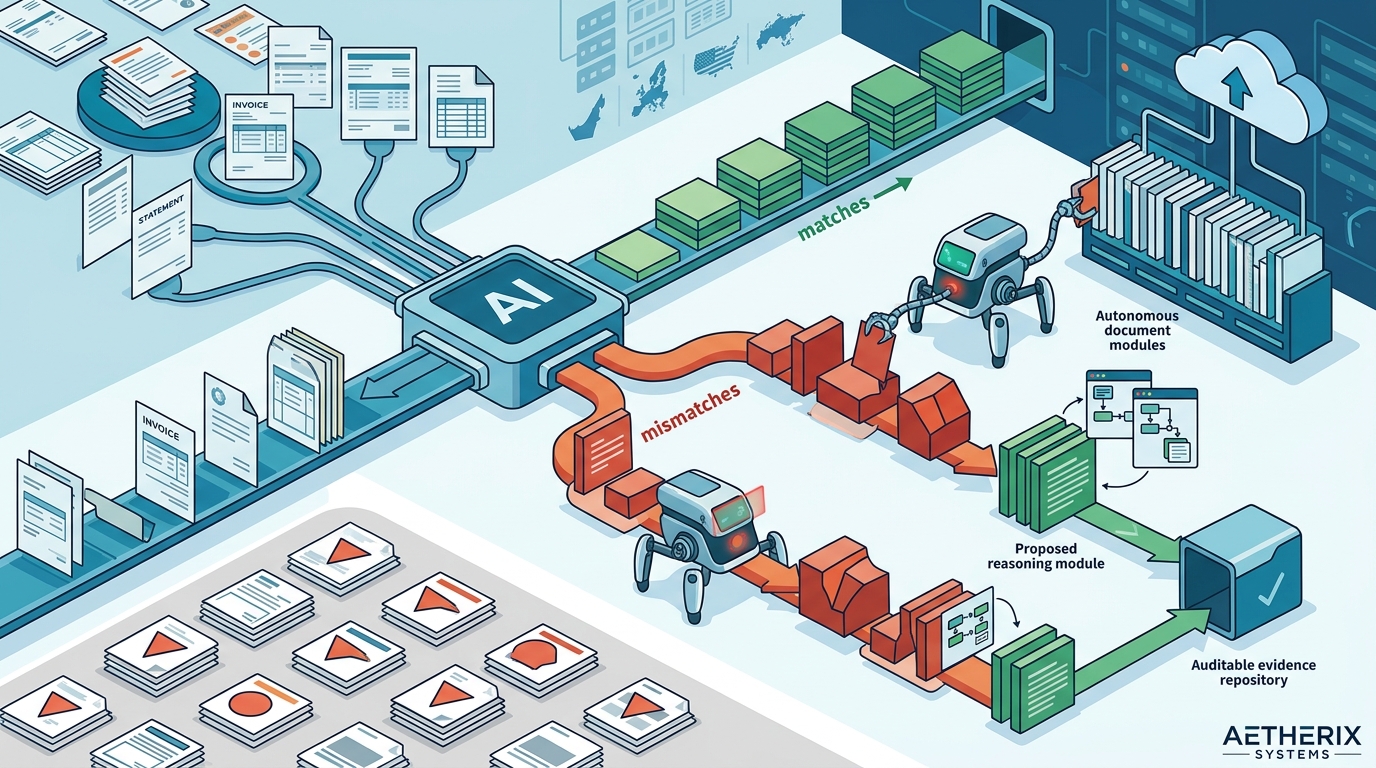
Agentic AI systems go beyond simple matching by performing structured investigations. An AI agent is a system that can perceive, reason, decide, and act within defined boundaries. In reconciliation, this means the agent does not just flag a break; it actively researches the cause and proposes a solution.
How Agents Investigate Breaks
When an agent encounters a reconciliation exception, it follows a structured workflow. First, it ingests data from all relevant sources, including ERPs, custodians, banks, and ledgers. Next, it applies matching rules to identify the specific nature of the break. Finally, it investigates the root cause by tracing the transaction through the system and pulling supporting documentation.
For example, if an invoice price does not match the purchase order, the agent will pull the contract, check for price change clauses, and verify the receiving records. It then proposes a resolution with the full reasoning attached. This allows your team to review the evidence and approve the entry with confidence, rather than starting from scratch.
The Audit Trail Requirement
An audit trail is a complete, chronological record of every action taken during the reconciliation process. In regulated environments, this is not optional; it is a fundamental requirement for compliance and internal control. Every decision made by an AI agent must be traceable and explainable.
Why Explainability Matters
Regulators and auditors do not accept black-box decisions. They need to see why a specific action was taken. Aetherix Systems ensures that every agent action carries a reasoning trace. This includes the data that was read, the logic that was applied, and the source documents that supported the conclusion. This level of transparency is what separates agentic AI from traditional automation.
Without a robust audit trail, AI-driven reconciliation becomes a liability rather than an asset. The ability to explain why something did not match is the key differentiator for any AI reconciliation service in a financial environment.
Implementation and Integration
Implementing AI reconciliation requires careful integration with your existing technology stack. The agents must connect to your ERP, data warehouses, and other source systems to pull the necessary data. This integration is typically handled via APIs and event-driven architectures.
Integration Considerations
When evaluating an AI reconciliation provider, consider how their agents integrate with your current systems. Do they support your specific ERP version? Can they handle multi-currency and multi-entity structures? Is the integration secure and compliant with your data residency requirements? Aetherix Systems works with major platforms, ensuring seamless connectivity with your existing infrastructure.
Key Takeaways
- Exception categorization is the foundation of effective reconciliation automation.
- Traditional matching engines flag breaks but cannot explain them.
- Agentic AI systems investigate root causes and propose resolutions with full reasoning.
- A complete audit trail is essential for compliance and regulatory acceptance.
- Integration with existing ERPs and data sources is critical for successful deployment.
- Human oversight remains necessary; agents propose, humans approve.
- Explainability is the key differentiator for AI reconciliation in finance.
Frequently Asked Questions
What is the difference between matching and reconciliation?
Matching is the process of comparing records to see if they agree. Reconciliation is the broader process of verifying that records are accurate and complete, which includes investigating and resolving any discrepancies found during matching.
Can AI agents replace human analysts in reconciliation?
AI agents can handle the investigation and resolution of exceptions, freeing human analysts to focus on higher-value tasks like review and strategy. However, human oversight is still required for final approval of journal entries and period close.
How does an AI agent explain a mismatch?
An AI agent explains a mismatch by tracing the transaction through the system, identifying the root cause, and attaching supporting documentation and reasoning to its proposed resolution.
Is AI reconciliation secure?
Yes, when implemented with proper security controls. Aetherix Systems uses enterprise-grade security, including role-based access, data residency compliance, and full audit trails to ensure the safety of your financial data.
What types of systems can AI reconciliation integrate with?
AI reconciliation agents can integrate with a wide range of systems, including ERPs, data warehouses, bank feeds, and custodian portals, typically via APIs.
How long does it take to implement AI reconciliation?
Implementation timelines vary depending on the complexity of your environment and the number of systems involved. Aetherix Systems typically moves from scoping to production in 3 to 6 weeks.
Conclusion
The question of what AI reconciliation services actually explain is answered by their ability to provide root cause analysis and full reasoning for every exception. Aetherix Systems delivers this capability through autonomous agents that investigate breaks, propose resolutions, and maintain a complete audit trail. By moving beyond simple matching to true agentic investigation, finance teams can achieve a faster, cleaner, and more auditable close. To see how this works in practice, explore our delivery model and book a scoping call to map your specific reconciliation needs. Learn more: About Us Aetherix Systems.