

What AI Reconciliation Services Actually Explain Why Something Didn't Match
AI reconciliation services explain mismatches by generating a reasoning trace that documents the data compared, the logic applied, and the root cause identified. Aetherix Systems builds these agents to investigate every break, not just flag it. This guide covers how exception categorization works, the difference between matching and investigation, and how to evaluate reasoning quality in agentic finance operations.
Exception Categorization in AI Reconciliation
Reconciliation exception categorization is the process of classifying every mismatch into a specific type so that the appropriate investigation workflow can be applied. Without clear categorization, an AI agent cannot determine which documents to pull or which rules to apply. Aetherix Systems configures its agents to recognize distinct failure modes before attempting resolution.
Timing vs. Genuine Errors
The most common distinction is between timing differences and genuine errors. A timing difference occurs when a transaction is recorded in one system but not yet in another due to settlement cycles or posting delays. A genuine error involves a fundamental discrepancy in amount, quantity, or coding. AI agents must identify which category a break falls into before proposing any action.
Specific Exception Types
Financial operations involve several distinct exception types that require different investigation paths. Price variances occur when the invoiced amount differs from the purchase order. Quantity mismatches happen when received goods do not match ordered quantities. Duplicate invoices, credit memo mismatches, and GL coding errors each have unique resolution workflows. The agent must classify the exception correctly to pull the right supporting documentation.
Matching vs. Investigation: The Critical Distinction
Matching is the process of comparing two sets of records to identify items that agree. Investigation is the process of determining why items that do not agree are different. Most traditional reconciliation software handles matching well but leaves investigation to humans. This is where the value of AI agents emerges.
Rules-based matching engines can handle the 80-90% of transactions that agree perfectly. However, the remaining exceptions consume disproportionate analyst time. When a human investigates a break, they pull the purchase order, check the receiving log, compare to the contract, and document their findings. This manual process is slow, error-prone, and difficult to audit. AI agents perform this same investigation workflow automatically, with full reasoning attached to every step.
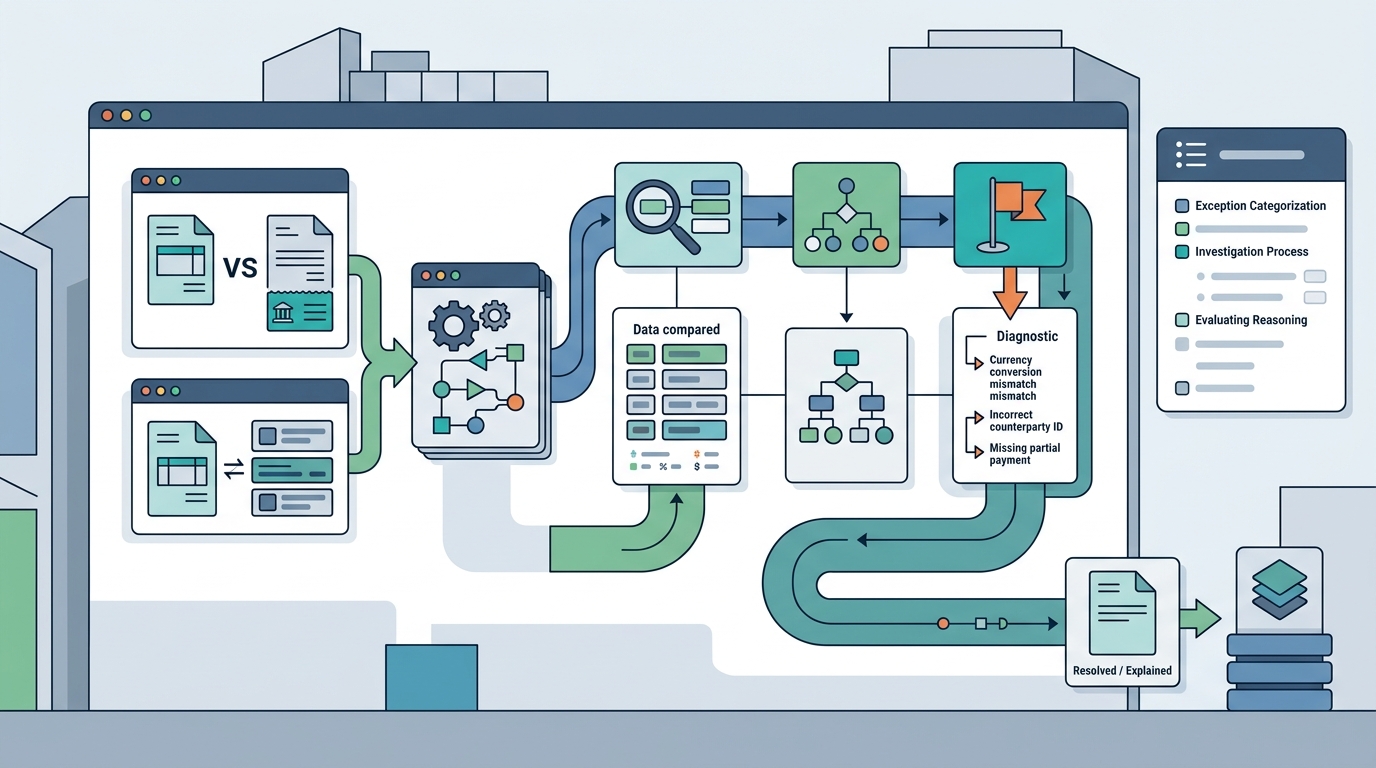
Anatomy of a Reasoning Trace
A reasoning trace is a complete log of the data an AI agent examined, the logic it applied, and the conclusion it reached. This is the core differentiator between a simple matching tool and a true AI reconciliation service. The trace must be human-readable and auditable.
What a Trace Contains
A complete reasoning trace includes the source documents compared, the matching rules applied, the specific fields that differed, and the root cause identified. For example, if an invoice price differs from the purchase order, the trace shows the PO line item, the invoice line item, the contract clause referenced, and the tolerance threshold applied. This level of detail allows a human reviewer to verify the agent's conclusion without redoing the investigation.
Auditability Requirements
Every action taken by an AI agent must be logged with a complete audit trail. This includes timestamp, user or agent identifier, data read, logic applied, and action proposed. The trace must be exportable for regulatory reporting or external audit. Aetherix Systems ensures that every agent action is logged with full reasoning, making the entire process transparent and verifiable.
Evaluating AI Reconciliation Providers
When evaluating AI reconciliation services, you must look beyond matching coverage and assess the quality of exception investigation. A provider that only flags exceptions without explaining them does not solve the core problem. You need a system that investigates, documents, and proposes resolutions with full reasoning.
| Capability | Rules-Based Matching | AI Agentic Reconciliation |
|---|---|---|
| Exception Flagging | Yes | Yes |
| Root Cause Identification | No | Yes |
| Reasoning Trace | No | Yes |
| Resolution Proposal | No | Yes |
| Audit Trail | Limited | Complete |
The table above illustrates the fundamental difference between traditional matching engines and AI agentic systems. Rules-based tools create an exception queue that humans must work through. AI agents investigate the queue, determine root causes, and propose resolutions with full documentation. This distinction is critical when evaluating providers for your finance operations.
Key Takeaways
- AI reconciliation services explain mismatches by generating reasoning traces that document data compared, logic applied, and root cause identified.
- Exception categorization is the first step in AI reconciliation, classifying breaks into timing differences, price variances, quantity mismatches, and other types.
- Matching and investigation are distinct processes; most traditional software handles matching but leaves investigation to humans.
- A complete reasoning trace must be human-readable, auditable, and exportable for regulatory reporting.
- When evaluating providers, assess the quality of exception investigation, not just matching coverage.
- AI agents propose resolutions with full documentation, allowing human reviewers to verify conclusions without redoing the investigation.
- The audit trail must include timestamp, agent identifier, data read, logic applied, and action proposed for every step.
Frequently Asked Questions
What is a reasoning trace in AI reconciliation?
A reasoning trace is a complete log of the data an AI agent examined, the logic it applied, and the conclusion it reached when investigating a reconciliation break.
How does AI reconciliation differ from rules-based matching?
Rules-based matching identifies items that agree and flags items that do not. AI reconciliation investigates the flagged items, determines root causes, and proposes resolutions with full documentation.
Can AI agents close a client's books?
No. AI agents propose journal entries and resolutions, but a named human employee must review and post them. The final close sign-off remains with the client's team.
What types of exceptions do AI agents categorize?
AI agents categorize exceptions into timing differences, price variances, quantity mismatches, duplicate invoices, credit memo mismatches, and GL coding errors, among others.
Is the reasoning trace auditable?
Yes. Every agent action is logged with a complete audit trail that includes timestamp, data read, logic applied, and action proposed. The trace is exportable for regulatory reporting or external audit.
How do I evaluate an AI reconciliation provider?
Assess the quality of exception investigation, not just matching coverage. Look for providers that generate human-readable reasoning traces, identify root causes, and propose resolutions with full documentation.
Do AI agents work with existing ERP systems?
Yes. AI agents integrate with existing ERP systems, custodian feeds, bank statements, and other data sources. They work with whatever format you currently use, without requiring migration.
Conclusion
The core question of what AI reconciliation services actually explain is answered by the quality of their reasoning traces. Aetherix Systems builds AI agents that investigate every break, determine root causes, and propose resolutions with full documentation. This approach transforms reconciliation from a manual marathon into a predictable, accelerated process. To see how our agents handle exception investigation in your specific environment, explore our delivery model or review our invoice reconciliation services. Learn more: About Us Aetherix Systems.