

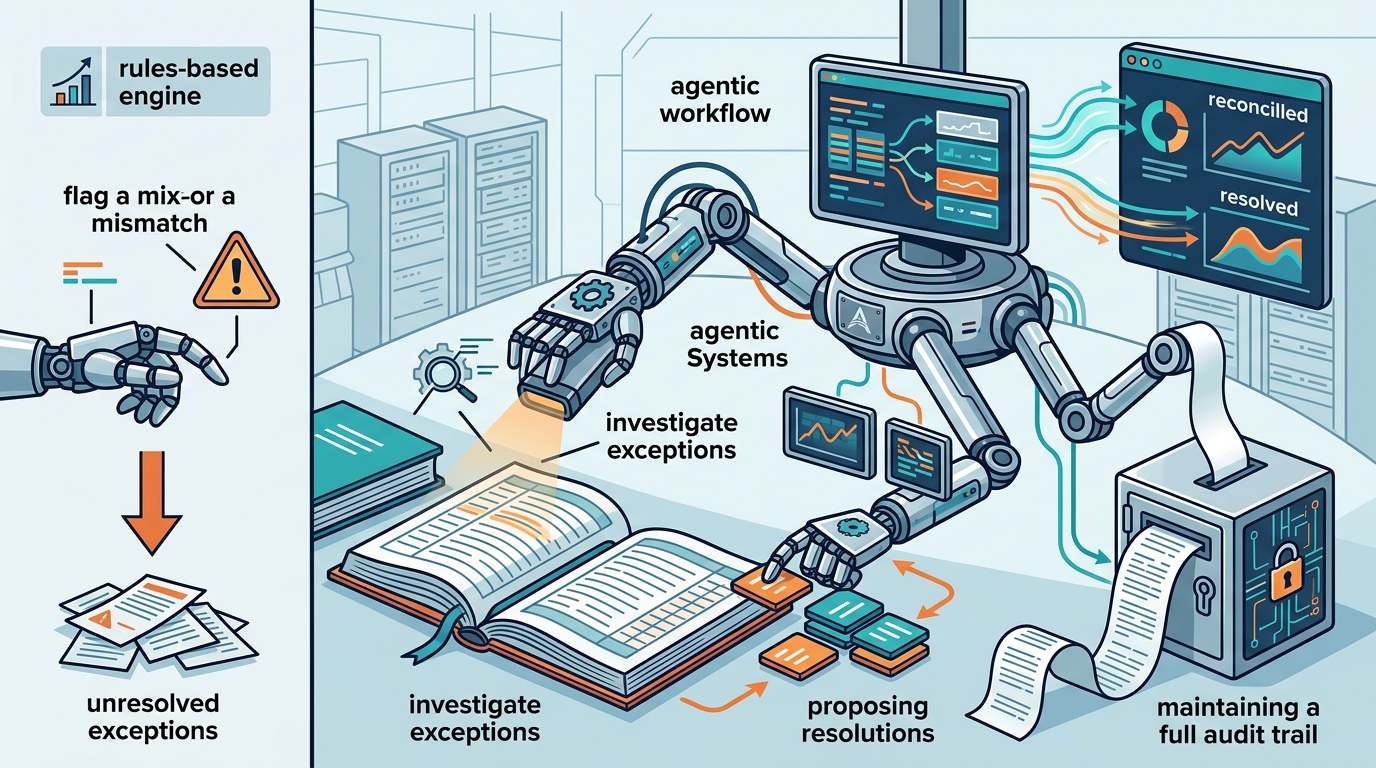
The best AI reconciliation for financial operations teams is an agentic system that investigates exceptions, proposes resolutions, and maintains a full audit trail, rather than a rules-based engine that only flags mismatches. This guide covers enterprise reconciliation platforms, transaction matching automation, and financial close management to help you evaluate the right technology for your close cycle.
Enterprise Reconciliation Platforms
Enterprise reconciliation platforms are software systems designed to automate the comparison of financial records across multiple sources, such as ERPs, banks, and custodians. Traditional platforms focus heavily on matching logic, using rules to identify transactions that agree. However, the modern enterprise environment requires more than just matching; it requires the ability to investigate and resolve the discrepancies that remain. according to General ledger reconciliation
The Limitation of Rules-Based Matching
Most legacy reconciliation tools operate on deterministic rules. If a transaction matches a specific pattern, it is cleared. If it does not, it is flagged as an exception. The problem is that the exception queue often becomes a bottleneck. In complex environments, such as multi-subsidiary structures or multi-custodian portfolios, the volume of exceptions can overwhelm human analysts. These tools create a list of problems but do not solve them. according to Budget and Accrual
Agentic AI as a New Paradigm
Agentic AI represents a shift from passive flagging to active investigation. An AI agent is a system that can perceive, reason, decide, and act within defined boundaries. In the context of reconciliation, these agents do not just identify a break; they pull supporting documentation, trace the transaction through the system, and propose a resolution. This approach addresses the root cause of the discrepancy rather than just highlighting the symptom.
When evaluating enterprise platforms, you must distinguish between a tool that automates the match and a service that manages the operation. Aetherix Systems, a Dubai-based firm, runs reconciliation operations using AI agents that investigate every break and attach full reasoning to their actions. This operational model ensures that the close comes back clean and that every action is auditable.
Transaction Matching Automation
Handling the Exception Queue
The majority of transactions in a typical financial operation will match automatically. The challenge lies in the remaining percentage that requires human attention. In a high-volume environment, even a small exception rate can generate thousands of breaks per day. Manual investigation of these breaks is slow, error-prone, and difficult to audit. Automation that stops at flagging these items leaves the most difficult work to the human team. according to General ledger reconciliation
Investigation and Resolution Workflows
Advanced automation involves structured investigation workflows. For each break, the system must identify the root cause. Is it a timing difference? A missing entry? A duplicate? A pricing variance? The system should be able to classify the exception type and apply the appropriate resolution logic. For example, a timing difference might be auto-resolved once the settlement date passes, while a pricing variance might require a check against a contract or a previous invoice.
Aetherix Systems implements this by having agents ingest data from custodians, banks, and ledgers, match positions and cash, and then investigate breaks. The agents research the discrepancy, chase missing data, and propose a resolution with the full reasoning attached. This ensures that the human team reviews proposed solutions rather than performing the initial investigation from scratch.
Financial Close Management
Financial close management is the orchestration of all tasks required to finalize the accounting period, including reconciliation, journal entries, flux analysis, and consolidation. The goal is to produce accurate financial statements in the shortest possible time. Reconciliation is a critical component of this process, as the close cannot be completed until all accounts are balanced and supported.
Accelerating the Close Cycle
Traditional close processes are often serial, with tasks waiting on upstream completion. If a reconciliation is delayed, the consolidation is delayed, and the reporting is delayed. This creates a bottleneck that extends the close cycle. By automating the investigation and resolution of reconciliation breaks, organizations can parallelize work and move the close process forward more quickly.
Auditability and Compliance
Speed is important, but accuracy and compliance are paramount. Every action taken during the close must be documented and auditable. This includes the data used for matching, the logic applied for resolution, and the approval of any journal entries. A full audit trail is essential for regulatory compliance and for providing evidence to auditors. Systems that operate as black boxes, where the reasoning for a decision is not visible, pose a significant risk to the integrity of the close.
Aetherix Systems provides a delivery model that moves from scoping to production in a structured timeframe. The agents run the reconciliation, and the team receives daily exception reports with proposed resolutions and full reasoning. Escalations are routed to the human team for review and approval. This model ensures that the close is accelerated without compromising the control environment.
Key Takeaways
- Enterprise reconciliation platforms must move beyond rules-based matching to include active investigation of exceptions.
- Agentic AI systems can investigate breaks, determine root causes, and propose resolutions with full reasoning.
- Transaction matching automation is only valuable if it effectively manages the exception queue.
- Financial close management benefits from parallelized reconciliation tasks that reduce the overall close cycle.
- A full audit trail is essential for compliance and for providing evidence to auditors.
- Human oversight remains critical; agents propose actions, but named humans must approve and post entries.
- Evaluating a provider requires looking at their operational model, not just their software features.
Frequently Asked Questions
What is the difference between a reconciliation tool and a reconciliation service?
A reconciliation tool is software that you operate, where your team performs the investigation and resolution. A reconciliation service is an operational model where a provider runs the process for you, using AI agents to investigate and propose resolutions, while your team reviews and approves.
How do AI agents handle reconciliation exceptions?
AI agents investigate exceptions by pulling supporting documentation, tracing transactions through the system, and identifying the root cause. They then propose a resolution with the full reasoning attached, allowing the human team to review and approve the action.
Is AI reconciliation suitable for multi-entity structures?
Yes, AI reconciliation is particularly well-suited for multi-entity structures. Agents can reconcile each entity independently and then validate the consolidation, handling the complexity of intercompany transactions and multi-currency balances.
What is the role of human oversight in AI reconciliation?
Human oversight is essential. AI agents propose journal entries and resolutions, but a named human employee must review and approve these actions before they are posted to the ledger. This ensures that the control environment remains intact.
How does Aetherix Systems ensure auditability?
Aetherix Systems maintains a full audit trail on every action. Every decision carries its reasoning and source documents, allowing you to audit why a match was made, why an item was escalated, and what data was read.
Can AI reconciliation integrate with existing ERP systems?
Yes, AI reconciliation systems can integrate with existing ERP systems such as SAP, Oracle, and NetSuite. They connect via APIs or direct data feeds to pull data for matching and investigation, without requiring code changes on the client side.
Conclusion
Selecting the best AI reconciliation for financial operations teams requires looking beyond simple matching capabilities. The most effective systems are those that actively investigate exceptions, propose resolutions, and maintain a full audit trail. Aetherix Systems provides this capability through its agentic AI platform, which runs reconciliation operations for family offices, investment funds, and financial institutions. To plan your visit, to discuss how agentic reconciliation can accelerate your close cycle.