

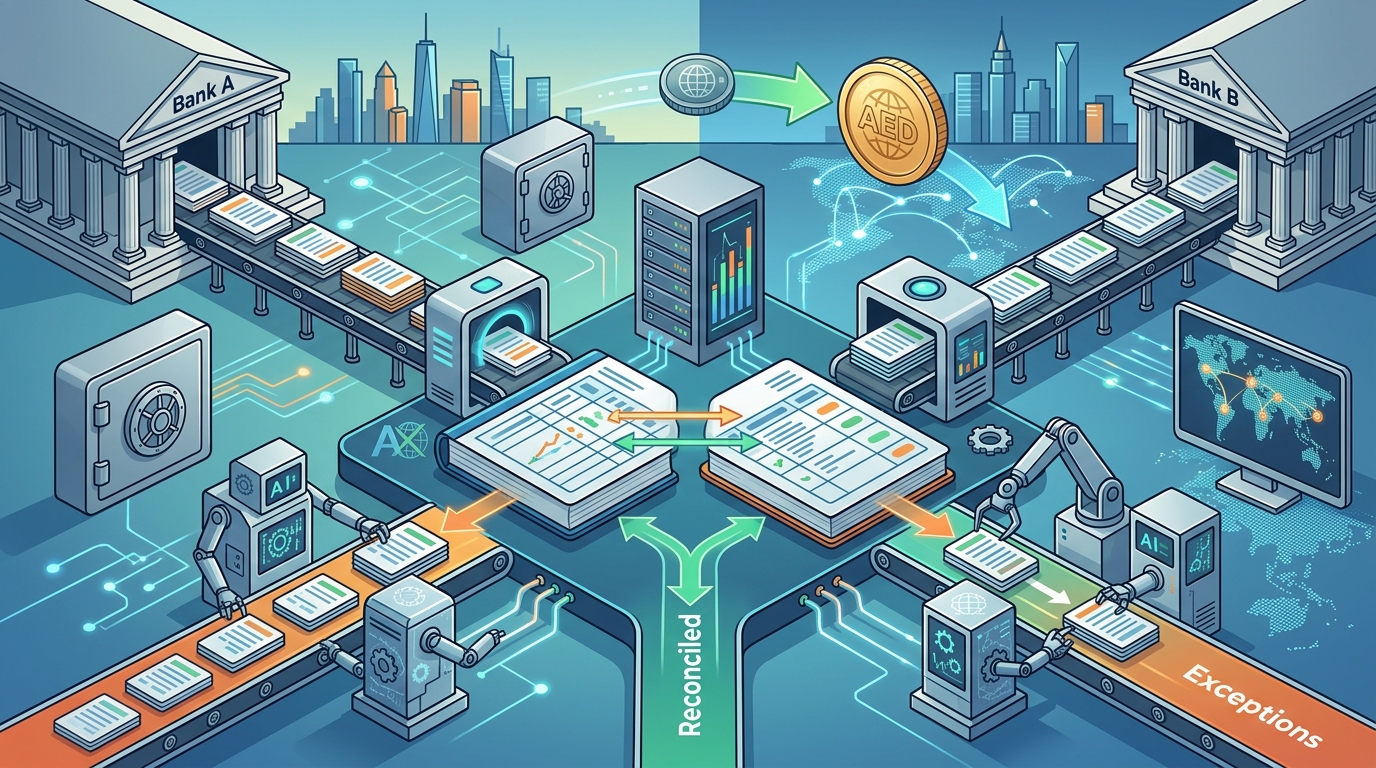
Banks use AI to automate nostro and vostro reconciliation by deploying agentic workflows that match transaction records across custodians, carriers, and internal ledgers. These systems investigate exceptions, propose journal entries, and maintain a full audit trail. Aetherix Systems builds these production AI systems for financial institutions, ensuring that automated actions remain under human oversight while significantly reducing manual processing time. For additional details, review the aetherixsystems com.
The Shift from Rules-Based to Agentic Reconciliation
For example, if a nostro account statement from a custodian shows a transaction that is missing from the bank's general ledger, an agentic system can query the payment carrier's API to check if the funds are in transit. It can then check the internal payment instruction log to see if the transaction was initiated. This investigative capability moves the process from simple detection to active resolution. The implication for banks is a reduction in the volume of exceptions that require human intervention. Only complex or ambiguous cases are escalated to finance teams.
Handling Multi-Currency and Multi-Jurisdiction Complexity
Nostro and vostro reconciliation is inherently complex due to multi-currency and multi-jurisdiction factors. A nostro account is a bank account held by one bank in the currency of another country, typically at a correspondent bank. A vostro account is the reciprocal account held by the correspondent bank. Reconciling these requires handling different time zones, settlement cycles, and currency conversion rates. AI systems handle this complexity by normalizing data formats and applying dynamic matching logic.
Consider a scenario involving a cross-border payment in a volatile currency. The settlement date may differ between the originating bank and the correspondent bank due to local holidays. A rules-based system might flag this as a mismatch. An AI system, however, can recognize the holiday calendar and adjust the expected settlement date accordingly. It can also account for the specific FX rate used at the time of the transaction, rather than the end-of-day rate. This reduces false positives and ensures that the reconciliation reflects the true economic reality of the transaction. The result is a cleaner exception queue for human reviewers.
Key Insight: AI excels at handling the unstructured and semi-structured data that often causes reconciliation failures, such as free-text memos or inconsistent date formats.
Maintaining Audit Trails and Regulatory Compliance
Aetherix Systems operates to SOC 2 Type II, ISO 27001, and ISO 42001 standards. These frameworks ensure that the AI systems we build are secure, reliable, and explainable. We do not claim to be certified by financial regulators, as we are not a licensed audit or accounting firm. Instead, we provide the technical infrastructure that supports compliance. Our agents propose journal entries, but a named client employee posts them. This human-in-the-loop design ensures that the bank retains ultimate control and accountability. The audit trail generated by our systems provides the evidence needed to demonstrate that reconciliation processes are robust and controlled.
Integrating AI with Existing Core Banking Systems
Implementing AI for reconciliation requires seamless integration with existing core banking systems and ERPs. Banks often use a mix of legacy systems and modern platforms. AI agents must be able to connect to these diverse data sources. This involves building robust APIs and data pipelines that can handle high volumes of transaction data in real-time or near real-time.
For instance, a bank might use a legacy core banking system for its general ledger and a modern cloud-based platform for its payment processing. An AI reconciliation system must be able to pull data from both sources and reconcile them. This requires careful data mapping and transformation. Aetherix Systems specializes in building these data platforms and integration layers. We work with clients to map their specific data structures and build the necessary connectors. This ensures that the AI system has access to the most up-to-date and accurate data. The implication is that banks can adopt AI reconciliation without needing to replace their entire core banking infrastructure.
Measuring the Impact of AI on Reconciliation Operations
Key Takeaways
- Agentic AI systems investigate reconciliation exceptions rather than just flagging them.
- AI handles multi-currency and multi-jurisdiction complexity by normalizing data and applying dynamic logic.
- Human oversight remains critical, with AI proposing actions and humans approving them.
- Integration with existing core banking systems is a key challenge that requires robust data pipelines.
- Impact metrics vary by implementation, but the general trend is a reduction in manual effort.
Frequently Asked Questions
What is the difference between a nostro and a vostro account?
A nostro account is held by a bank in a foreign currency at a correspondent bank. A vostro account is the reciprocal account held by the correspondent bank. Reconciling these accounts requires matching transactions across two different institutions.
How does AI handle exceptions in reconciliation?
AI agents investigate exceptions by querying multiple data sources, such as custodians, carriers, and internal logs. They identify the root cause of the mismatch and propose a resolution, such as a journal entry or a status update.
Is AI reconciliation fully autonomous?
No, AI reconciliation is not fully autonomous. It operates with human oversight. AI agents propose actions, but a named client employee reviews and approves them before they are posted to the general ledger.
What standards does Aetherix Systems follow?
Aetherix Systems operates to SOC 2 Type II, ISO 27001, and ISO 42001 standards. These frameworks ensure that our AI systems are secure, reliable, and explainable.
Can AI integrate with legacy banking systems?
Yes, AI systems can integrate with legacy banking systems through robust APIs and data pipelines. This allows banks to adopt AI reconciliation without replacing their entire core banking infrastructure.
How is the audit trail maintained in AI reconciliation?
Conclusion
Banks are increasingly using AI to automate nostro and vostro reconciliation, moving from rules-based matching to agentic investigation. This shift reduces manual effort and improves accuracy while maintaining the human oversight required for regulatory compliance. Aetherix Systems provides the engineering expertise to build and manage these production AI systems, ensuring they are secure, explainable, and integrated with your existing infrastructure. To discuss how AI can transform your reconciliation operations, contact Aetherix Systems. Learn more: aetherixsystems com.