

AI Tools for NAV Production: Matching Investor Records and Fund Data
AI tools help NAV production teams match investor records and fund accounting data by automating the ingestion, normalization, and reconciliation of multi-source financial data. These systems identify discrepancies, investigate root causes, and generate audit-ready documentation. This guide covers the core components of AI-driven NAV reconciliation, including platform capabilities, record matching, exception handling, break detection, and audit trail management.
NAV Reconciliation Platforms
NAV reconciliation is the process of verifying that a fund's internal books match external records from custodians, administrators, and prime brokers. Traditional platforms often rely on static rules that fail when data formats change or when complex instruments are involved. AI-driven platforms introduce dynamic reasoning capabilities that allow systems to interpret context rather than just comparing numbers.
Core Platform Capabilities
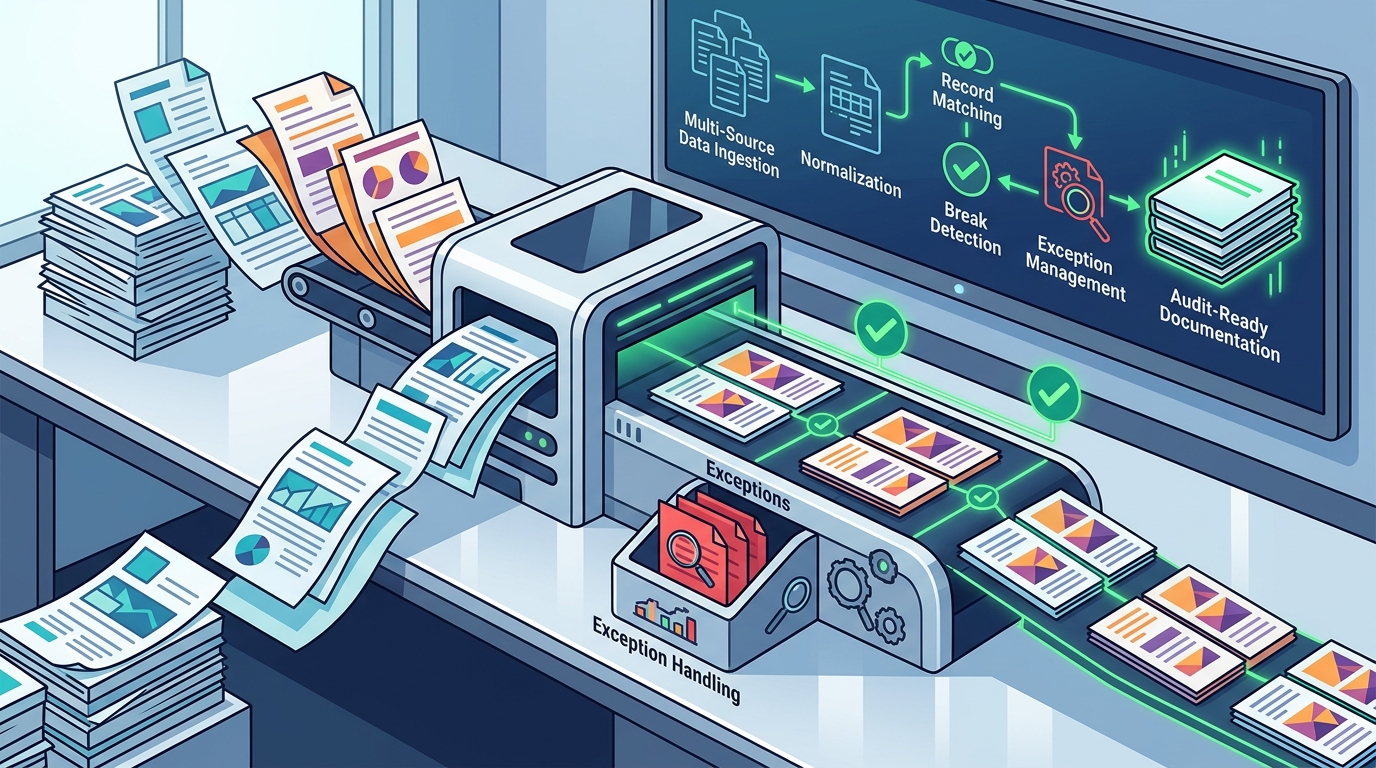
Modern AI reconciliation platforms ingest data from multiple sources, including SWIFT messages, custodian portals, and PDF statements. They normalize this data into a unified schema before running matching logic. This normalization step is critical because different providers use different naming conventions and date formats. Without robust normalization, even simple matching tasks become error-prone.
Platforms like those offered by Aetherix Systems focus on the full lifecycle of reconciliation. They do not just flag differences; they investigate them. The platform acts as an autonomous agent that can pull supporting documentation, trace transactions through the system, and propose resolutions. This shifts the workload from manual data wrangling to high-value review and approval.
Integration with Existing Stacks
Integration is a major consideration for NAV teams. AI tools must connect seamlessly with existing ERPs, portfolio management systems, and accounting software. API-first architectures allow these tools to trigger runs based on events, such as the completion of an ERP batch or the receipt of a bank file. This event-driven approach ensures that reconciliation happens as soon as data is ready, rather than waiting for a scheduled batch job.
Investor Record Matching
Investor record matching is the process of aligning investor-level data, such as capital calls, distributions, and fee calculations, between the fund administrator and the general ledger. This is often the most complex layer of NAV production because it involves multiple entities and varying reporting periods. Mismatches here can lead to incorrect NAV calculations and regulatory reporting errors.
Handling Multi-Entity Complexity
Funds often operate across multiple legal entities, each with its own chart of accounts and close calendar. AI tools must handle this complexity by reconciling each entity independently before validating the consolidation. They identify intercompany transactions that need elimination and ensure that management fees and cost allocations are recorded consistently on both sides. This prevents the common issue where one entity records a payable that the other does not record as a receivable.
Fee and Accrual Verification
Fee reconciliation is a critical component of investor record matching. AI agents verify management fees, performance fees, and custody charges against invoices and contractual schedules. They catch overbilling or underbilling before it settles. For example, an agent can compare the accrued fee in the general ledger against the invoice from the administrator. If there is a variance, the agent traces it back to the specific contract clause or calculation error. This level of detail is difficult to achieve with manual spreadsheet-based processes.
Exception Handling Automation
Exception handling automation is the use of AI to investigate and resolve discrepancies that automated matching cannot clear. While matching engines handle the transactions that agree, the real cost sits in the exceptions. These are the items that do not match, such as price variances, quantity mismatches, or missing credits. Manual exception handling is time-consuming and prone to human error.
Investigation Workflows
AI agents execute structured investigation workflows for each break. They pull supporting detail from both sides of the reconciliation, trace the transaction through the system, and identify the root cause. For instance, if a trade settlement does not match, the agent checks the settlement calendar, confirms pending status, and verifies corporate actions. It then classifies the exception type and proposes a resolution. This process is fully documented, providing a clear audit trail of why the agent reached its conclusion.
Escalation and Human Oversight
Automation does not mean removing human oversight. AI agents operate within defined safety boundaries. They cannot write to the ledger or close a period without human approval. When an exception exceeds a configured tolerance threshold, the agent escalates it to a human reviewer with full context attached. This ensures that high-risk or complex items are handled by a named employee who can make the final judgment call. The human reviews the proposed entry and approves it, maintaining control over the financial records.
Automated Break Detection
Automated break detection is the process of identifying discrepancies between two sets of records using algorithmic and AI-driven logic. Effective break detection requires more than simple arithmetic comparison. It must account for timing differences, currency fluctuations, and instrument-specific rules. AI enhances this process by learning from historical resolutions and adapting to new patterns.
Types of Breaks
Breaks can be categorized into several types, each requiring a different investigation path. Timing breaks occur when one side records a transaction in a different period than the other. Quantity breaks involve mismatches in lot levels or partial fills. Price breaks arise from stale valuations or FX rate discrepancies. AI tools classify each break by type and apply the appropriate investigation workflow. This classification ensures that the right documents are pulled and the right thresholds are applied.
Real-Time Detection
Real-time break detection allows teams to address issues as they occur, rather than waiting for month-end close. AI agents can run reconciliation continuously, flagging new breaks as they appear. This reduces the backlog of exceptions and prevents errors from compounding. Real-time dashboards show activity, exception rates, and resolution accuracy, giving teams visibility into the health of their reconciliation process. Anomalies trigger alerts before they become material issues.
Audit Trail Documentation
Audit trail documentation is the record of every action taken during the reconciliation process, including data sources, matching logic, and resolution decisions. In a regulatory environment, auditors expect documented resolution workflows, not ad-hoc email chains. AI tools generate this documentation automatically, ensuring that every match and every break is logged with a complete reasoning trail.
Compliance and Regulatory Reporting
Regulatory reporting requires accurate and verifiable data. AI-driven reconciliation provides the evidence needed to support NAV calculations and regulatory filings. The audit trail includes timestamps, user attributions, and source documents, making it exportable for external audit without manual reconstruction. This improves compliance posture and reduces the time spent preparing for audits. Teams can pull the audit trail at any time, providing a clean chain of evidence for regulators and auditors.
Transparency and Explainability
Explainability is a key feature of AI reconciliation tools. Agents do not operate as black boxes. Every decision carries its reasoning and source documents. Users can audit why an agent matched a transaction, why it escalated an exception, and what data it read. This transparency builds trust in the automation process and ensures that the system remains aligned with business rules and regulatory requirements. It also facilitates training and onboarding of new team members, who can learn from the documented decision-making process.
Key Takeaways
- AI tools automate the ingestion and normalization of multi-source financial data, reducing manual data wrangling.
- Investor record matching requires handling multi-entity complexity and verifying fee calculations against contracts.
- Exception handling automation investigates root causes and proposes resolutions, shifting work to human review.
- Automated break detection classifies discrepancies by type and applies appropriate investigation workflows.
- Real-time detection reduces backlogs and prevents errors from compounding during the close cycle.
- Audit trail documentation provides a complete reasoning trail for every action, supporting regulatory compliance.
- Human oversight remains critical, with agents escalating high-risk items for approval by named employees.
- Integration with existing ERPs and accounting systems is essential for seamless workflow adoption.
Frequently Asked Questions
What is the primary benefit of using AI for NAV reconciliation?
The primary benefit is the automation of exception investigation. AI agents investigate breaks, determine root causes, and propose resolutions, freeing teams to focus on high-value review and analysis.
How do AI tools handle multi-entity fund structures?
AI tools reconcile each entity independently and then validate the consolidation. They identify intercompany transactions that need elimination and ensure consistent recording across entities.
Can AI agents post journal entries to the general ledger?
No. AI agents propose journal entries, but a named client employee must review and post them. Write access is never implicit and is granted per-system with an approval workflow.
What types of breaks can AI tools detect?
AI tools detect timing breaks, quantity breaks, price breaks, and GL coding errors. They classify each break by type and apply the appropriate investigation workflow.
How does AI improve audit readiness?
AI tools generate a complete audit trail for every action, including data sources, matching logic, and resolution decisions. This documentation is exportable for external audit without manual reconstruction.
Do AI tools require significant changes to existing systems?
AI tools integrate with existing systems via APIs and webhooks. They do not require code changes on the client side, making deployment non-disruptive to existing workflows.
How are tolerance rules configured in AI reconciliation?
Tolerance rules are configurable per account type, entity, and period. They define what auto-resolves and what requires human review, ensuring that only material variances are escalated.
Conclusion
AI tools are transforming NAV production by automating the complex tasks of matching investor records and fund accounting data. By handling exception investigation, break detection, and audit documentation, these systems allow teams to close faster and with greater confidence. Aetherix Systems provides AI-driven reconciliation services that integrate with your existing stack, offering a full audit trail on every action. To explore how AI can streamline your NAV production process, for a scoping call.