

Family offices manage complex financial ecosystems where precision is non-negotiable. According to recent industry benchmarks, manual invoice processing consumes approximately 20 hours per month for mid-sized family offices, creating significant bottlenecks in cash flow visibility. This operational drag directly impacts the ability to make timely investment decisions. By implementing automated reconciliation workflows, these organizations can reduce processing time by up to 70%, ensuring that every transaction is accounted for with absolute accuracy. The shift from manual entry to autonomous agent-based systems represents a fundamental change in how private wealth is managed.
Why Automation Matters for Family Offices
Family offices operate differently than traditional corporate entities. They handle diverse asset classes, including real estate, private equity, and public markets. This diversity creates a fragmented data landscape. Invoices arrive from various custodians, banks, and service providers in different formats. Without a unified system, tracking liabilities becomes a manual nightmare.
Traditional accounting software often fails to address the unique needs of multi-entity structures. It lacks the ability to handle intercompany eliminations or complex netting scenarios. This gap leads to errors in financial reporting and delayed close cycles. Automation bridges this gap by providing a single source of truth for all financial data.
The goal is not just speed, but accuracy. Every transaction must be traceable. This requirement drives the need for systems that offer full audit trails. When an invoice is processed, the system must record every step taken, from ingestion to final approval. This level of transparency is critical for internal governance and external audits.
Core Features of Modern Invoice Automation
To effectively automate invoice processing, a system must possess specific technical capabilities. These features ensure that the automation is robust, scalable, and reliable. Below are the essential components that define a high-performance solution.
1. Intelligent Data Ingestion
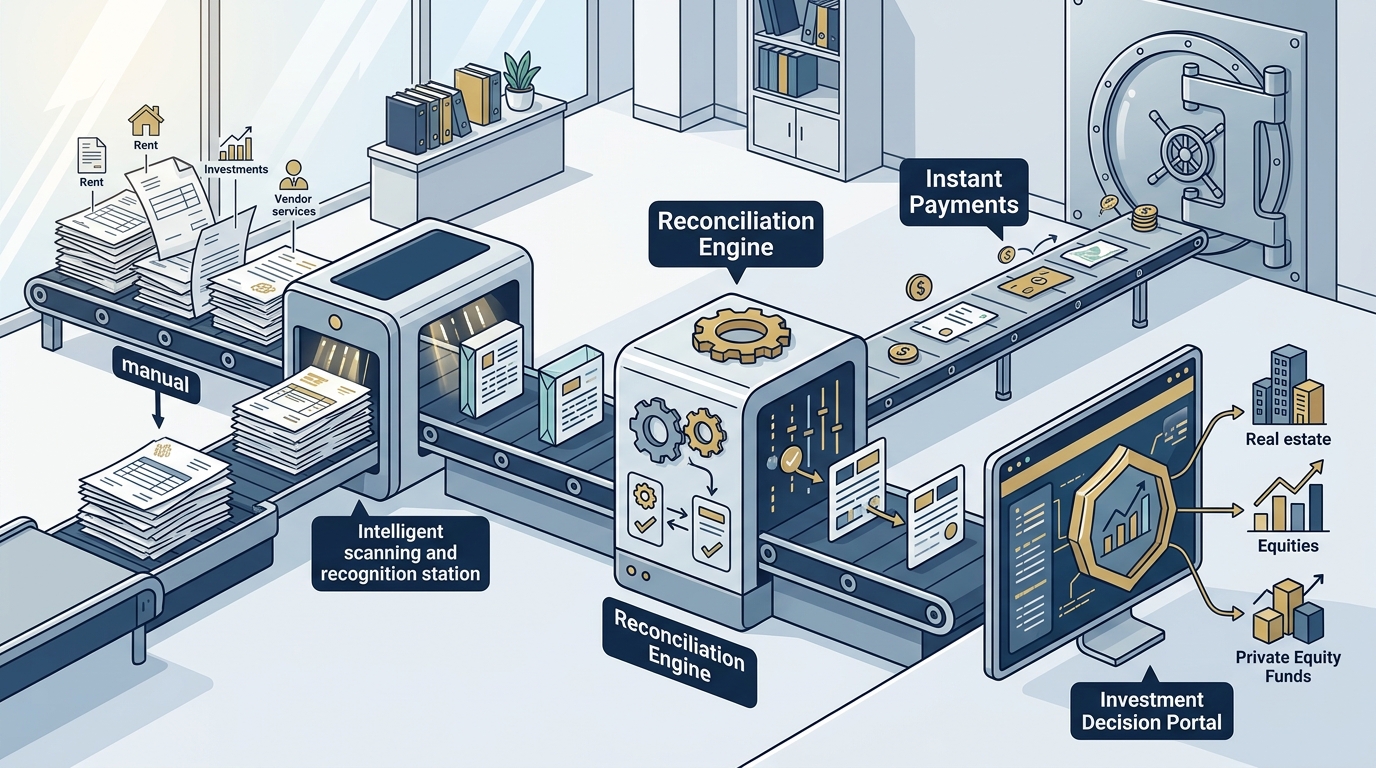
The first step in automation is capturing data from diverse sources. Invoices come as PDFs, emails, scanned documents, and digital feeds. A robust system must use Optical Character Recognition (OCR) and natural language processing to extract key fields such as vendor name, date, amount, and line items. This process must be accurate enough to minimize manual correction.
Intelligent ingestion also handles unstructured data. It can parse complex tables and identify discrepancies between purchase orders and receipts. This capability is vital for three-way matching, which ensures that the goods received match the invoice and the original order.
2. Automated Matching Engines
Matching is the core of invoice automation. The system must automatically compare incoming invoices against existing records. This includes matching against general ledger accounts, budget codes, and approval workflows. Advanced systems use fuzzy logic to handle minor variations in vendor names or invoice numbers.
When a match is found, the system can auto-approve the invoice. When a break occurs, it flags the issue for review. This reduces the workload on accounting staff and ensures that only exceptions require human intervention. The result is a faster close cycle and reduced operational costs.
3. Exception Handling and Resolution
No system is perfect. Breaks in matching are inevitable. A critical feature is the ability to investigate these breaks autonomously. The system should be able to research the source of the discrepancy, such as a pricing error or a missing approval. It can then propose a resolution based on historical data and predefined rules.
This autonomous investigation reduces the time spent on chasing down information. It also provides a clear audit trail of how the break was resolved. This transparency is essential for maintaining trust in the automated process.
4. Real-Time Reporting and Analytics
Family offices need real-time visibility into their financial position. Automated systems provide dashboards that show key metrics such as accounts payable aging, vendor performance, and cash flow projections. This data allows for proactive decision-making rather than reactive problem-solving.
Analytics also help identify trends and anomalies. For example, the system can flag unusual spending patterns or duplicate payments. This proactive approach helps prevent fraud and ensures that budgets are adhered to.
Compliance and Security Standards
Security is paramount in family office operations. These entities handle sensitive financial data and must adhere to strict regulatory standards. Any automation solution must be built with enterprise-grade security at its core.
Data Protection and Privacy
Compliance with global data protection regulations is non-negotiable. This includes the General Data Protection Regulation (GDPR) in Europe and the California Consumer Privacy Act (CCPA) in the United States. The system must ensure that personal data is processed lawfully and securely.
Data residency is another critical factor. Family offices often operate across multiple jurisdictions. The ability to store data in specific regions ensures compliance with local laws. This is particularly important for cross-border transactions and multi-entity structures.
Audit Trails and Governance
Every action taken by the automation system must be logged. This includes data ingestion, matching decisions, and exception resolutions. A comprehensive audit trail provides a complete history of the transaction lifecycle. This is essential for internal audits and regulatory examinations.
Governance frameworks ensure that the system operates within defined boundaries. Role-based access controls restrict who can view or modify data. This prevents unauthorized changes and ensures accountability. The system must also support human-in-the-loop controls for high-risk transactions.
Integration with Existing Financial Systems
Automation does not exist in a vacuum. It must integrate seamlessly with the family office's existing tech stack. This includes ERP systems, accounting software, and banking platforms. Poor integration leads to data silos and manual workarounds, defeating the purpose of automation.
ERP and Accounting Software
Common ERP systems used by family offices include NetSuite, Sage Intacct, and Microsoft Dynamics. The automation solution must have native connectors or robust APIs to sync data with these platforms. This ensures that invoices are posted to the correct accounts and that financial statements are up to date.
Integration also extends to expense management tools. Connecting with platforms like Ramp or Bill.com allows for unified visibility of all corporate spending. This holistic view is essential for accurate financial reporting.
Banking and Custodian Feeds
Family offices rely on multiple banks and custodians. The automation system must be able to ingest transaction data from these sources. This includes bank statements, wire transfers, and settlement reports. Real-time synchronization ensures that cash positions are always accurate.
This integration is critical for reconciliation. By matching bank transactions with internal records, the system can identify discrepancies quickly. This reduces the time spent on manual reconciliation and improves cash flow management.
The Role of AI Agents in Reconciliation
Artificial Intelligence (AI) is transforming invoice automation. AI agents are not just tools; they are autonomous workers that can perceive, reason, decide, and act. They represent the next paradigm in enterprise software.
Autonomous Investigation
AI agents can investigate breaks in reconciliation autonomously. They can search for supporting documents, contact vendors, and propose resolutions. This reduces the burden on human staff and speeds up the close cycle. The agents learn from each interaction, improving their accuracy over time.
Multi-Agent Collaboration
Complex workflows require multiple agents working together. One agent might handle data ingestion, while another manages matching and a third handles exceptions. This orchestration ensures that tasks are routed efficiently and that handoffs are seamless. The result is a more resilient and scalable system.
Predictive Analytics
AI agents can also provide predictive insights. They can forecast cash flow needs, identify potential fraud, and optimize payment schedules. This proactive approach helps family offices manage their finances more effectively. It also reduces the risk of late payments and associated penalties.
Key Takeaways
- Operational Efficiency: Automation reduces invoice processing time by up to 70%, freeing staff for strategic tasks.
- Accuracy: Intelligent matching engines minimize errors and ensure that every transaction is accounted for.
- Compliance: Enterprise-grade security and audit trails ensure adherence to GDPR, CCPA, and SOC 2 standards.
- Integration: Seamless connectivity with NetSuite, Sage Intacct, and banking platforms is essential for data integrity.
- AI Agents: Autonomous agents handle investigation and resolution, providing a full audit trail for every action.
- Scalability: Multi-agent orchestration allows the system to handle increasing volumes without proportional cost increases.
- Real-Time Visibility: Dashboards provide immediate insights into cash flow and liabilities, enabling proactive decision-making.
Frequently Asked Questions
What is invoice automation?
Invoice automation is the use of technology to capture, process, and reconcile invoices without manual intervention. It involves data extraction, matching, and approval workflows.
How does AI improve invoice processing?
AI improves processing by autonomously investigating discrepancies, predicting cash flow needs, and learning from historical data to increase accuracy over time.
Is invoice automation secure for family offices?
Yes, when implemented with enterprise-grade security. Solutions must comply with GDPR, CCPA, and SOC 2 standards, ensuring data protection and auditability.
Can automation integrate with existing ERP systems?
Yes, modern automation platforms integrate with major ERPs like NetSuite, Sage Intacct, and Microsoft Dynamics via APIs or native connectors.
What is the ROI of invoice automation?
The ROI comes from reduced labor costs, fewer errors, faster close cycles, and improved cash flow management through early payment discounts and penalty avoidance.
How are breaks in reconciliation handled?
AI agents investigate breaks by researching source documents and proposing resolutions. Human staff review and approve these resolutions, maintaining a full audit trail.
What are the key compliance requirements?
Key requirements include data residency compliance, role-based access controls, and comprehensive audit trails for all financial transactions.
Next Steps for Your Family Office
Transforming your family office's financial operations requires a strategic approach. Aetherix Systems specializes in building autonomous AI agents that handle reconciliation operations with enterprise-grade reliability. Our solutions are designed to integrate seamlessly with your existing tech stack, providing full visibility and control.
Book a scoping call to discuss how our agents can streamline your invoice processing. Visit our home page to learn more about our services. Explore our about page to understand our mission. Review our compliance standards to ensure data security. See how our agents work in our how we work section. Connect with our teams to get started.