

AI Tools for NAV Production: Matching Investor Records and Fund Accounting
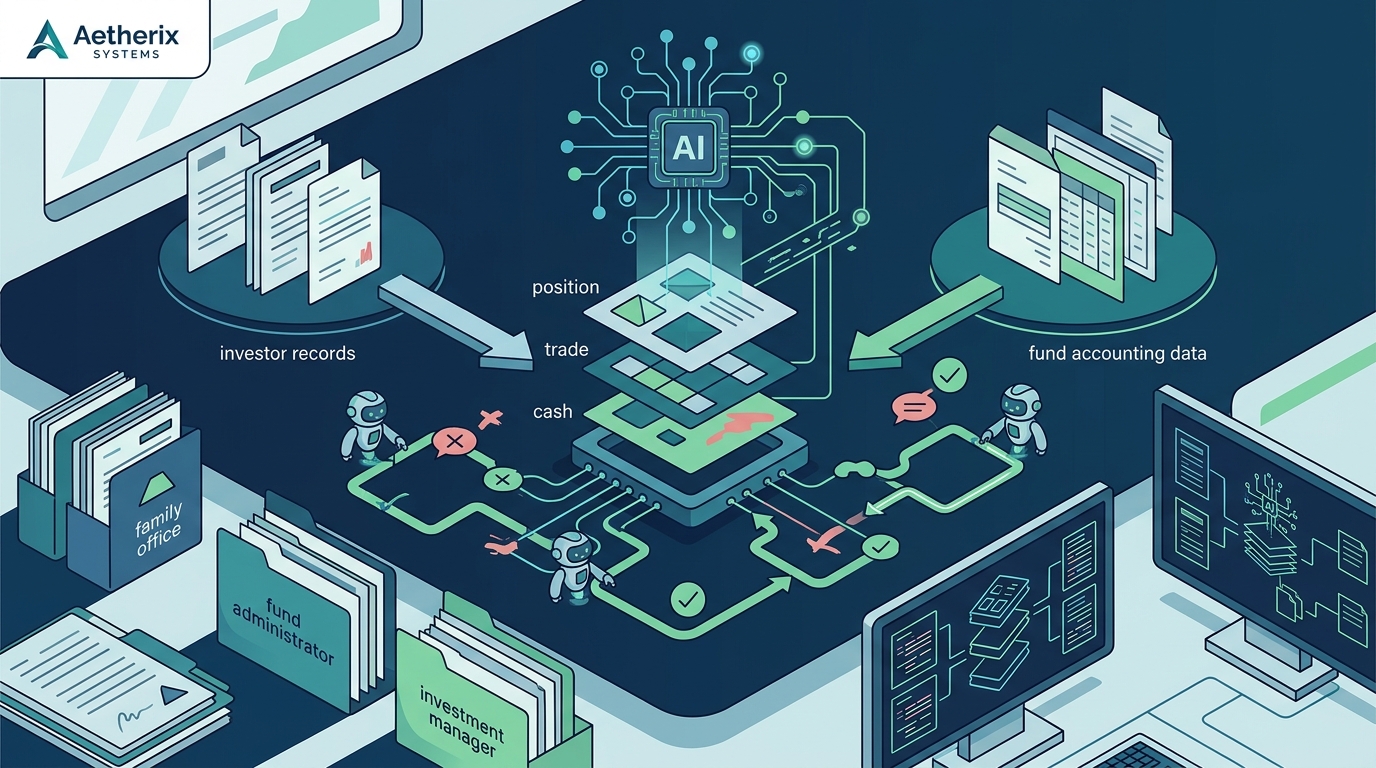
AI tools help NAV production teams match investor records and fund accounting data by automating the investigation of discrepancies that traditional matching engines cannot resolve. This guide covers how agentic systems handle the complex reconciliation layers required for accurate Net Asset Value (NAV) calculation, including position, trade, and cash matching. We explore the specific technologies that move beyond simple rule-based matching to provide auditable, intelligent exception handling for fund administrators and investment managers.
NAV Reconciliation Platforms
NAV reconciliation is the control process used to prove that an investment manager's or fund's positions, trades, cash, income, fees, corporate actions, and valuations agree with the records held by custodians, prime brokers, fund administrators, counterparties, and internal accounting systems. It is not a single balance comparison. It is a connected set of reconciliations that supports accurate books, reliable exposure data, and the evidence used in NAV production and review.
Traditional platforms often rely on static rules to match data. While effective for clean data, they struggle when data sources use different formats, naming conventions, or settlement cycles. Modern AI-driven platforms, such as those developed by Aetherix Systems, utilize agentic workflows to handle these complexities. These systems do not just flag differences; they investigate the root cause of the discrepancy.
The Multi-Layered Nature of NAV
NAV production involves multiple distinct reconciliation layers. Each layer has specific failure modes that require different investigative approaches. A robust platform must address all of these layers to ensure the final NAV is accurate.
| Reconciliation Layer | Records Compared | Control Objective |
|---|---|---|
| Positions | OMS/PMS or accounting book against custodian, prime broker, or administrator holdings | Prove quantity, instrument, account, and long/short direction |
| Trades | Executed orders and internal bookings against broker confirmations and settlement records | Identify missing, duplicated, misbooked, or unsettled trades |
| Cash | Internal cash ledgers against bank, custodian, and prime-broker balances and movements | Prove available cash, margin movements, income, fees, and settlement activity |
| Valuation | Internal or administrator marks against approved market, counterparty, or model sources | Identify price, FX, methodology, stale-price, and source differences |
For a deeper dive into how these layers interact, you can review our Investment & Fund Reconciliation Guide. This resource details the specific operational complexities of hedge-fund reconciliation, including prime-broker relationships and financing.
Investor Record Matching
Investor record matching is the process of verifying that investor-level data, such as capital calls, distributions, and fee calculations, aligns between the fund administrator and the investor's own records. This is a critical component of NAV production because errors at the investor level directly impact the reported Net Asset Value per unit or share.
Investor records are often fragmented across multiple systems. A fund administrator might use one system for capital calls and another for fee billing. Investors may hold their records in spreadsheets or their own portfolio management systems. AI tools excel in this environment by normalizing disparate data formats and identifying subtle mismatches that rule-based systems miss.
Handling Multi-Currency and FX Complexity
Global funds often operate in multiple currencies. Investor records must be translated into the fund's base currency using specific exchange rates. AI agents can trace each variance back to the rate differential and classify whether the difference is due to a realized gain, an unrealized loss, or a timing mismatch in the rate application.
At Aetherix Systems, we specialize in reconciliation for family offices and investment managers who manage wealth across dozens of custodians and asset classes. Our agents ingest feeds from every source, normalize the data, and run the matching automatically. This ensures that investor records are accurate before the NAV is finalized.
Exception Handling Automation
Exception handling automation is the use of AI agents to investigate, classify, and propose resolutions for reconciliation breaks that cannot be auto-matched. While traditional software flags exceptions, it leaves the investigation to human analysts. AI agents take over this investigative work, significantly reducing the time required to clear the exception queue.
The core value of AI in this context is its ability to reason through complex scenarios. For example, if a trade settlement date differs between the manager and the custodian, an AI agent can check the settlement calendar, confirm the pending status, and determine if the difference is a standard T+1 or T+2 timing issue or a genuine error.
From Flagging to Resolution
Most reconciliation tools auto-match the straightforward items. That part is solved. The real cost sits in the exceptions. These are the positions that do not match, the trades that settled differently than expected, and the fees that do not tie back to the contract. Each one requires investigation: pulling statements, checking corporate actions, verifying settlement dates, and documenting the resolution.
Our automated invoice reconciliation agents work the exception queue. They investigate each break, pull supporting documentation from both sides, apply your tolerance rules, and either resolve the item or escalate it with a complete audit trail. The result is a clean reconciliation delivered on your schedule. You can learn more about this process in our Invoice Reconciliation Services guide.
Automated Break Detection
Automated break detection is the systematic identification of discrepancies between two or more sets of financial records. In the context of NAV production, this involves comparing internal books against external sources like custodians and prime brokers. Effective break detection requires more than simple arithmetic; it requires understanding the context of each transaction.
Breaks can be categorized into several types, each with distinct root causes. Understanding these categories helps teams prioritize their investigation efforts and configure their AI tools appropriately.
Common Break Categories
- Timing Breaks: Trade date vs. settlement date mismatches, pending corporate actions, dividend accrual differences. These often self-clear but need to be tracked to ensure they do not age.
- Quantity Breaks: Lot-level mismatches, partial fills, stock splits not yet reflected, transfer-in-kind lag. These require tracing back to the source trade and verifying corporate action schedules.
- Price/Valuation Breaks: Stale NAVs on alternatives, FX rate discrepancies, mark-to-model differences. These require checking the valuation source and methodology.
AI agents are configured to recognize these patterns. They apply the appropriate investigation workflow for each break type. For instance, a quantity break might trigger a check of the corporate action schedule, while a price break might trigger a comparison of valuation sources. This targeted approach ensures that the investigation is efficient and accurate.
Audit Trail Documentation
Audit trail documentation is the complete, immutable record of every action taken during the reconciliation process, including the data compared, the logic applied, and the reasoning behind each decision. In regulatory environments, this documentation is not optional; it is a requirement. Auditors and regulators expect a clean chain of evidence, not a folder of emails and annotated spreadsheets.
Traditional manual processes often lack this level of documentation. When a human resolves an exception, the reasoning is rarely recorded in a structured, retrievable format. AI agents, by contrast, generate a full reasoning trace for every action. This trace includes the source documents, the matching rules applied, and the specific logic used to reach a conclusion.
Compliance and Regulatory Readiness
Regulatory pressure adds urgency to the need for robust audit trails. Settlement discipline regimes penalize late settlements, and auditors expect documented resolution workflows. The cost of getting reconciliation wrong is no longer just operational; it is regulatory.
At Aetherix Systems, we maintain rigorous compliance with global data protection regulations and AI governance frameworks. Our agents operate within precisely defined safety boundaries, with full audit trails, role-based access, and data residency compliance. Every agent action is logged, timestamped, and attributed, making it easy to export evidence for regulatory reporting or external audit.
Key Takeaways
- NAV reconciliation is a multi-layered process involving positions, trades, cash, and valuations, each with distinct failure modes.
- AI tools move beyond simple matching to investigate the root cause of discrepancies, reducing the time spent on manual exception handling.
- Investor record matching is critical for accurate NAV per unit, requiring normalization of disparate data sources and multi-currency handling.
- Exception handling automation allows AI agents to reason through complex scenarios, such as timing mismatches and corporate action failures.
- Automated break detection categorizes discrepancies into timing, quantity, and price breaks, applying targeted investigation workflows for each.
- Comprehensive audit trail documentation is essential for regulatory compliance, providing a complete record of every reconciliation action.
- AI-driven reconciliation platforms, like those from Aetherix Systems, offer a full audit trail on every action, ensuring transparency and accountability.
- Implementing AI in NAV production requires a phased approach, starting with shadow periods to validate agent performance before full deployment.
Frequently Asked Questions
What is the primary benefit of using AI for NAV reconciliation?
The primary benefit is the automation of exception investigation. While traditional tools flag discrepancies, AI agents investigate the root cause, propose resolutions, and document the reasoning, significantly reducing the time and effort required to clear the exception queue.
How do AI agents handle multi-currency reconciliation?
AI agents trace variances back to the exchange rate differential and classify whether the difference is due to a realized gain, an unrealized loss, or a timing mismatch in the rate application. This ensures that multi-currency complexities are handled accurately and consistently.
Can AI agents replace human analysts in NAV production?
AI agents handle the investigative work, but human analysts remain essential for final approval and judgment. The agents propose resolutions, and a named human reviews and approves them. This human-in-the-loop approach ensures that critical decisions are made by qualified professionals.
What types of breaks do AI agents investigate?
AI agents investigate timing breaks, quantity breaks, and price/valuation breaks. They apply specific investigation workflows for each type, such as checking settlement calendars for timing breaks or comparing valuation sources for price breaks.
How is audit trail documentation generated by AI agents?
Every action taken by an AI agent is logged with a full reasoning trace. This includes the data compared, the logic applied, and the source documents used. This documentation is immutable and can be exported for regulatory reporting or external audit.
What is the role of tolerance rules in AI reconciliation?
Tolerance rules define what auto-resolves and what requires human review. AI agents apply these rules to determine if a discrepancy is within acceptable limits. If a break exceeds the tolerance, the agent escalates it with full documentation attached.
How long does it take to implement AI reconciliation tools?
Implementation typically involves a scoping call, configuration, a shadow period, and then production. From scoping call to production, the process can take 3 to 6 weeks, depending on the complexity of the systems and data sources involved.